所屬科目:研究所、轉學考(插大)◆分子生物學
1. Which of the following lead(s) to a point mutation? (A) deamination of a cytosine base into a uracil base (B) benzo(a)pyrene conversion of guanine to a thymine base (C) deamination of 5-methyl cytosine into thymine (D) all of the above
2. A mutation that changes the recognition sequence for the restriction enzyme EcoRI from GAATTC to GATTTC is an example of a (A) restriction fragment length polymorphism (RFLP). (B) single nucleotide polymorphism (SNP). (C) simple sequence repeat (SSR). (D) a and b (E) all of the above
3. Which of the following is not a mobile DNA element? (A) transposon (B) long terminal repeats (LTR) (C) long interspersed elements (LINES) (D) insertion sequence (IS) elements
4. All of the following statements about mitochondrial DNA are true except (A) Mammalian mitochondrial DNA contains introns. (B) In mice, 99.99 percent of mitochondrial DNA is maternally inherited. (C) Mitochondrial DNA encodes rRNAs and tRNAs. (D) The human mitochondrial genome is smaller than the yeast mitochondrial genome.
5. Open reading frame (ORF) analysis is not effective in identifying genes in higher eukaryotes because of the presence of (A) promoters. (B) enhancers. (C) introns. (D) repetitious DNA.
6. Telomeres (A) consist of repetitive sequences with high G content. (B) are a few hundred base-pairs long in vertebrates. (C) have specific proteins bound at the DNA ends. (D) a and c
7. Most eukaryotic genes are controlled at the level of (A) transcription initiation. (B) transcription elongation. (C) transcription termination. (D) translation initiation.
8. All the following elements can function as eukaryotic promoters except (A) a TATA box. (B) an initiator element. (C) CpG islands. (D) an enhancer.
9. What is the function of TFIIH in the transcription initiation complex? (A) binding to the TATA box (B) unwinding the DNA duplex (C) catalyzing the synthesis of RNA (D) all of the above
10. Which of the following does not require protein enzymes? (A) RNA editing (B) excision of group II introns (C) transsplicing (D) excision of group III introns
11. RNA molecules that exhibit catalytic activity are called (A) microRNAS (B) ribonucleases (C) ribosomes (D) ribozymes (E) ribonucleotides
12. True statements about retrotransposons include which of the following? I. They replicate through the RNA intermediate. II. They utilize reverse transcriptase for replication. III. They may contain introns. (A) I only (B) III only (C) I and III only (D) II and III only (E) I, II and III
13. Which of the following is true about a circular double-stranded DNA genome that is determined by chemical means to be 21 percent adenosine? (A) The genome is 10.5% guanosine. (B) The genome is 21% guanosine. (C) The genome is 29% guanosine. (D) The genome is 58% guanosine. (E) The base percent composition of guanosine in the genome cannot be determined from the information given.
14. Common lesions found in DNA after exposure to ultraviolet light are (A) pyrimidine dimers (B) single strand breaks (C) base deletions (D) purine dimers (E) transpositions
15. All of the following components of a retrovirus are encoded by the viral genome EXCEPT (A) matrix proteins (B) viral RNAS (C) capsid proteins (D) envelope lipids
16. Some viruses have increased the coding potential of their genome by (A) integrating into the host genome (B) using host ribosomes for translation (C) using alternative splicing sites (D) using a degenerative triplet code (E) covalently linking a protein to the genome
17. Which of the following is most likely to lead to a loss of gene function? (A) A missense mutation in the open reading frame (B) A change from a TAA codon to a TAG codon in the coding region (C) A change from T to C in the promoter region (D) A frameshift mutation in the coding region (E) A sequence change in the 3' untranslated region
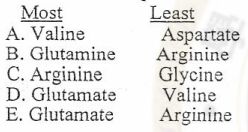
18. DNA polymerase contains a lysine residue that is important for binding to DNA. Mutations were found that converted this lysine to either aspartate, glutamate, glycine, valine, glutamine, or arginine. Which mutations would be predicted to be the most and least harmful to the ability of the enzyme to bind DNA?
19. The recognition site of the restriction endonuclease Aval is CPyCGPUG, where Py is any pyrimidine and Pu is any purine. What is the expected average distance, in nucleotide pairs, between Aval cleavage sites in a random DNA sequence? (A) 4,096 (B) 1,024 (C) 682 (D) 64 (E) 6
20. Transcription of gene X is controlled by transcription factor A. Gene X is only transcribed when factor A is phosphorylated. Data on the tissue distribution of factor A and the activities of a protein kinase and a protein phosphatase specific for factor A are presented in the table below.Of these three tissues, gene X will be transcribed in (A) muscle only (B) heart only (C) brain only (D) brain and heart only (E) muscle, heart, and brain
21. Which of the following are found only in organisms containing polycistronic mRNA? (A) Missense mutations (B) Polar mutations (C) Temperature-sensitive mutations (D) Alternative splicing sites
22. An E. coli strain lacking DNA polymerase I would be deficient in DNA (A) repair (B) methylation (C) splicing (D) degradation (E) transcription
23. Indicate the order in which the following steps occur in the production of a mature mRNA. (A) initiation of transcription, splicing, addition of 5" cap, addition of polyA. tail, transport to cytoplasm (B) initiation of transcription, addition of 5' cap, splicing, addition of polyA. tail, transport to cytoplasm (C) initiation of transcription, addition of polyA. tail, addition of 5' cap, splicing, transport to cytoplasm (D) initiation of transcription, addition of 5' cap, addition of polyA. tail, splicing, transport to cytoplasm
24. Assuming that there is single hormone-responsive regulatory element in the gene, that element is located between (A)-742 and -638 (B)-638 and -424 (C) -424 and-315 (D)-315 and -116 (E)-116 and -27
25. A new construct was made that began at -742 and was identical to that shown in the figure except that the sequences between -424 and -315 were inverted. In this new construct, which of the following are closest to the expected CAT activities in the absence and presence, respectively, of hormone? (A) 25 units/250 units (B) 25 units/25 units (C) 50 units/50 units (D) 5 units/50 units (E) 5 units/5 units
26. DNA chips are used (A) to sequence DNA. (B) in DNA fingerprinting. (C) to determine which genes are silent or are being expressed. (D) in PCR. (E) for all of these.
27. An advantage of x-ray crystallography relative to NMR for structure determination is that using x-ray crystallography: (A) It is easier to solve the structure of transmembrane domain-containing proteins. (B) It is easier to grow crystals than to prepare samples for NMR. (C) It is easier to interpret diffraction data. (D) It is easier to determine the structures of large proteins.
28. While there are many definitions of "functional genomics," select the best of these choices: (A) The assignment of function to genes based primarily on genomewide gene expression data using techniques such as microarrays or SAGE (B) The assignment of function to genes based primarily on comprehensive surveys of protein-protein interactions and protein networks (C) The combined use of genetic, biochemical, and cell biological approaches to study the function of a particular gene, its mRNA product, and its corresponding protein product (D) The assignment of function to genes and proteins using genomewide screens and analyses
29. Reverse genetics approaches involve (A) Systematically inhibiting the functions of one or many genes (or gene products), and measuring the phenotypic consequences correctly. (B) Measuring a phenotype of interest (such as cell growth), applying an intervention (such as radiation exposure) to generate a large collection of mutants, and identifying changes to the phenotype of interest. (C) Treating an organism with a chemical mutagen or other agent to induce mutations, observing a phenotype of interest, and mapping the gene(s) responsible for the phenotype. (D) all of the above.
30. The term "whole-genome shotgun sequencing" refers to: (A) A strategy to sequence an entire genome by breaking up DNA and sequencing using oligonucleotide primers that span the genomic DNA.. (B) A strategy to sequence an entire genome by breaking up DNA, cloning it into libraries, and sequencing using oligonucleotide primers that correspond to know chromosomal locations (contigs). (C) A strategy to sequence an entire genome by breaking up DNA, cloning it into libraries, hybridizing small fragments, then reassembling the fragments into a complete map. (D) A strategy to sequence an entire genome by breaking up DNA, cloning it into libraries, sequencing small fragments, then reassembling the fragments into a complete map.
31. A major advantage of two-dimensional protein gels as a high-throughput technology for protein analysis is that: (A) Sample preparation and the process or running two-dimensional gels is straightforward and can be automated. (B) The result of two-dimensional gels includes data on both the size and the charge of thousands of proteins. (C) The etechnique is well suited to the detection of low-abundance proteins. (D) The technique is well suited to the detection of hydrophobic proteins.
32. Photosystems are mainly (A) light-trapping molecules. (B) enzymes for splitting water. (C) clusters of ATP molecules. (D) sugar assembly sites. (E) electron transport systems.
33. Because AUG serves as the start codon for protein synthesis, methionine is found only at the N terminus of proteins. (A) False (B) True
34. Many antibiotics used in modern medicine selectively inhibit bacterial protein synthesis by exploiting the structural and functional differences between prokaryotic and eukaryotic ribosomes. (A) False (B) True
35. One can determine if a membrane protein is exposed on the external side of the plasma membrane by covalent attachment of a labeling reagent or by protease digestion only if the membrane is intact. (A) False (B) True
36. Hydrophobic interactions are exhibited with (A) ions. (B) nonpolar molecules. (C) hydration ions. (D) polar molecules. (E) none of these.
37. Radioactive isotopes (A) are electrically unbalanced. (B) behave the same chemically and physically but differ biologically from other isotopes. (C) are the same physically and biologically but differ from other isotopes chemically. (D) have an excess number of neutrons. (E) are produced when atoms lose electrons.
38. microRNAS (A) are a class of exogenous RNAs (B) small and highly conserved noncoding RNAS (C) control gene expression post-translationally
39. A short RNA molecule was isolated that demonstrated a hyperchromic shift indicating secondary structure. Its sequence was determined to be "AGGCGCCGACUCUACU". What DNA sequence would give rise to this RNA molecule through transcription? (A) TCCGCGGCTGAGATGA (B) AGTAGAGTCGGCGCCT (C) UCCGCGGCUGAGAUGA (D) AGUAGAGUCGGCGCCU
40. During elongation of a polypeptide chain (A) the tRNA moves from one codon of the mRNA to the next (B) the ribosome move closer to the 3' end of the mRNA (C) the growing polypeptide chain is passed from the tRNA of the A site to the amino acid present in P site (D) tRNAs enter empty P site
41. Suppose you are labeling a population of cells growing asynchronously with [H]thymidine. G₁ is 6 hour, S is 6 hours, G2 is 5 hours, and M is 1 hour. What percentage of the cells would have labeled mitotic chromosomes if you chased the cells for 18 hours? (A) One-third of the cells (B) None of the cells (C) Two-third of the cells
42. Would you agree with the statement that the centrosome plays a key role in determining the rates of lengthening and shorting of the microtubules of an animal cell? (A) Yes (B) No
43. Would you expect the greenhouse effect (an increase in the CO2 content of the atmosphere) to have a greater effect on C4 plants or C3 plants? (A) C4 plants (B) C3 plants
44. How does the p53 gene protect against the development of cancer? (A) The p53 is normally expressed at a high level but this decrease if the DNA is damaged. (B) If the DNA is not repaired, the p53 gene can induce apoptosis of the cell. (C) The p53 protein can activate genes that cause the inhibition of the cyclin-dependent kinases which are needed for the cell to proceed through the restriction point in S phase.
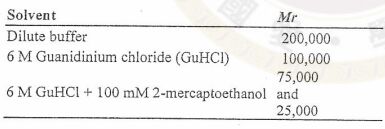
45. Molecular weight analysis of a protein yields the following information:
(Guanidinium chloride is a chaotropic (denaturing) reagent and 2-mercaptoethanol can reduce disulfide bonds.)What can you deduce about the protein's quaternary structure? (A) Dimer of 100,000-M.. (B) Each 100,000-M. unit is dimer of a 25,000-M, and 75,000-M, protein jointly covalently by disulfide bonds. (C) Dimer of a 25,000-M, and 75,000-M, protein. (D) Monomer of 200,000-M..
46. All of the following can be true of cloning vectors EXCEPT that they (A) are plasmid that slip into a host cell. (B) are plasmids that accept foreign DNA.(C) can be engineered to contain multiple cloning sites. (D) are portions of the main bacterial chromosome. (E) can be viruses.
47. All of the following are involved in Polymerase Chain Reaction (PCR) EXCEPT (A) free nucleotides. (B) DNA templates. (C) high temperature. (D) RNA polymerase. (E) low temperature.
48. Which is false about the wobble effect? (A) It explains why and how there can be fewer than 64 kinds of transfer RNA molecules. (B) It allows the third codon to vary if the first two codons in the anticodon follow the base-pair rule. (C) It indicates that transfer RNA combines with either the small or large subunit of ribosomes. (D) It permits certain amino acids to be specified by more than one codon.
49. The value of inserting human genes suspected of causing Alzheimer disease into mice is to (A) make mice act more human. (B) make antibodies, which can be injected into suffering patients. (C) develop mice that can serve as models for study of this condition. (D) use the mice for production of a vaccine foe the disease.
50. The oxygen released in photosynthesis comes from (A) carbon dioxide. (B) glucose. (C) ribulose bisphosphate. (D) water. (E) atmospheric oxygen.
 阿摩線上測驗
登入
 Of these three tissues, gene X will be transcribed in (A) muscle only (B) heart only (C) brain only (D) brain and heart only (E) muscle, heart, and brain