所屬科目:研究所、轉學考(插大)◆基礎分子生物學
1. Which of the following proteins are seven transmembrane proteins? (A) Fas (B) integrin (C) rhodopsin (D) Wnt protein (E) TGF receptor
2. Calmodulin is: (A) a scaffold protein (B) a protein kinase (C) an enzyme activator (D) a second messenger (E) a calcium binding protein
3. Which of the following compounds are activators of peroxysome proliferator-activator receptor ? (A) estradiol (B) thrombin (C) tocopherol (D) prostaglandin (E) retinoic acid
4. Which ligands or receptors are involved in the second messengers in cells? (A) IGF receptor (B) cholecalciferol (C) androgen receptor (D) leukotriene receptor (E) acetylcholine receptor
5. Which of the following descriptions regarding double-stranded DNA molecules are correct? (A) They can exist as A-, B-, or Z-form. (B) The two strands are antiparallel and complmentary with each other. (C) An AT-rich DNA sequence (that is, a sequence contains more AT base pairs) is usually more stable than a GC-rich sequence. (D) The stacking interactions between neighboring base pairs provide stability to a DNA molecule. (E) The major groove of B-form DNA is wider than the minor groove.
6. Inhibition of DNA topoisomerases may lead to which of the following events? (A) inhibition of replication (B) apoptosis (C) inhibition of transcription (D) DNA damages (E) cell cycle arrest
7. Which of the following molecules may influence the structures of RNA molecules? (A) carbon monoxide (CO) (B) polyamines (C) magnesium ion (D) histones (E) helicases
8. Which of the following statements regarding proteasome degradation pathway are correct? (A) Proteins targeted for degradation are usually mono-ubiquitylated. (B) Ubiquitin is transferred to substrate proteins by the so-called E3 enzymes. (C) This pathway is ATP-dependent. (D) Inhibition of proteasome degradation pathway may lead to cell cycle arrest. (E) This pathway also involves in antigen presentation.
9. What factor(s) can make tumor suppressor RB inactive? (A) CDK2 (B) CDK4 (C) Cdc25 phosphatase (D) SV40 T antigen (E) HIN1 hemagglutinin.
10. Which-following protein(s) can shuttle between cytoplasm and nucleus? (A) Erk1/2 (B) Akt (C) STAT3 (D) insulin receptor (E) Src.
11. Which following statement(s) is/are correct? (A) Protein glycosylation occurs immediately after protein synthesis is complete. (B) Protein glycosylation happens during the process of protein synthesis. (C) Protein glycosylation begins in endoplasmic reticulum. (D) Protein glycosylation occurs only after the protein is transported to Golgi. (E) A given protein can have different glycosylation modifications in different types of cells.
12. What following alteration(s) will let an oncogene become oncogenic? (A) gene amplification (B) protein overexpression (C) CpG island methylation (D) ubiquitination (E) loss of function on a cognate inhibitor which is specific for the protein translated from the oncogene.
13. DNA pyrosequencing is a method that reads DNA sequence based on the amount of pyrophosphate generated by the DNA polymerase. For each sequencing cycle, one single triphosphate nucleotide
(A) GCTAGCT (B) GCAGCT (C) GCTAGGCCT (D) GCAGGCCT (E) CGTCCGGA
14. Which of the following statements about DNA agarose electrophoresis is TRUE? (A) DNA carries negative charges and run to anode (B) Large DNA carries more negatives and run faster than small DNA (C) Large DNA run slower because it is heavier than small DNA (D) Large DNA run slower because it faces a greater resistance (E) Low percentage agarose gel provides better resolution for small DNA
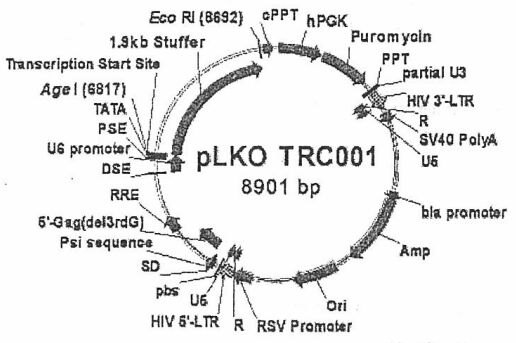
15. Shown below is the plasmid backbone for small hairpin RNA (shRNA) used in the National RNAi Core
(A) The plasmid carries a gene for selection of E. coli that carry it (B) The plasmid carries features that facilitate its integration into mammalian genome (C) The plasmid carries a gene for selection of mammalian cells that carry it (D) shRNA can be inserted to the plasmid and can be expressed driven by the U6 promoter (E) The plasmid itself is infectious because it contains HIV elements
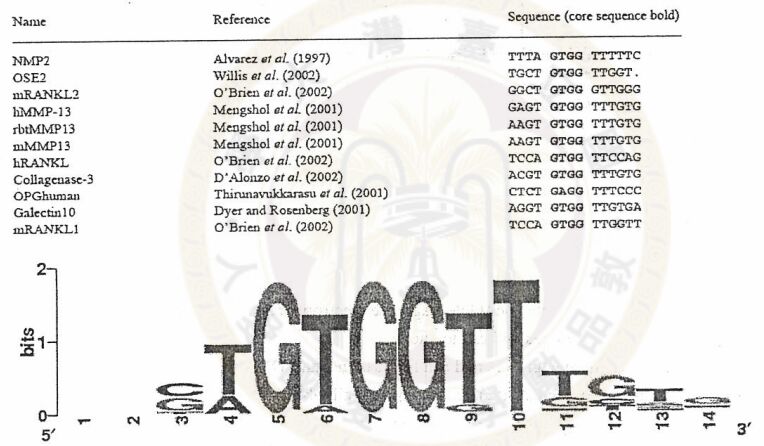
16. List in the table are DNA sequences to which 11 transcription factors bind. A sequence logo was
(A) Positions 5, 7, 8, and 10 are the tallest because the nucleotides are highly conserved in those positions among all sequences (B) Position 6 is taller than position 4 because position 6 is less conserved (C) Position 3 is shorter than position 11 (D) T in position 6 has the same height as T in position 9 (E) Tin position 11 is taller than G in position 12 although they appear in both positions with an equal frequency
17. Which molecules can be found in Basement membrane (BM)? (A) type 1 collagen (B) type 4 collagen (C) perlecan (D) fibronectin (E) lamin A.B.C
18. which are not required for Rec A recombination repair activities. (A) ATP (B) 5' end single strand DNA (C) 3' end single strand DNA (D) Non-homologus sequences (E)
19. which molecules are glycosaminoglycans? (A) hyluronic acid (B) collagen (C) condroitin sulfate (D) heparin sulfate (E) fibronectin
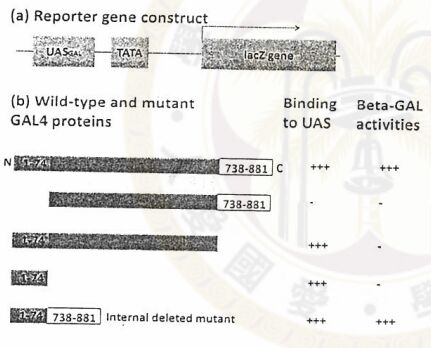
20. GAL4 is a transcription activator in yeast which promotes expression of a group of genes. In the upstream of genes driven by GAL4, there are one or more copies of a related 17-bp sequence known as
To show that UASGAL is the GAL4 responsive element, one constructed a lacZ reporter as shown in (a) and showed that the expression of lacZ is activated in galactose media in wild-type cells but not in gal4 mutants. She also did another set of experiments, in which various mutant GAL4 molecules are are examined for their transcription activator activities. Which of the following conclusions can be drawn from her experiments? (A) N terminal aal-74 is required for GAL4 binding to UAS sequence (B) N terminal aal-74 is sufficient to bind to UAS sequence (C) C terminal aa738-881 is required for GAL4 to activate lacZ expression (D) the fusion protein composed of aal-74 and aa738-881 is sufficient to activate lacZ expression. (E) aa75-737 is not dispensable for lacZ expression
21. Cellular proteins give cells structure and perform many cellular tasks except for (A) RNA-dependent RNA polymerase (B) cytoskeleton of cells (C) ion channels (D) ribozymes (E) kinases
22. Which of the following statement are correct (A) DNA severs as a template for DNA synthesis (B) RNA severs as a template for protein synthesis (C) DNA serves as a template for miRNA synthesis (D) DNA serves as a template for mRNA synthesis (E) protein serves as a template for RNA synthesis
23. The fluidity of lipid membranes in cells on depends on (A) temperature (B) the amount of unsaturated fatty acyl chain (C) the length of the fatty acid chain (D) the amount of cholesterol (E) the surface area of lipid membranes
24. Proteins may non-covalently interact with small molecules such as GTP, , etc. Which of the following statement is/are NOT correct? (A) after first oxygen binding, hemoglobulin adapts a new conformation and could interact the second oxygen molecule better (B) neurotransmitter glutamate triggers calcium influx by non-covalently binding to calcium channel on the post-synaptic membrane. (C) facilitates the hemophilic interaction between E-cadherin (D) binding to either GTP or GDP activates small G protein, such as Ras. (E) when cellular ATP level is high, excessive ATP non-covalently binds to and inhibits pyruvate kinase, which mediates glycolysis and ATP production
25. Proteins could be covalently modified by chemicals and small peptides, such as (A) phosphorus (B) ubiquitin (C) methyl group (D) acetyl group (E) Sumo
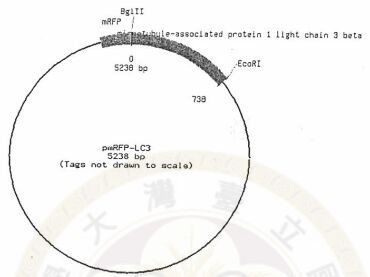
26. If you receive from your collaborator a DNA plasmid with a map shown below.
Which of the following methods could help you to check if you have received a right plasmid?(A) Run the un-cut supercoiled form plasmid DNA in an agarose gel with DNA size marker. You find that the supercoiled plasmid migrates to the position between 5kb and 6 kb bands. (B) You digest the plasmid DNA with BgIII and run the cut plasmid DNA in an agarose gel with DNA size marker. You find that the cut plasmid migrates to the position between 5kb and 6 kb bands. (C) You digest the plasmid DNA with EcoRI and run the cut plasmid DNA in an agarose gel with DNA size marker. You find that the cut plasmid migrates to the position between 5kb and 6 kb bands. (D) You digest the plasmid DNA with BgIII and EcoRI. Then you run the cut plasmid DNA in an agarose gel with DNA size marker. You find 4.5kb and 738bp bands after double digestion. (E) Sequence the plasmid using a primer specific to mRFP.
27. BrdU is an analog of thymine that can be incorporated into double stranded DNA during DNA polymerization in S phase. Unsynchronized cells at various stages of cell cycle are first treate for 2 hours and then cultured in the absence of BrdU for another 4 hours. What would happen to those unsynchronized cells exposure to BrdU?(A) BrdU is incorporated into all the unsynchronized cells. (B) If a cell is labeled by BrdU, only one of the sister chromatins is labeled (C) If a cell is labeled by BrdU, only one strand of DNA is labeled (D) In the 2-hour BrdU pulse, only mitotic cells are labeled (E) In the 2-hour BrdU pulse, only mitotic cells are not labeled
28. The following diagram shows a family pedigree of a disease characterized by muscle weakness from
(A) autosomal dominant (B) autosomal recessive (C) sex-linked dominant (D) sex-linked recessive (E) mitochondrial inheritance
29. DNA recombination refers to moving a DNA segment from one to another DNA molecule. This process (A) biogenesis of miRNA (B) linkage mapping human mutations that cause diseases (C) gene targeting, replacing a gene by a mutant allele. (D) tissue specific inactivation of a target gene by the Cre/loxP system. (E) to repair a DNA double strand break
30. Which of the following descriptions about exon, intron, 5' UTR, and 3' UTR is/are NOT correct (A) nonsynonymous mutation is a nucleotide change in exon that changes amino acid sequence of the encoded protein. (B) synonymous mutation is a single nucleotide change in intron that would never cause any change in the amino acid sequence of the encoded protein. (C) although not translated, the nucleotide sequence in the 5' UTR of mRNA corresponds to genomic sequence of exons but not introns. (D) although not translated, mutation in 3' UTR could profoundly affect mRNA stability. (E) mutation in intron sometimes affects protein sequence by introducing mRNA splicing errors.
31. Which of the following descriptions about protein synthesis and targeting are correct? (A) ER (endoplasmic reticulum) targeting of proteins synthesized in the cytosol requires a N-terminus signal sequence. (B) Cotranslational translocation of proteins into ER lumen requires SRP (signal recognition particle) and the SRP receptor, and this protein translocation is energy-independent. (C) a-helix of the membrane spanning domains of proteins can function as a topogenic sequence and determine the orientation of the proteins on the membrane. (D) Most proteins in the mitochondria are encoded and synthesized in the mitochondria, and therefore do not need targeting sequences for mitochondrial localization. (E) Proper folding of proteins require posttranslational modifications.
32. Which of the following about the cell nucleus and nuclear transport are correct? (A) Nucleolus is the major protein synthesis site in the nucleus. (B) Import into and export out of the cell nucleus require a nuclear localizing signal (NLS) and a nuclear export signal (NES), respectively. (C) The cargo-importin complex is cotransported into the nucleus with a GTP-bound Ran. It is the GTP hydrolysis in the nucleus that changes the Ran to the GDP-bound state and releases the cargo into the nucleoplasm. (D) The outer membrane of the nuclear envelope is continuous with the ER. (E) All protein components in the nuclear pore complex (NPC) undergo constant turnover and most have a short half-life.
33. Which of the following approaches may help Michael determine the sequence of protein Q movements between the compartments X, Y and Z? (A) Sit down in front of the microscope, and follow the movements of GFP particles in live, unfixed cultured cells in real time. (B) Add another ligand that competes for the same receptor with protein Q, and measure the difference of GFP signals between compartments X, Y and Z. (C) Add GFP-protein Q to the medium at 4°C. Raise the culture temperature briefly to 37°C to enable endocytosis to occur, and then go back to 4°C again. After this treatment, do the immunostaining-GFP colocalization experiment at different time points. (D) Perform immunoEM to determine the exact localization of protein Q in X, Y or Z. (E) Purify individual intracellular compartments and determine the level of protein Q.
34. Somehow Michael was able to solve his problem, and now he had evidence that protein Q first entered (A) Use cultured fibroblasts that are deficient for Y, and see whether protein Q accumulates in compartment X or compartment Z. The first will indicates protein Q trafficking as X -> Z -> Y, while the latter will suggest X -> Y -> Z. (B) Same approach as A, but accumulation in compartment X indicates the order of transport as X -> Y -> Z, whereas accumulation in compartment Z indicates the order as X -> Z -> Y. (C) Use RNAi to interfere with the functions or biogenesis of compartments X, Y or Z, and see in which compartment is protein Q trafficking blocked. (D) Collect and homogenize the cells at different time points, and purify compartment Y or Z by density gradient centrifugation. Test whether protein Q exists in the fraction containing Y or Z. (E) Use a radioisotope-labeled protein Q instead of GFP, and measure the radioactivity within compartment Y or compartment Z under light microscopy.
35. Finally Michael worked out the order of protein Q trafficking as X -> Y -> Z. At the same time, Lisa (A) Sequencing the genomic loci of all the 50 genes is the best way to identify the mutation. (B) Since more than 50 genes are likely to be candidates for the locus harboring this mutation, it is of little help to do traditional genetic mapping. (C) Lisa should perform 2-D gel electrophoresis to identify the mutant protein band. Remove the band from the gel and send it to the mass spectrometry - that is the simplest way to identify the mutation. (D) Do complementation test with individual mutant strains of these 50 genes. A failure to complement will indicate that Lisa's mutation is allelic (i.e., in the same locus) to this mutant. (E) Lisa's mutant could be a dominant, gain-of-function mutation or a recessive loss-of-function mutation.
36. About intracellular signaling, which of the following descriptions is correct? (A) Guanine nucleotide-exchange factors (GEFs) switch the GTPases to GTP-bound forms and inactivate them, whereas GTPases-activating proteins (GAPs) switch the GTPases to GDP-bound states and activate them. (B) Calcium serves as an important second messenger, and the intracellular calcium is primarily stored in endoplasmic reticulum (ER) and the Golgi. (C) Upon activation of G protein-coupled receptors (GPCR), the Ga subunit of G protein dissociates from the receptors and binds to downstream effectors to activate the signaling cascades. (D) GPCR is one of the largest protein families in the genome of metazoan species. (E) GPCRs regulate cAMP- or phospholipase C (PLC)-based signaling pathways, but they do not regulate ion channels.
37. About microtubules, which of the following descriptions are correct? (A) Microtubules are associated with the microtubule-organizing center (MTOC) with their (-) ends, and the (+) ends of microtubules point away from the MTOC. (B) Treadmill (progressive growth) of microtubules requires ATP, with GTP-bound ẞ-tubulins added at the (+) ends of microtubules. (C) Kinesins are microtubule (-)-end-orineted motors, and dyneins are (+)-end-oriented motor proteins. (D) Microtubules go through alternating rescue (growing phase) and catastrophe (shrinking phase), a process known as the dynamic instability. (E) Microtubules determine the shape of a cell but do not function in regulating cellular polarity.
38. About actin cytoskeleton, which of the following descriptions are correct? (A) At steady state of actin polymer formation, the concentration of monomeric actins is determined by the critical concentration Cc. (B) The rate-limiting step in actin polymerization is the elongation phase from a short actin oligomer to a long polymer. (C) ATP-G-actins add at both the (+) and the (-) ends, but adding of ATP-G-actins is faster at the (-) end. (D) Arp2/3 prevents actin polymers from growth, whereas capping proteins promote actin branching. (E) The small GTPases Rho, Rac and Cdc42 are critical regulators of actin dynamics. 39-40. Jared is studying how cell division is controlled, using the Xenopus (a kind of frog) fertilized oocytes
39. Which of the following experiments may NOT help Jared gain support for his hypothesis? (A) Compare the protein contents in unfertilized oocytes and fertilized oocytes; proteins existing in the latter but not in the former could be candidates for cell division-promoting factors. (B) Analyze the sperm proteins. Since the oocyte begins to divide after fertilization, the key element is in the cytoplasm of the sperm. (C) Separate the nucleus, cell membrane as well as the cytoplasm of fertilized oocytes, and add each of these individual components to the non-dividing cells. The prediction is that the fertilized oocyte cytoplasm should induce cell division when added to other non-dividing cells. (D) Do a pulse-labeling of newly synthesized proteins in the fertilized oocytes with radioisotopes, and compare protein radioactivities in the dividing v.s. non-dividing cells. This may help identify proteins that are associated with cell division cycles. (E) Do a genome-wide RNAi screen to identify the gene encoding the cytoplasmic factor that Jared is looking for.
40. Jared finally succeeded in isolating the protein cyclin B, showing that adding purified cyclin B alone to (A) In the cells, cyclin B synthesis is on and off. When cyclin B synthesis is turned off, cells do not divide. (B) There is another factor that may inhibit cyclin B activity during the non-division phase. (C) Non-dividing cells have an intrinsic factor that complexes with cyclin B and triggers cell division. After cell division is complete, the concentration of this factor is diluted and becomes inadequate for binding to cyclin B. As a result, the cell does not begin to divide unless the level of this intrinsic factor builds up again. (D) Cyclin B has a limited half life and when cyclin B is degraded, cell division does not occur. (E) Cyclin B is sensitive to the copy number of chromosome and is active only when the cell contains replicated DNA materials.
 阿摩線上測驗
登入
 (D) histones (E) helicases
 (A) GCTAGCT (B) GCAGCT (C) GCTAGGCCT (D) GCAGGCCT (E) CGTCCGGA
 (A) The plasmid carries a gene for selection of E. coli that carry it (B) The plasmid carries features that facilitate its integration into mammalian genome (C) The plasmid carries a gene for selection of mammalian cells that carry it (D) shRNA can be inserted to the plasmid and can be expressed driven by the U6 promoter (E) The plasmid itself is infectious because it contains HIV elements
 (A) Positions 5, 7, 8, and 10 are the tallest because the nucleotides are highly conserved in those positions among all sequences (B) Position 6 is taller than position 4 because position 6 is less conserved (C) Position 3 is shorter than position 11 (D) T in position 6 has the same height as T in position 9 (E) Tin position 11 is taller than G in position 12 although they appear in both positions with an equal frequency


 , etc. Which of the following statement is/are NOT correct? (A) after first oxygen binding, hemoglobulin adapts a new conformation and could interact the second oxygen molecule better (B) neurotransmitter glutamate triggers calcium influx by non-covalently binding to calcium channel on the post-synaptic membrane. (C)
 facilitates the hemophilic interaction between E-cadherin (D) binding to either GTP or GDP activates small G protein, such as Ras. (E) when cellular ATP level is high, excessive ATP non-covalently binds to and inhibits pyruvate kinase, which mediates glycolysis and ATP production
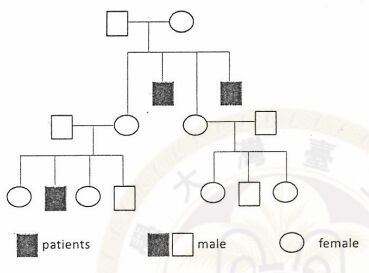 (A) autosomal dominant (B) autosomal recessive (C) sex-linked dominant (D) sex-linked recessive (E) mitochondrial inheritance