所屬科目:轉學考-普通化學
1. Radioactive elements decay via first-order kinetics. Consider a certain type of nucleus that has a rate constant of 2.6✕10–2 h–1. A sample contains 6.5✕108 radioactive nuclides. Calculate the time required for 61% of the nuclides to decompose. (A) 1.9 ✕101 h; (B) 1.6✕101 h; (C) 0.8✕101 h; (D) 3.6✕101 h; (E) 2.4✕101 h
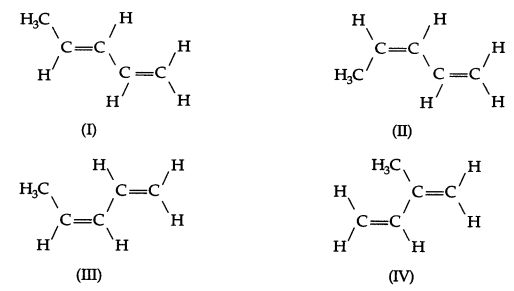
2. Consider the following four compounds: Which of these compounds would have the same physical properties (melting point, boiling point, density, and so on)?(A) I and II; (B) I and III; (C) II and III; (D) III and IV; (E) I and IV.
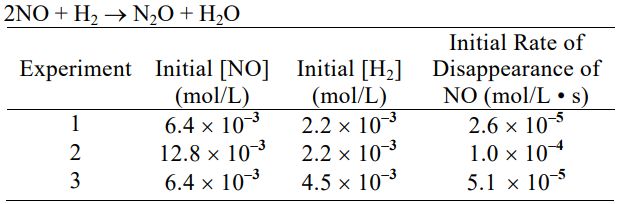
8. What is the rate law for the following reaction, given the data below? (A) Rate = k[NO]; (B) Rate = k[NO]2; (C) Rate = k[NO]2[H2]; (D) Rate = k[NO][H2]; (E) Rate = k[N2O][H2O]
10. The wavelength of light associated with the n = 2 to n = 1 electron transition in the hydrogen spectrum is 1.216✕10–7 m. By what coefficient should this wavelength be multiplied to obtain the wavelength associated with the same electron transition in the Li2+ ion? (A) 1/9; (B) 1/7; (C) 1/4; (D) 1/3; (E) 1
11.For a reaction in a voltaic cell, both △H° and △S° are positive. Which of the following statements is true? (A) E°cell will increase with an increase in temperature. (B) E°cell will decrease with an increase in temperature. (C) E°cell will not change when the temperature increases. (D) G° > 0 for all temperatures. (E) None of the above statements is true.
14.Using the following data, calculate the standard heat of formation of the compound ICl in kJ/mol: (A) –211 kJ/mol; (B) –14.6 kJ/mol; (C) 16.8 kJ/mol; (D) 245 kJ/mol; (E) 439 kJ/mol
16.A 0.050 M aqueous solution of a weak monoprotic acid is 1.2 % ionized at equilibrium at 298 K. Calculate Ka for this acid. (A) 3.4✕10–2 (B) 6.4 ✕10–8 (C) 7.3✕10–33 (D) 29 (E) none of these
17. At a certain temperature, K for the reaction : 2NO2⇌ N2O4 is 7.5 L/mol. If 2.0 mol of NO2 is placed in a 2.0-liter container and permitted to react at this temperature, calculate the concentration of N2O4 at equilibrium. (A) 0.39 mol/L; (B) 0.65 mol/L; (C) 0.82 mol/L; (D) 7.5 mol/L; (E) none of these
2. The mass percent of carbon in a typical human is 18 %, and the mass percent of 14C in natural carbon is 1.6✕10-10 %. Assuming a 200-lb person, how many decay events per second occur in this person due exclusively to β-decay of 14C (for 14C, t1/2 = 5730 years; 1 lb = 0.454 kg)
3. Carbonate buffers are important in regulating the pH of blood at 7.40. If the carbonic acid concentration in a sample of blood is 1.2 mM, determine the bicarbonate ion concentration required to buffered the pH of blood at pH = 7.40. H2CO3(aq)⇌HCO3-(aq) + H+(aq) ; Ka = 4.3✕10-7
4. Trans fats are made by treating free-flowing oils with hydrogen, a catalyst, and high heat to change the structure of the oil. Although the hydrogenated oils are much more stable toward spoilage, a serious drawback to this process has been realized that the trans form of the fat poses serious health risks when compared to naturally occurring cis form of the oils. The part of the hydrogenated process that results in the formation of trans fat can be summarized as follows: cis fat(aq) + H2(aq) ⇌ trans fat(aq) A typical value of equilibrium constant of this type of reaction is about 5.0. If we start with 0.1 mol/L each of cis fat and H2. Calculate the equilibrium concentrations of cis fat and trans fat, respectively.
 阿摩線上測驗
登入
 (A) Rate = k[NO];
(B) Rate = k[NO]2;
(C) Rate = k[NO]2[H2];
(D) Rate = k[NO][H2];
(E) Rate = k[N2O][H2O]
 (A) –211 kJ/mol; (B) –14.6 kJ/mol; (C) 16.8 kJ/mol; (D) 245 kJ/mol; (E) 439 kJ/mol