所屬科目:研究所、轉學考(插大)-經濟學
1. Which of the following is true about the corresponding marginal revenue curve when the demand is downward-sloping? (A) It is downward-sloping. (B) It is the demand curve under \( 1^{\text{st}} \) degree price discrimination. (C) It is steeper than the demand if there is no price discrimination. (D) All of the above.
2. Which of the following is true about economic rent? (A) It is a wedge in quantities. (B) It comes from some exclusivity. (C) It is part of the deadweight loss. (D) It prevents black market deals.
3. Which of the following is not true about perfect versus monopolistic competition? (A) Individual firm produces more output in perfect than in monopolistic competition. (B) Individual firm charges a lower price in perfect than in monopolistic competition. (C) Individual firm breaks even in long-run equilibrium in both of them. (D) The market supply equals the horizontal summation of each individual firm's supply in both of them.
4. Which of the following is not a characteristic of a monopoly? (A) It is difficult to find substitutes for its product. (B) It is the only supplier in the market. (C) It is a price-taker. (D) It is almost impossible for others to enter.
5. Which of the following statement best describes the concept of consumer surplus? (A) The camera costs exactly my budget for it. (B) It is always a happy surprise to have extra discounts when buying something. (C) The seller refuses to accept a lower price. (D) Consumers are willing to pay more for better quality.
6. If John's consumption for coffee decreases by 15% as the price of coffee increases by 30%, we call John has a(n) _______ demand for coffee. (A) elastic (B) inferior (C) inelastic (D) unit-elastic
7. Which of the following is not true about "long run" in economics? (A) It has to be at least over one year. (B) All inputs are variable inputs. (C) It differs case by case. (D) Every input changes with level of outputs.
8. Given the information below, what is the cost of traveling abroad for the summer? (A) $3,000 (B) $4,600 (C) $5,000 (D) $5,800
9. When there is a shortage in a free market, the (A) price will fall. (B) price will rise. (C) quantity will fall. (D) quantity will rise.
10. Which of the following is true about efficiency wages? (A) Efficiency wages are set below the equilibrium. (B) Efficiency wages cause frictional unemployment. (C) Efficiency wages generate higher average wage costs for employers. (D) Efficiency wages generate higher opportunity costs for employees.
11. Which of the three goods is a luxury good? (A) Good A (B) Good B (C) Good C (D) None of the above.
12. Rank the three goods in terms of the slope of their demand curves. (A) A > B > C (B) A > C > B (C) C > B > A (D) Not enough information.
13. What is the equilibrium quantity? (A) 10 (B) 20 (C) 30 (D) 60
14. What is the equilibrium price? (A) 10 (B) 20 (C) 30 (D) 60
15. What is the producer surplus in this market when it is at equilibrium? (A) $150 (B) $200 (C) $450 (D) $600
16. What is the deadweight loss when government sets a price floor at $15? (A) $0 (B) $37.5 (C) $75 (D) $150
17. Which of the following is true about the curves? (A) Curve A is the average total cost curve. (B) Curve A is the marginal cost curve. (C) Curve C is the average total cost curve. (D) Curve C is the marginal cost curve.
18. According to your answer to question 17, what is the total cost when producing 300 units of output? (A) $7,500 (B) $10,500 (C) $18,000 (D) None of the above
19. Why does curve C approach curve B as output increases? (A) Diminishing marginal value. (B) Diminishing marginal opportunity cost. (C) Just a special case for this particular graph. (D) Diminishing average fixed cost as more output been produced.
(a) List the key elements of a game.
(b) List the dominant strategy/strategies for player 2 (the column player), if any.
(c) List the dominated strategy/strategies for player 2 (the column player), if any.
(d) List the Nash equilibrium/equilibria of this game, if any.
1. 利用流動性偏好理論、總合供需模型以及菲力浦曲線說明此一政策對短期的產出、失業、利率與物價水準的影響。(10分)
2. 在經濟體系由短期均衡趨向長期均衡的過程中,前述各變數會如何變動?請說明調整過程。並請說明在長期,名目利率與實質利率會如何變動。(10分)
四、請計算下列各題,只有答案無計算過程不計分。1. 假設某個國家在計算消費者物價指數時,所用的一籃子商品只包含5本書和10台計算機。假設在2009年書的單價為$24,而計算機的單價為$8;在2010年書的單價為$30,而計算機的單價為$12;在2011年書的單價為$32,而計算機的單價為$15。如果基期年為2009年,請分別計算此三年度的消費者物價指數,與2010年和2011年的物價膨脹率。(10分)
2. 假設某國在某年男性非勞動力共45百萬人,女性非勞動力共35百萬,男性失業人口共5百萬,女性失業人口共5百萬,男性就業人口共85百萬,女性就業人口共65百萬。請計算該國的勞動參與率與失業率。請區分男性、女性以及該國總人口。(10分)
3. 假設某國的所有政府政策皆沒有排擠效果,且該國的民眾邊際消費傾向是 \( 3 / 4 \) 。若該國政府增加政府支出200億元,但為了維持政府預算平衡,同時並增稅200億元。請問在其他條件不變之下,此些政策對該國總合需求的影響為何?請區分個別影響以及總影響。(10分)
 阿摩線上測驗
登入
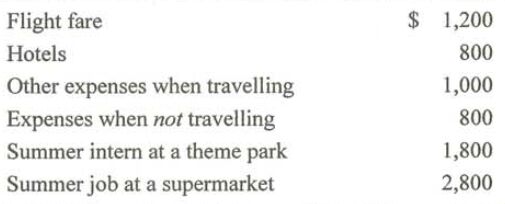 (A) $3,000 (B) $4,600 (C) $5,000 (D) $5,800