所屬科目:研究所、轉學考(插大)◆生化暨分子生物學
1. When you decide to start a genomic study with the establishment of an expressed sequence tag or EST library, the first step you need to do is to (A) isolate total DNA from the target cells and then digest DNA with a mixture of restriction enzymes (B) isolate total RNA from the target cells and then make cDNAs via reverse transcription (C) extract cellular proteins and then digest them with selected proteinases (D) cultivate the target cells and then fix them with glutaldehyde/paraformaldehyde
2. Which of the followings is a general characteristic of the life cycle of negative-strand RNA viruses? (A) Release from cells by cell lysis (B) Genome replication occurs in the nucleus (C) Virions carry an RNA-dependent RNA polymerase (D) Structure proteins are derived from polyprotein cleavage
3. Which of the followings is an important property of enveloped viruses? (A) They are environmentally labile (B) They are released from cell by cell lysis (C) They can survive the adverse conditions of the gut (D) Antibody is sufficient for immunoprotection
4. The expression of the lac operon in E. coli is: (A) Inhibited by glucose through a process called catabolite repression. (B) Inhibited by allolactose through a process called catabolite repression. (C) Activated by lactose through activation of Crp. (D) Activated by cAMP through inhibition of LacI.
5. During the log growth phase: (A) The death rate and the duplication rate of the bacteria reach balance. (B) The density of the bacterial population increases exponentially. (C) The growth rate varies along time. (D) The stringent response is activated during log growth phase to enhance growth.
6. Bacterial flagellum: (A) Is for the motility of the bacterium (B) Is for the transformation of the bacterium (C) Is for invading a host cell (D) Is for aggregating with other bacteria
7. The difference between Thymine and Uracil base structure is at (A) OH group in the sugar portion (B) Double bond difference in nucleotide (C) Presence or absence of CH3 group (D) Position of sugar attachment
8. Shine-Dalgarno sequence is responsible for bacterial (A) Transformation (B) Transcription (C) Translation (D) Transfection
9. Which codon is NOT a stop codon (A) UAG (B) UGA (C) UAA (D) UUU
10. Which of the following gene transfer mechanisms is mediated by bacteriophages? (A) Transduction (B) Transposition (C) Transformation (D) Conjugation
11. Agarose gel electrophoresis separates DNA based on it's (A) charge (B) structure (C) size (D) sequence
12. Protein A-conjugated agarose is commonly used to perform immuno-precipitation (IP) experiment because it can bind to antibody molecules through their (A) Fab region (B) Fc region (C) hinge region (D) None of the above
13. Which of the following methods is used to analyze RNA transcription (A) Southern hybridization (B) Western blotting (C) Northern hybridization (D) All of the above
14. Which of the following sequences or structures is NOT found in mRNA? (A) Cap (B) Codon for Met (C) Exon (D) Promoter
15. Which of the following techniques can be applied to detect gene mutation in leukemia cells? (A) ELISA (B) Northern hybridization (C) Southern hybridization (D) Western blotting
16. Which of the following compounds is the most commonly used antibiotic for selection of a transformed plasmid into E. coli competent cells? (A) Ampicillin (B) Bleomycin (C) G418 (D) 2-mercaptoethanol
17. Which of following reagents can be used for RNA interference? (A) siRNA (B) shRNA (C) miRNA (D) All of the above
18. What is the role of the Kozak sequence? (A) Initiation of RNA transcription (B) Initiation of protein translation (C) The ribosomal binding site (D) A transcription factor binding site
19. When preparing SDS-PAGE gels, the pH of the stacking gel should be adjusted to? (A) 5.8 (B) 6.8 (C) 7.8 (D) 8.8
20. Which of the following enzymes is NOT required during mammalian DNA replication? (A) T4 DNA polymerase (B) DNA ligase (C) DNA helicase (D) Primase
21. All of the followings are involved in protein translation in a cell EXCEPT (A) rRNA (B) siRNA (C) mRNA (D) tRNA
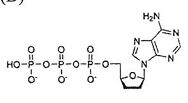
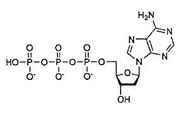
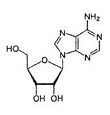
22. Which of the followings is a DNA molecule? (A) (B) (C)(D)
23. Which of the following descriptions of a "virus" is INCORRECT ? (A) A virus is a small infectious agent that can replicate only inside the living cells of an organism. (B) A virus is composed of a protein coat and nucleic acid. (C) The genetic material of a virus is either a double-stranded DNA or a single-stranded RNA. (D) During virus replication, some virus particles may not contain the viral genome.
24. Which of the following methods is used to detect the DNA-protein interaction? (A) Electrophoretic mobility shift assay (B) Yeast-two-hybrid system (C) MALDI-TOF analysis (D) DNA cloning
25. In which phase of the cell cycle does DNA replication occur? (A) GO (B) G1 (C) S (D) M
26. DNA methylation is associated with (A) CAT box. (B) CpG island. (C) TATA box. (D) enhancer.
27. One of the strong pieces of evidence for the process of gene duplication and mutation is the occurrence of (A) pseudogenes. (B) introns. (C) transposons. (D) heterochromatin.
28. If you want to prepare a protein gel for electrophoresis, you need to have the followings:
(i) polyacryamide (ii) SDS (iii) ammonium sulfate (iv) TEMED(A) (i) and (ii) (B) (ii) and (iii) (C) (iii) and (iv) (D) All
29. The fluidity of the lipid side chains in the interior of a bilayer is generally increased by: (A) a decrease in temperature. (B) an increase in fatty acyl chain length. (C) an increase in the number of double bonds in fatty acids. (D) the binding of water to the fatty acyl side chains.
30. Fluorescence resonance energy transfer (FRET) analysis can provide information on: (A) enzyme kinetic (B) protein stability (C) protein-protein interaction (D) open the ion channels
31. Which of the following molecules is able to translate proteins? (A) DNA polymerase I (B) Proteinase K (C) RNA polymerase II (D) Ribosome
32. Which of the following statements is NOT true? (A) Histones help compact chromosomes (B) Histones help regulate gene expression in prokaryotes (C) Histones have N-terminal tails that can be covalently modified (D) Histones exist as octamers
33. Which of the following techniques CANNOT be used to test the loss-of-function phenotype of a gene? (A) Reporter construct (B) RNAi (C) Knock-out animal (D) Radiation induced chromosomal deletion
34. Which of the following components does NOT participate in protein degradation? (A) Ubiquitination (B) Proteasome (C) E3 ligase (D) Lysozyme
35. Which of the followings is NOT a function of carbohydrates? (A) They are the catalytic components of enzymes. (B) They play key roles in processes that take place on the surface of cells. (C) They are used in structural roles. (D) They are the major energy sources.
36. Which amino acid has the one-letter symbol E? (A) Lysine (B) Phenylalanine (C) Histidine (D) Glutamic acid
37. Which of the following amino acids contain sulfur? (A) Cysteine and lysine (B) Cysteine and methionine (C) Arginine and methionine (D) Cysteine and isoleucine
38. Which of the following strategies can be used for identifying the binding site of transcription factors within promoter region? (A) DNA microarray (B) Southern hybridization (C) DNA footprinting (D) Dot blotting
39. Which of the following statements is CORRECT for the purification of a biological molecule? (A) The protein G is used to purify nucleic acid and lipids. (B) Gel-filtration chromatography is a separation method for discriminating protein hydrophobicity. (C) Alteration of pH value or ion strength cannot interrupt the protein-ligand binding in the affinity purification. (D) The affinity chromatography uses the specific binding properties of a protein to purify the desired protein.
40. Which of the following strategies can be used for determining protein half-life? (A) Mass spectrometry (B) Two-dimensional electrophoresis (C) Pulse-chase labelling (D) Western blotting
41. Post-translational modification is important for protein activity. Which of the following modifications is involved in the covalent linkage between two amino acids? (A) Ubiquitination (B) Glycosylation (C) Phosphorylation (D) Acetylation
42. Which gel type would you recommend for analyzing a sample containing glycosylated proteins of different sizes? (A) Gradient gel (B) Low density gel (C) High density gel (D) Agarose gel
1. Transcription start site
2. Alternative splicing
3. DNA dependent RNA polymerase
4. Frame shift mutation
5. Reverse transcriptase
三、翻譯題 One of the most difficult and interesting mysteries surrounding the origin of life is exactly how the genetic material could have formed starting from simpler molecules present on the early earth. Judging from the roles that RNA has in modern cells, it seems likely that RNA appeared before DNA. When modern cells make proteins, they first copy genes from DNA into RNA and then use the RNA as a blueprint to make proteins. This last stage could have existed independently at first. Later on, DNA could have appeared as a more permanent form of storage, thanks to its superior chemical stability.
 阿摩線上測驗
登入
 (B)
 (C)
 (D)