所屬科目:轉學考-普通化學
12. Consider a solution containing the following cations: Na⁺, and Ag⁺. Treatment of the solution with dilute HCl followed by saturation with H2S results in formation of precipitate(s). Which ions still remain in solution ? (A) Ag⁺ only; (B) Na⁺, ; (C) Ag⁺ and ; (D) Na⁺, , and ; (E) Na⁺ only
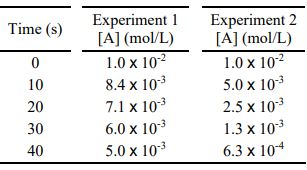
1. Consider the following hypothetical data collected in two studies of the reaction. 2A + 2B → C + 2DIn experiment 1, [B]0 = 10.0 MIn experiment 2, [B]0 = 20.0 M Rate = -∆[A]/ ∆t Solve the value of the rate constant (k) for the reaction. Include units.
2. Calculate the equilibrium concentration of and in a 1.00 M solution of H3PO4 where the , for H3PO4 are , , and , respectively. Besides, what’s the pH of this solution?
3. You have a concentration cell with Cu electrodes and = 1.00 M (right side) and = 1.0x M (left side). Calculate the potential for this cell at 25℃. ( → Cu;= 0.34 V;
4. Carbon tetrachloride, CCl4, has a vapor pressure of 213 torr at 40℃ and 836 torr at 80℃. What’s the normal boiling point of CCl4 (in K)? (8%; R: 8.314 J・ = 0.082 L・atm・)
5. Consider the following reaction at 25℃: The value of ∆Ho and ∆So are -58 kJ/mole and -176.6 J/K.mol, respectively. Calculate the value of K at 100℃ assuming ∆Ho and ∆So do not depend on the temperature. (6%; R: 8.314 J・ = 0.082 L・atm・)
 阿摩線上測驗
登入
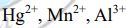 and Ag⁺. Treatment of the solution with dilute HCl followed by saturation with H2S results in formation of precipitate(s). Which ions still remain in solution ? (A) Ag⁺ only; (B) Na⁺,
 ; (C) Ag⁺ and
 ; (D) Na⁺,
 , and
 ; (E) Na⁺ only
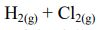 →
 ∆G = -45.54 kJ; ∆H = -44.12 kJ; ∆S = -4.76 J/K
 and
 in a 1.00 M solution of H3PO4 where the
 ,
 for H3PO4 are
 ,
 , and
 , respectively. Besides, what’s the pH of this solution?
 = 1.00 M (right side) and
 = 1.0x
 M (left side). Calculate the potential for this cell at 25℃. (
 → Cu;
 = 0.34 V;
 = 0.082 L・atm・
 )

 = 0.082 L・atm・
 )