所屬科目:轉學考-物理
1. A car of mass 2000 kg, can reach a speed of 100 Km/h in 10 sec. What is the average power needed to accomplish this? (A) 103.6 hp, (B) 77.3 hp, (C) 103.6 kW, (D) 77.3 kW.
2. Ten bricks, each 10 cm thick and mass 1 kg, lie on a flat floor. How much work is required to stack them on top of one another? Assume the bricks have uniform density. (A) 40 J, (B) 44.1 J, (C) 49.5 J, (D) 55 J.
3. The moment of inertia of a solid sphere is 2MR²/5, hollow sphere is 2MR²/3, solid cylinder is MR²/2, and hollow cylinder is MR². All of the same mass M and the same outer radius R. If these four objects are released from rest at the top of an incline and start rolling without sliding. Which one will the last arrive at the bottom? (A) solid sphere, (B) hollow sphere, (C) solid cylinder, (D) hollow cylinder.
4. Assume the earth is a prefect sphere with uniform density and the radius is 6400 km. What is the difference of gravitational acceleration at equator and at north pole? (A)0.017 m/s², (B) 0.034 m/s², (C) 0.17 m/s², (D) 0.34 m/s².
5. The period of T of a simple pendulum of length L is given by T = 2π(L/g)¹/². When it is taken to a mountain top it lose 1 min per day. What is the height of the mountain? (A) 3 km, (B) 3.55 km, (C) 4 km, (D) 4.55 km.
6. Which function does not represent traveling wave. (A) A*sin²[π(t-x/v)], (B) Acos(kx-ωt)², (C) A(x+vt)³, (D) A*sin[(kx)²-(ωt)²].
7. A mass of 1 kg attached to a spring with a spring constant of 100 Nt/m oscillates horizontally on a smooth frictionless table with amplitude of 0.5 m. When the mass is 0.25 m away from equilibrium, determine the total mechanical energy. (A) 3.125 J, (B)9.375 J, (C) 12.5 j, (D) 15.625 J.
8. The Carnot cycle consists of (A) two adiabatic processes and two isochoric processes, (B) two isothermal processes and two isobaric processes, (C) two isothermal processes and two adiabatic processes, (D) two isobaric processes and two isochoric processes.
9. Solar radiation supplies approximately 1 kW/m² at the earth's surface. A 3 m x 2 m solar collector is used to heat water. If the required temperature rise is 40°C, what is the necessary flow rate of the water in kg/s? Assume the water absorbs 80% of the radiant energy. (A) 28.6 g/s, (B) 35.75 g/s, (C) 63.66 g/s, (D) 79.58 g/s.
10. Find the internal energy of one mole of diatomic ideal gas with rotation and vibration at 300 K. (A) 3.74 KJ, (B) 6.24 KJ, (C) 8.73 KJ, (D) 12.56 KJ.
11. A 50-g ice cube at 0℃ melts (reversibly) to water at 0℃. What is the change in entropy of the ice and the universe respectively? (A) 61.2 J/K and -61.2 J/K, (B) 61.2 J/K, 0 J/K (C) -61.2 J/K, 0 J/K (D) -61.2 J/K, 61.2 J/K.
12. An electric hair dryer is rated at 1500 W at 110V. Calculate the maximum instantaneous power. (A) 1500 W, (B) 2121 W, (C) 3000 W, (D) 3500 W.
13. An electron moving at constant speed v in a circular orbit with radius r around the nucleus. What is the ratio of its magnetic dipole moment to its orbital angular momentum? (A) e/m (B) e/2m (C) -e/m (D) -e/2m.
14. Suppose we use a Hall probe to measure the magnitude of a constant magnetic field. The Hall probe is a strip of copper with a height of 1 mm. We measure a voltage of 0.15 µV across the probe when we run a current 2 A through it. What is the magnitude of the magnetic field? (The density of copper is 8.96 g/cm3, and 1 mole of copper is 63.5 g and each copper atom has one conduction electron) (A) 0.5 T, (B) 0.8T, (C) 1.02 T, (D) 2.1 T.
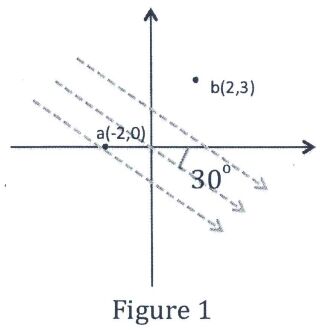
15. A uniform electric field of 200 V/m is directed at 30° below the x axis, as shown in fig. 1. Find the changes in potential: Vb - Va. The coordinates are b = (2 cm, 3 cm) and a = (-2 cm, 0 cm). (A) -3.9 V, (B) 3.9 V, (C) -9.9 V, (D) 9.9 V.
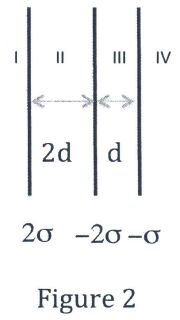
16. Three parallel infinite sheets with charged densities are 2σ, -2σ and σ C/m² respectively and separate 2d and d, as shown in fig. 2. These sheets divide the space into four parts, I, II, III, and IV. Which two regions have the same electric filed. (A) I and II, (B) II and III, (C) II and IV, (D) I and III.
17. A flat, circular coil of radius 4 cm carries a current of 1.3 A and produces a magnetic field of 4.9 Gauss at its center. How many turns does it have? (A) 12, (B) 24, (C) 36, (D) 48.
18. The current in a long solenoid varies according to I(t) = 4+ 6t² A. The solenoid has 800 turns/m and a radius of 2 cm. At t = 2 s find the magnitude of the induced electric filed at 4 cm from the central axis. (A) 1.21x10⁻⁴ V/m, (B) 1.21 x10⁻⁴ J/(A*m), (C) 2.42x10⁻⁴ V/m, (D) 2.42x10⁻⁴ J/(C*m).
19. A coil is composed of circular loops of radius r = 5.13 cm and has N = 47 windings. A current, i = 1.27 A, flows through the coil, which is inside a homogeneous magnetic field of magnitude 0.911 T. What is the maximum torque on the coil due to the magnetic field? (A) 0.148Nt.m, (B) 0.211 Nt.m, (C) 0.350 Nt.m, (D) 0.450 Nt.m.
20. Calculate the potential difference induced between the tips of the wings with a wingspan of 64.67 m at a speed of 913 km/h. Assume the magnitude of the downward component of the earth's magnetic field is B = 5.0*10-5 T. (A) 0.82 V, (B) 1.64 V, (C) 2.95 V, (D) 10.4 V.
21. Which experiment indicates the particle-like wave? (A) Compton scattering, (B) Rutherford scattering, (C) Bragg reflection, (D) Stern-Gerlach experiment.
22. Ultraviolet light of wavelength 350 nm is incident on a material with a stopping potential of 0.25 V. The work function of the material is (A) 1.3 eV, (B) 2.3 eV, (C) 3.3 V, (D) 5.2 V.
23. Which one of the following statements is true if the intensity of a light beam is increased while its frequency is kept the same? (A) The photon gains higher speeds. (B) The energy of photons is increased. (C) The number of photons per unit time in increased. (D) The wavelength of the light is increased.
24. What accelerating voltage is needed to produce electrons with wavelength 0.01 nm? (A)10 kV, (B) 12 kV, (C) 15 kV, (D) 20 kV.
25. An electron has a kinetic energy of 2 MeV. What is its speed? (A) 1.4x10⁸ m/s, (B) 2.4x10⁸ m/s(C) 2.94x10⁸ m/s, (D) 3.8x10⁹ m/s.
 阿摩線上測驗
登入
 (A) 1.4x10⁸ m/s, (B) 2.4x10⁸ m/s(C) 2.94x10⁸ m/s, (D) 3.8x10⁹ m/s.