所屬科目:研究所、轉學考(插大)◆分子生物學
1. The defect of which biological process will result in the increase of mutation rate? (A) DNA synthesis (B) RNA synthesis (C) DNA repair (D) protein synthesis
2. How many times is a replication origin used during a cell cycle? (A) Once (B)twice (C)five times (D) twenty times
3. DNA replication (A)occurs throught the addition of nucleotides to the end of the parental DNA molecule (B)results in the formation of four new DNA strand (C)use each strand of a DNA molecule as a template for the creation of a new strand (D)begins when two DNA molecules join together to exchange segments.
4. If 15% of the bases in a region of the human genome are cytosine, what percentage in that region are thymidine? (A)15% (B)35% (C)65% (D)85%.
5.Why does a DNA strand grow only in the 5' to 3' direction? (A)because DNA polymerase can only add nucleotides to the 3' end of the growing molecule. (B)because DNA polymerase can only add nucleotides to the 5' end of the growing molecule. (C)because the DNA molecule only unwinds in the 5' to 3' direction. (D)because DNA polymerase requires the addition of a starter nucleotide at the 5' end.
6. The importance of telomeres in eukaryotic cells is related to (A)the termination of DNA replication. (B)the initiation of RNA transcription. (C)the elongation of DNA replication. (D)the initiation of homologous recombination.
7. Which of the following enzymes catalyzes the elongation of a new DNA strand? (A)helicase (B)ligase (C)single-stranded binding protein (D)DNA polymerase.
8. During complementary base pairing, enzymes join the base's nucleotide to from double strand DNA by (A)electrostatic bond. (B)phosphodiester bond. (C)ionic bond. (D)hydrogen bond.
9. Homeodomain functions at (A) DNA-DNA interaction. (B)DNA-RNA interaction. (C)DNA-protein interaction. (D)RNA-protein interaction.
10. The regulation of a gene expression can NOT be achieved by (A)binding of transcription factors to a gene regulatory region. (B)controlling the mRNA transportation from nucleus to cytoplasm. (C) changing the binding affinity of a structure protein. (D) controlling the degradation of mRNAs.
11. The initiation of a gene transcription can be achieved by (A)removing the activator. (B)removing the repressor. (C)removing RNA polymerase. (D)removing DNA polymerase.
12. Skin cells and neuron cells in an individual show very distinct morphology and function, but they carry identical genome. How can this occur? (A) Different mutations occur in different cell types. (B) Different parts of genome are lost in different cell types. (C) Different sets of genes are expressed in different cell types. (D) Different chromosomes are inactivated in different cell types.
13. Gene activator proteins can stimulate transcription initiation by (A)packing nucleosome and DNA together. (C) binding to RNA synthase directly. histone. (B)recruiting RNA reverse transcriptase. (D)recruiting chromatin remodeling complex to remove
14. The formation of an entire organ can be triggered by (A)the serial expression of transcription factors. (B)the synthesis of multiple structure proteins. (C)the modification of some structure genes. (D)the serial expression of cell-cycle controllers.
15. X-inactivation in female cells of mammals (A) is induced by RNA mediated chromosome condensation. (B) occurs at two-cell embryonic stage. (C) is achieved by degradation of telomeres on X chromosome. (D) only occurs in paternal inherited X chromosome.
16. Which of following events is happened in nuclei? (A) splicing (B) 5'-capping (C) 3'-polyadenylation (D) all of them
17. Which of following elements is contained in spliceosomes? (A) RNase (B) snRNPs (C) RNA polymerase (D) histone
18. What region of gene does not appear in mRNA? (A) exons (B) introns (C) CDS (D) 5'-UTR
19. 5'cap of mRNAs do not serve what function? (A) protect mRNA (B) help DNA replication (C) enhance translation (D) all of them
20. Which type of RNA has 3' poly-adenylation tail? (A) tRNA (B) precursor messenger RNA (C) rRNA (D) mRNA
21. What regions of gene will be translated into polypeptides? (A) exons (B) introns (C) CDS (D) 5'-UTR
22. In eukaryotic cells, what modification is not required for processing precursor messenger RNA into mature mRNA? (A) splicing (B) 5'-capping (C) 3'-polyadenylation (D) duplication
23. What types of mutations could contribute to SNP in an organism? (A) insertion (B) deletion (C) translocation (D) point mutation
24. The high-throughput sequencing assay can NOT be applied to which type of studies? (A) genotyping (B) transcriptome (C) RNA expression level (D) protein expression level
25. The microarray assay can be used for what type of study? (A) gene expression profile (B) proteome (C) DNA replication (D) none of the above
26. What type of mutations could not result in the copy number variation (CNV)? (A) duplication (B) deletion (C) point mutation (D) none of above
27. Which of following methods could be used for studying protein-protein interactions? (A) microarray (B) ChIP-Seq (C) co-immunoprecipitation (D) all of them
28. A researcher identified a sequence of a novo gene from an unknown animal. What is the easiest way to guess the function of this novo gene? (A) put this gene into bacteria (B) BLAST this sequence (C) delete this gene in this animal (D) isolate the gene product
29. Which of the following factors is involved in proofreading during transcription in prokaryotes? (A) GreB (B) NusA (C) sigma-factor (D) rho-factor
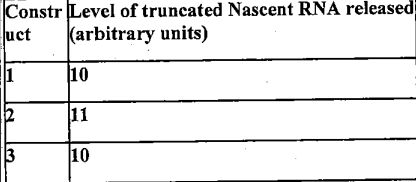
30. A prokaryote experiment was conducted to determine the hairpin loop region in termination. Two DNA templates were prepared and used in an in vitro transcription assay. The samples were analyzed for release of the RNA polymerase. Construct 1 - hairpin sequence removed;
Construct 2 - two copies of hairpin sequence inserted; Construct
3 - normal DNA with only one hairpin sequence The data from this experiment suggest that
(A) hairpin loops are not required for termination. polymerase. (B) two hairpin loops rapidly destabilize the (C) the data are inconclusive. (D) additional hairpin loops increase the stability of the RNA:DNA hybrid.
31. Which of the following techniques is most useful in determining if RNA polymerase has initiated transcription from the lac DNA template in prokaryotes? (A) Southern analysis (B) RACE (C) run-off transcription assay (D) DNA fingerprinting
32. In the process of creating a trp operon mutant, the region for the riboswitch was accidentally deleted. Which of the following would be a likely observation in the transcription assays? (A) RNA polymerase cannot bind to the promoter. (C) Attenuation would be impaired. (B) The operon is permanently inhibited. (D) Termination would be triggered.
33. Which of the following sigma specificity factors is involved in middle gene transcription during SPO1 phage infection of bacteria? (A) gp28 (B) gp33 (C) gp43 (D) host sigma
34. Which of the following proteins is not involved the lytic phase of 2-infection of bacteria? (A) CIII (B) S10 (C) NusA (D) NusG
35. All of the following contain helix-turn-helix motifs except (A) repressor (B) tryptophan (C) Cro (D) CAP
36. Which of the following is NOT a part of the core class II promoter in eukaryotes? (A) TATA box (B) upstream element (C) BRE (D) DPE
37. The CCAAT boxes are bound by which of the following? (A) Sp1 (B) DPE (C) TBP (D) CTF
38. The archaea, P. woesei, produces a transcription factor that is similar to which of the following in eukaryotes? (A) TFIIA (B) TFIIB (C) TFIID (D) TFIIF
39. Which of the following would you expect to bind to a chromatography column made of a resin conjugated to UBF? (A) Sp1 (B) SL1 (C) TFIIB (D) TFIIH
40. Which of the following is a target site for GAL4 in eukaryotes? (A) UASG (B) CСAАТ (C) GCAAT (D) UASG and CCAАТ
41. Which of the following molecules can expedite RNA Pol II elongation through a nucleosome? (A) HAT (B) FACT (C) IFN-B (D) ChIP
42. The Histone Code states that the (A) primary sequence of the histone proteins never changes over time. (B) combination of histone modification on a given nucleosome near a gene's control region affects the efficiency of transcription of that gene. (C) lysines are the only amino acids found in histones that can be acetylated and deacetylated. (D) histones are found in all living cells.
1.
2.
3.
4.
5.
6.
7.
簡答題:
1. Which operons are glucose-sensitive operons in E. coli?
2.Which characteristic domains of Transcription factors were suggested responsible for the activation of transcription in eukaryotes?
3. Explain the phenomenon and mechanism of genomic imprinting.
 阿摩線上測驗
登入
 (A) hairpin loops are not required for termination. polymerase. (B) two hairpin loops rapidly destabilize the (C) the data are inconclusive. (D) additional hairpin loops increase the stability of the RNA:DNA hybrid.