所屬科目:轉學考-普通化學
7. Using the following data reactions:Calculate the energy of an H–Cl bond.(A)770kJ(B)856 kJ(C)518 kJ (D)487 kJ(E)428 kJ
12. A possible mechanism for the overall reaction: Br2(g) + 2NO(g)→ 2NOBr(g) : NO(g) + Br2(g) ←→ NOBr2(g) (fast; rate constant for forward reaction is k1 and k-1 for reverse reaction) NOBr2(g) + NO(g)→ 2NOBr2(g) (slow; rate constant is k2) The rate law for formation of NOBr based on this mechanism is rate = ________. (A)k1[NO]½ (B)k1[Br₂]½ (C) (k2k1/k-1)[NO]²[Br₂] (D)(k1/k-1)2[NO]² (E)k2[NOBr2][NO]
13. For the reaction CaCO₃(s) ←→ CaO(s) + CO₂(g), Kp = 1.16 at 800.°C. If a 21.1 gram sample of CaCO₃ is put into a 10.0 L container and heated to 800°C, what percent of the CaCO₃ will react to reach equilibrium? (A)32.3%(B)62.5%(C)83.8% (D)41.9%(E)100.0%
17. The equilibrium constant K for the dissociation reaction of a molecule X2
X2(g) ←→ 2X(g)
was measured as a function of temperature (in Kelvin). A graph of ln K versus 1/T for this reaction gives a straight line with a slope of –1.352x10⁴ and an intercept of 15.59 K. The value of ∆S for this dissociation reaction is: (A)1.875 J/K mol(B)259.2 J/K mol(C)32.4 J/K mol (D)64.81 J/K mol(E)129.6 J/K mol
18. An excess of finely divided iron is stirred up with a solution that contains Cu²⁺ ion, and the system is allowed to come to equilibrium. The solid materials are then filtered off and electrodes of solid copper and solid iron are inserted into the remaining solution. What is the value of the ratio [Fe²⁺]/[Cu²⁺] at 25°C? The following standard reduction potentials apply: (A)1(B)1.3x1026(C)2.5x1026 (D)4.4x10⁻²⁷(E)8.8x10⁻²⁷
 阿摩線上測驗
登入
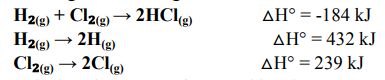 Calculate the energy of an H–Cl bond.(A)770kJ(B)856 kJ(C)518 kJ (D)487 kJ(E)428 kJ
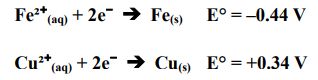 (A)1(B)1.3x1026(C)2.5x1026 (D)4.4x10⁻²⁷(E)8.8x10⁻²⁷
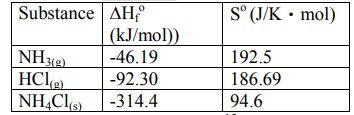 Substance ∆Hf o (kJ/mol)) So (J/K・mol) NH3(g) -46.19 192.5 HCl(g) -92.30 186.69 NH4Cl(s) -314.4 94.6 (A)150(B)9.3×10¹⁵(C)8.4×10⁴ (D)1.1×10⁻¹⁶(E)7.2×10¹²