所屬科目:研究所、轉學考(插大)-經濟學
1. Bill is restoring a car and has already spent $4000 on the restoration. He expects to be able to sell the car for $6200. Bill discovers that he needs to do an additional $2400 of work to make the car worth $6200 to potential buyers. He could also sell the car now, without completing the additional work, for $3800. What should he do? (A) He should sell the car now for $3800. (B) He should keep the car since it wouldn't be rational to spend $6400 restoring a car and then sell it for only $6200. (C) He should complete the additional work and sell the car for $6200. (D) It does not matter if Bill sells the car now or completes the work and then sells it at the higher price because the outcome will be the same either way.
2. Bridget drinks three sodas during a particular day. The marginal benefit she enjoys from drinking the third soda (A) can be thought of as the total benefit Bridget enjoys by drinking three sodas minus the total benefit she would have enjoyed by drinking just two sodas. (B) determines Bridget's willingness to pay for the third soda. (C) is likely different from the marginal benefit provided to Bridget by the second soda. (D) All of the above are correct.
3. Based on the values in the table, the production possibilities frontier is (A) bowed outward indicating increasing marginal opportunity costs. (B) bowed outward indicating decreasing marginal opportunity costs. (C) a straight line indicating constant marginal opportunity costs. (D) bowed inward indicating decreasing marginal opportunity costs.
4. Which of the following combinations of cookies and coffee is not currently attainable but would be attainable if there was an improvement in overall production technology? (A) 800 dozen cookies and 150 pounds of coffee (B) 700 dozen cookies and 400 pounds of coffee (C) 500 dozen cookies and 850 pounds of coffee (D) 300 dozen cookies and 900 pounds of coffee
5. Both Danny and Mark should specialize in producing (A) pizza only. (B) pizza and lemonade, respectively. (C) lemonade and pizza, respectively. (D) lemonade only.
6. If one pizza can exchange 3 pitchers of lemonade in the market, which of the following is correct. (A) Danny is willing to trade, but Mark does not. (B) Mark is willing to trade, but Danny does not. (C) Both Danny and Mark are not willing to trade. (D) Both Danny and Mark are willing to trade.
7. Suppose Harry, Darby, and Jake are the only demanders of sandwiches. Also suppose x = 2. Then (A) the slope of Jake's demand curve is -2, and the slope of the market demand curve is -5/2. (B) the slope of Jake's demand curve is -2, and the slope of the market demand curve is -2/5. (C) the slope of Jake's demand curve is -1/2, and the slope of the market demand curve is -5/2. (D) the slope of Jake's demand curve is -1/2, and the slope of the market demand curve is -2/5.
8. Suppose Harry, Darby, and Jake are the only demanders of sandwiches. Also suppose the following: (1) \( x = 2 \); (2) the current price of a sandwich is $3.00; (3) the market quantity supplied of sandwiches is 4; (4) the slope of the inverse supply curve is 2. Then there is currently a (A) shortage of 6 sandwiches, and the equilibrium price of a sandwich is less than $3.00. (B) shortage of 6 sandwiches, and the equilibrium price of a sandwich is $5.00. (C) surplus of 6 sandwiches, and the equilibrium price of a sandwich is less than $3.00. (D) surplus of 6 sandwiches, and the equilibrium price of a sandwich is $5.00.
9. Suppose Harry, Darby, and Jake are the only demanders of sandwiches. Also suppose the following: (1) \( x = 2 \); (2) the current price of a sandwich is $3.00; (3) the market quantity supplied of sandwiches is 5; (4) the slope of the inverse supply curve is 1. Then there is currently a (A) shortage of 5 sandwiches, and the equilibrium price of a sandwich is between $3.00 and $5.00. (B) shortage of 5 sandwiches, and the equilibrium price of a sandwich is $5.00. (C) surplus of 5 sandwiches, and the equilibrium price of a sandwich is between $3.00 and $5.00. (D) surplus of 5 sandwiches, and the equilibrium price of a sandwich is $5.00.
10. Suppose the government has imposed a price ceiling on sliced sandwich bread. Which of the following events could transform the price ceiling from one that is binding to one that is not binding? (A) An increase in the price of flour, which is used to make bread. (B) A decrease in the price of lunch meat. (C) A decrease in the price of unsliced bread, which people consider a substitute for sliced bread. (D) An decrease in the price of peanut butter and jelly.
11. Suppose the government has imposed a price floor on cellular phones. Which of the following events could transform the price floor from one that is binding to one that is not binding? (A) Cellular phones become less popular. (B) Traditional land line phones become more expensive. (C) The components used to produce cellular phones become less expensive. (D) Firms expect the price of cellular phones to fall in the future.
12. In which of the following instances would the deadweight loss of the tax on cartons of cigarettes increase by a factor of 9? (A) The tax on cartons of cigarettes increases from $10 to $11. (B) The tax on cartons of cigarettes increases from $10 to $20. (C) The tax on cartons of cigarettes increases from $10 to $30. (D) The tax on cartons of cigarettes increases from $10 to $90.
13. When marginal cost is rising, average variable cost (A) must be rising. (B) must be falling. (C) must be constant. (D) could be rising or falling.
14. Which of the following is not a property of a firm's cost curves? (A) Marginal cost must eventually rise as a result of diminishing marginal product. (B) Average total cost is U-shaped. (C) Economies of scale will exist when average total cost falls as output rises. (D) Average total cost will cross marginal cost at the minimum of marginal cost.
15. The long-run supply curve for a competitive industry may be upward sloping if (A) there are barriers to entry. (B) firms that enter the industry are able to do so at lower average total costs than the existing firms in the industry. (C) some resources are available only in limited quantities. (D) accounting profits are positive.
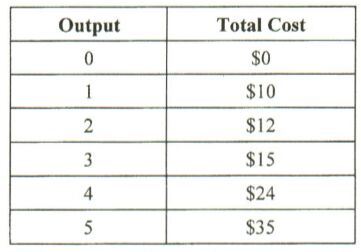
16. A monopolistically competitive firm has the following cost structure: The firm faces the following demand curve:To maximize profit (or minimize losses), the firm will produce (A) 20 units. (B) 30 units. (C) 40 units. (D) 50 units.
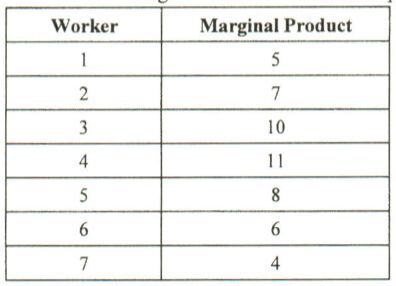
Consider the following information about bread production at Beth's Bakery. 17. Beth pays all her workers the same wage, and labor is her only variable cost. From this information we can conclude that Beth's marginal cost (A) is constant. (B) increases as output increases from 0 to 33, but declines after that. (C) declines as output increases from 0 to 11, but increases after that. (D) declines as output increases from 0 to 33, but increases after that.
18. In the short run, there are 500 identical firms in a competitive market. The firms do not use any resources that are available in limited quantities, and each of them has the following cost structure: Which of the following is a point on the long-run supply curve? (A) P=$10, Q=500. (B) P=$6, Q=1,000. (C) P=$5, Q=500. (D) P=$5, Q=1,500.
19. Assume that Mary decides to consume $100,000 in the work period. How much money will she have available for consumption in her retirement period? (A) $100,000 (B) $150,000 (C) $165,000 (D) $265,000
20. If the interest rate on savings increases, it is possible that (A) Mary will decrease her savings in the work period. (B) Mary will increase her savings in the work period. (C) Mary will not change her consumption in the work period. (D) All of the above are possible.
21. If the interest rate on savings increases, (A) Mary will decrease her savings in the work period if the income effect is greater than the substitution effect for her. (B) Mary will increase her savings in the work period if the income effect is greater than the substitution effect for her. (C) Mary will increase her savings in the work period if the substitution effect is greater than the income effect for her. (D) Both a and c are correct.
22. In an imaginary economy, consumers buy only sandwiches and magazines. The fixed basket consists of 20 sandwiches and 30 magazines. In 2006, a sandwich cost $4 and a magazine cost $2. In 2007, a sandwich cost $5. The base year is 2006. If the consumer price index in 2007 was 125, then how much did a magazine cost in 2007? (A) $0.83 (B) $2.25 (C) $2.50 (D) $3.00
23. Other things the same, if the government increases transfer payments to households, then the effect of this on the government's budget (A) will make equilibrium interest rate rise and equilibrium investments increase. (B) will make equilibrium interest rate rise and equilibrium investments decrease. (C) will make equilibrium interest rate fall and equilibrium investments increase. (D) will make equilibrium interest rate fall and equilibrium investments decrease.
24. Assume there is a multiplier effect, some crowding out, and no accelerator effect. An increase in government expenditures changes aggregate demand more, (A) the smaller the MPC and the stronger the influence of income on money demand. (B) the smaller the MPC and the weaker the influence of income on money demand. (C) the larger the MPC and the stronger the influence of income on money demand. (D) the larger the MPC and the weaker the influence of income on money demand.
25. Assume the multiplier is 5 and that the crowding-out effect is $30 billion. An increase in government purchases of $20 billion will shift the aggregate-demand curve to the (A) right by $130 billion. (B) right by $70 billion. (C) right by $50 billion. (D) right by $10 billion.
26. If the natural rate of unemployment falls, (A) both the short-run and long-run Phillips curves shift left. (B) the short-run Phillips curve shifts left, the long-run Phillips curve is unchanged. (C) the short-run Phillips curve is unchanged, the long-run Phillips curve shifts right. (D) the short-run and the long-run Phillips curves shift right.
27. A policy that raised the natural rate of unemployment would shift (A) both the short-run and the long-run Phillips curves to the right. (B) the short-run Phillips curve right but leave the long-run Phillips curve unchanged. (C) the long-run Phillips curve right but leave the short-run Phillips curve unchanged. (D) neither the long-run Phillips curve nor the short-run Phillips curve right.
28. More flexible labor markets will shift (A) both the long-run Phillips curve and the long-run aggregate supply curve to the right. (B) both the long-run Phillips curve and the long-run aggregate supply curve to the left. (C) the long-run Phillips curve to the right and the long-run aggregate supply curve to the left. (D) the long-run Phillips curve to the left and the long-run aggregate supply curve to the right.
29. If the minimum wage increased, then at any given rate of inflation (A) both output and employment would be higher. (B) neither output nor employment would be higher. (C) output would be higher and unemployment would be lower. (D) output would be lower and unemployment would be higher.
30. In the open-economy macroeconomic model, if the supply of loanable funds increases, net capital outflow (A) and the real exchange rate increase. (B) and the real exchange rate decrease. (C) increases and the real exchange rate decreases. (D) decreases and the real exchange rate increases.
31. Other things the same, if foreign residents desired to purchase more U.S. wheat (A) the real exchange rate and net exports of U.S. would rise. (B) the real exchange rate of U.S. would rise and net exports of U.S. would be unchanged. (C) the real exchange rate of U.S. would fall and net exports of U.S. would be unchanged. (D) the real exchange rate of U.S. would fall and net exports of U.S. would rise.
 阿摩線上測驗
登入