所屬科目:中山◆資工◆工程數學
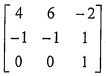
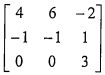
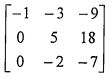
2.Please determine which the following matrix is a diagonal matrix. (A) (B) (C) (D)
3.Please select the right following description (A) = and have the same eigenvalues.(B) If matrix A is diagonalizable, then the column of A are linearly independent.(C) Every orthogonal set of V must be linearly independent.(D) If A is an orthogonal matrix, then A is symmetric
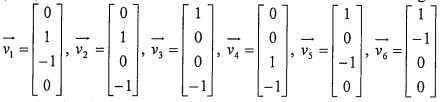
5.There are six vectors shown below. Please determine the right description
(A) ,are linear independent
(B) , are linear independent(C), are linear independent(D) , are linear independent
7.While receiving the signal, you adopt a circuit to process this signal. After your analysis, youcan model the circuit by using the following ordinary differential equation (ODE).y(x)+3y(x)+2y(x)= [δ(x-3)+δ(x+3)]
Please use the result in the previous problem and the symmetric property to solve the above ODE and
determine the right y(x).(A) π(δ(ω));(B)π(δ(ω-3)+δ(ω+3)).;(C)π(δ(ω+3)-δ(ω-3)).;(D)π(δ(ω-3)+δ(ω-3)).
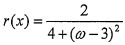
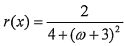
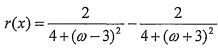
8. Now, you decide to transfer one signal s(x) (i.e., s(x) = )and make the f(x) as the carrie wave. Based on the modulation technique, you can create one new signal r(x) containing the s(x) and f(x). Please describe the formulation of the r(x) in the frequency domain. (A)(B) (C) (D)
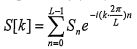
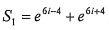
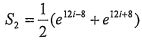
9.After your analysis, you find that it is not practical to analyze the phenomenon in thefrequency domain in the continuous time. Afterward, you decide to use Discrete Fourier Transform(DFT) instead. Assume you sample the new created r(x) signal every 2 unit time and collect 4 datafrom time zero (ie., x are 0, 2, 4, and 6 sequentially.) If you know that the DFT can be formulated aswhere the L is the length of the samples and the n indicates the sample number. Please select the rightfollowing result of your analysis in the frequency domain after applying your derived DFT.(A) ;(B) ;(C);(D);
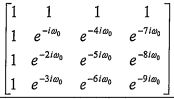
10. To facilitate the DFT analysis, you decide to program a DFT code. Besides, you find that you can adopt a matrix to perform this kind of transform. Please determine the proper Fourier matrix below, which can transform a length-4 data sequence from time domain to frequency domain.
(A)(B)(C)(D)
 阿摩線上測驗
登入
 (B)
 (C)
 (D)
 = and
 have the same eigenvalues.
 ,are linear independent
 , are linear independent
 , are linear independent
 , are linear independent
 [δ(x-3)+δ(x+3)]
 ;
 ;

 )and make the f(x) as the carrie wave. Based on the modulation technique, you can create one new signal r(x) containing the s(x) and f(x). Please describe the formulation of the r(x) in the frequency domain. (A)
 (B)
 (C)
 (D)
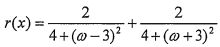
 ;(B)
 ;(C)
 ;(D)
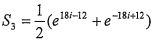 ;
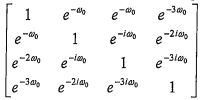 (B)
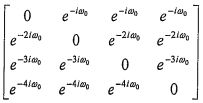 (C)
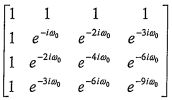 (D)