所屬科目:轉學考-普通化學
1.For the reaction of sodium bromide with chlorine gas to form sodium chloride and bromine, the appropriate half-reactions are (ox = oxidation and re = reduction): (A) (B) (C)(D)(E)
2. The following reactions: are examples of (A) acid-base reactions. (B) unbalanced reactions. (C) precipitation, acid-base, and redox reactions, respectively. (D) redox, acid-base, and precipitation reactions, respectively. (E) precipitation, redox, and acid-base reactions, respectively.
4. Air has an average molar mass of 29.0 g/ mol. The density of air at 1.00 atm and 30°C is (A) 29.0g/L (B) 40.0g/mL (C) 1.17g/L (D) 1.29g/L (E) 12g/L
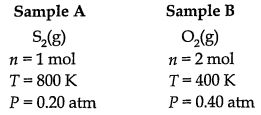
5. Consider the following gas samples:Which one of the following statements is false? (A) The volume of sample A is twice the volume of sample B. (B) The average kinetic energy of the molecules in sample A is twice the average kinetic energy of the molecules in sample B. (C) The fraction of molecules in sample A having a kinetic energy greater than some high fixed value is larger than the fraction of molecules in sample B having kinetic energies greater than that same high fixed value. (D) The mean square velocity of molecules in sample A is twice as large as the mean square velocity of molecules in sample B. (E) Assumning identical intermolecular forces in the two samples, sample A should be more nearly ideal than sample B.
6.Consider the following ground state electron configuration: 1s22s22p4. Which of the ions has this ground state electron configuration? (A) (B) (C) (D)
7. Which ionization process requires the most energy? (A) (B) (C) (D)
10.KBr crystallizes in a cubic unit cell with Br ions on each corner and each face. How many ions and ions are in each unit cell of KBr? (A) 1 ion and 1 ion (B) 2 ions and 2 ions (C) 4 ions and 4 ions (D) 8 ions and 8 ions
11.Which should be least soluble in water? (A) (B) (C) (D)
14.A solution is prepared by dissolving 20.0 g of sucrose, in 250. g of water at 25°C. What is the vapor pressure of the solution if the vapor pressure of water at 25°C is 23.76 mm Hg? (A) 0.198 mm Hg (B) 20.5 mm Hg (C) 23.7 mm Hg (D) 24.0 mm Hg
15.Assuming that sea water is a 3.5 wt % solution of NaCl in water, calculate its osmotic pressure at 20°C. The density of a 3.5% NaCl solution at 20°C is 1.023 g/mL. (A) 1.0 atm (B) 15 atm (C) 29 atm (D) 100 atm
16.A solution of a nonelectrolyte solution contains 30.0 g of solute dissolved in 250.0g of water. The freezing point of the water is observed to be -2.50°C. The Kf for water is 1.86 °C/m and normal freezing point of water is 0.00'C. What is the molar mass of the substance? (A) 335 g/mol (B) 89.5 g/mol (C) 895 g/mol (D) 33.5 g/mol
17.Which arrow represents ? (A) arrow (a) (B) arrow (b) (C) arrow (c) (D) arrow (d)
18.Which arrow represents ? (A) arrow (a) (B) arrow (b) (C) arrow (c) (D) arrow (d)
19. The following diagram shows a close-up view of the vapor pressure curves for a pure solvent and a solution containing a nonvolatile solute dissolved in this solvent. Which curve is the solvent and what happens to the vapor pressure when the solute is dissolved in the solvent? (A) Curve (a) is the solvent and the vapor pressure decreases. (B) Curve (a) is the solvent and the vapor pressure increases. (C) Curve (b) is the solvent and the vapor pressure decreases. (D) Curve (b) is the solvent and the vapor pressure increases.
21.A concentration-time study of the gas phase reaction 2 A3 - 3 A2 produced the data in the table below. What is the concentration of A2 after 30 seconds? (A) 5.00 x 10*M (B) 5.25 x 10*M (C) 5.50 x 10*M (D) 6.00 x 10*M
22.The following set of data was obtained by the method of initial rates for the reaction: (A)(B)(C) (D)
23.Shown is a concentration versus time plot for a reaction involving gases A, B, and C.Which equation best represents the reaction? (A) 4A(g) - B(g) +2C(g) (B) 4A(g) +B(g) -2C(g) (C) 2C(g) →4A(g)+B(g) (D) 2C(g) +B(g)→4A(g)
24.Consider a reaction that occurs by the following one-step mechanism: A2+ B2→ 2 AB The potential energy profile for this reaction is shown below. What is the species present at reaction stage 1? (A) an intermediate (B) a product (C) a reactant (D) a transition state
25. The following set of data was obtained by the method of initial rates for the reaction: What is the rate law for the reaction? (A) (B)(C)(D)
26.For a particular first-order reaction, it takes 48 minutes for the concentration of the reactant to decrease to 25% of its initial value. What is the value for rate constant for the reaction? (A) (B) (C)(D)
27.The reaction: 2 HI→ H2 + I2, is second order and the rate constant at 800 K is . How long will it take for 8.00 x mol/L of HI to decrease to one-fourth of its initial concentration? (A) 0.619s (B) 124 s (C) 387s (D) 429 s
28.What are the coefficients in front of and Cu(s) when the following redox equation is balanced in an acidic solution: (A) 2, 3 (B) 2,6 (C) 3,4 (D) 3,6
29.Determine the number of water molecules necessary to balance the following chemical equation. (A) 3 (B) 5 (C) 7 (D) 14
30.The iron content of foods can be determined by dissolving them in acid (forming ), reducing the iron(II) to iron(I), and titrating with cerium(IV): Identify the two half-reactions in the above reaction. (A) (B) (C) (D)
31.For the hypothetical reaction . For this reaction, if the value of x is 4, then the value of y =_________. (A)1 (B)2 (C)3 (D)4
32. Which of the following reactions should be spontaneous under standard conditions? (A) I and II are both nonsponta (B) I is nonspontaneous and I is spontaneous. (C) I is spontaneous and II is nonspontaneous. (D) I and II are both spontaneous.
33.At a certain temperature, Kc equals 1.4 x 10² for the reaction:2CO(g)+O2(g)⇌2 CO2(g) If a 2.50-L flask contains 0.400 mol of CO2 and 0.100 mol of O2 at equilibrium, how many moles of CO are also present in the flask? (A) 0.422 mol (B) 0.169 mol (C) 0.107 mol (D) 0.0114mol
34.The following pictures represent aqueous solutions of binary acids of the type HA where the water molecules have been omitted for clarity.Determine the strongest acid of the set. (A)A(B)B (C)C (D)D
35.What is the second stepwise equilibrium constant expression for phosphoric acid H3PO4? (A) (B) (C) (D)
36.Sodium reacts violently with water according to the equation: 2 Na(s) + 2 H2O(l)→ 2 NaOH(aq) +H2(g) The resulting solution has a higher temperature than the water prior to the addition of sodium. What are the signs of △H° and △S° for this reaction? (A) △H° is negative and △S° is negative. (B) △H° is negative and △S° is positive. (C) △H° is positive and △S° is negative. (D) △H° is positive and △S° is positive.
37.For the process Assuming that the surroundings can be considered a large heat reservoir at 25°C, calculate for the process at 25°C and 1 atm pressure. Is the process spontaneous at 25°C and 1 atm pressure? (A) (B) (C) (D)
38. In the following reaction the unshaded spheres represent H atoms. Identify the BrΦnsted-Lowry acid/base conjugate pairs. (A)(1)/(2) and (3)/(4) (B) (1)/(3) and (2)/(4) (C) (I)/(4) and(2)/(3) (D) none of the above.
39.An experiment with takes 47.5 hours. At the end of the experiment, 1.90 ng of remains. If the half life is 18.0 hours, how many ng of were originally present? (A) 2.47 ng (B) 3.05 ng (C) 3.28ng (D) 11.8 ng
40.The functional groups in the molecule below are (A) alkane, aldehyde, and ester. (B) alkane, aldehyde, ketone, and ether. (C) alkane, carboxylic acid, and ester. (D) alkane, ketone, and ester.
 阿摩線上測驗
登入
 (B)
 (C)
 (D)
 (E)


 (B)
 (C)
 (D)

 (B)
 (C)
 (D)

 ions and
 ions are in each unit cell of KBr?
(A) 1
 ion and 1
 ion
(B) 2
 ions and 2
 ions
(C) 4
 ions and 4
 ions
(D) 8
 ions and 8
 ions
 (B)
 (C)
 (D)

 in 250. g of water at
25°C. What is the vapor pressure of the solution if the vapor pressure of water at 25°C
is 23.76 mm Hg?
(A) 0.198 mm Hg
(B) 20.5 mm Hg
(C) 23.7 mm Hg
(D) 24.0 mm Hg
 ? (A) arrow (a) (B) arrow (b) (C) arrow (c) (D) arrow (d)
 ? (A) arrow (a) (B) arrow (b) (C) arrow (c) (D) arrow (d)


 (B)
 (C)
 (D)


 (A)
 (B)
 (C)
 (D)

 for the reaction? (A)
 (B)
 (C)
 (D)


 . How long will it take for 8.00 x
 mol/L of HI to decrease to one-fourth of its initial concentration? (A) 0.619s (B) 124 s (C) 387s (D) 429 s
 and Cu(s) when the following redox equation is balanced in an acidic solution:
 (A) 2, 3 (B) 2,6 (C) 3,4 (D) 3,6
 (A) 3 (B) 5 (C) 7 (D) 14
 ), reducing the iron(II) to iron(I), and titrating with cerium(IV):

 (B)
 (C)
 (D)

 . For this reaction, if the value of x is 4, then the value of y =_________. (A)1 (B)2 (C)3 (D)4

 (A) I and II are both nonsponta (B) I is nonspontaneous and I is spontaneous. (C) I is spontaneous and II is nonspontaneous. (D) I and II are both spontaneous.

 (B)
 (C)
 (D)


 for the process at 25°C and 1 atm pressure. Is the process spontaneous at 25°C and 1 atm pressure? (A)
 (B)
 (C)
 (D)


 takes 47.5 hours. At the end of the experiment, 1.90 ng of
 remains. If the half life is 18.0 hours, how many ng of
 were originally present?
 (A) alkane, aldehyde, and ester. (B) alkane, aldehyde, ketone, and ether. (C) alkane, carboxylic acid, and ester. (D) alkane, ketone, and ester.