所屬科目:研究所、轉學考(插大)◆工程數學
2. (5%) Which of the following is true? (A) A matrix is invertible if and only if its reduced row echelon form is an identity matrix. (B) For any two n x n matrices A and B, if AB = In, then A is invertibie and = B. (C) If a square matrix has a column consisting of all zeros, then it is not invertible. (D) If A and B are invertible matrices, then A + B is also invertible. (E) If A is an n X n matrix such that Ax = b is consistent for every b in Rn, then Ax = b has a unique solution for every b in Rn.
3. (5%) Which of the following is true? (A) Every function from Rnto Rm, T : Rn →Rm, has a standard matrix A such that T(x) = Ax for all . (B) The metrix transformation induced by an m x n matrix A is a linear traneformation. (C) The image of the zero vector under any linear transformation is the zero vector. (D) A function T : Rn -→ Rm is uniquely determined by the images of the standard vectors in its domain. (E) If f is a linear transformation and f(u) = f(v), then u -v.
4. (5%) Which of the following is true? (A) A linear transformation with codomain Rm is onto if and only if the rank of its standard matrix is m. (B) A linear transformation is one-to-one if and only if its null space consists only of the zero vector. (C) A linear transformation is onto if and only if the columns of its standard matrix form a generating set for its range. (D) If the composition UT of two linear transformations T : Rn → Rm and U : RP → Rq is defined, then m = p must be true and the composition UT is also a linear transformation. (E) For every invertible linear transformation T, the function is also a linear transfor- mation.
5. (5%) Which of the following statements about the determinant is true? (A) For any square matrix A, det AT = -det A. (B) The determinant of the n✖n identity matrix is (-1)n. (C) The determinant of an upper triangular matrix is always equal to the product of its diagonal entries. (D) Performing a row addition operation on a square matrix does not change its determinant. (E) Performing a scaling operation on a square matrix does not change its determinant.
6.(5%) Which of the following is true? (A) Every nonzero subspace of Rn has a unique basis. (B) Every subspace of Rn has a basis composed of standard vectors. (C) The column space of an m ✖ n matrix is contained in Rm. (D) If V is a subspace of dimension k, then every generating set for V contains exactly h vectors. (E) The pivot columns of a m ✖ n matrix A form a basis for the column space of A.
7. (5%) Which of the following is an eigenvect ctor of ?(A)(B)(C)(D)
8. (5%) Which of the following is a linear operator? (A) T : RR where T(x) = 4x + 3 for any . (B) T : R2 →R2 wherefor any vector (C) T :P → P where T(f(x)) = f(x)(x2 + 1) for any polynomial (D) T : where T(f(x)) = f'(x)+ f(x) for any differentiable function(E) None of the above.
9. (5%) Which of the following sets is an orthonormal basis for the designated vector space? (A) , for R2 with (x,y) -xTy. (B) {cosz,sin x},for C[0,2π] with (f,g) = f(x)g(x)dx. (C) {1,x,x2] for P3with(D) for R3 with (x,y)=xTMy where M = (E) None of the above.
10. (5%) Which of the following is a vector space? (A) P = {p I p is a polynomial in z of any order} (B) Pn = {p | p is a polynomial in ; of exactly nth order} (C) {TIT : Rn → Rm,T is a linear transformation}(D) The set of all m x n n matrices of which the sum of all entries is zero, ie,(E) The set of all n x n square matrices with trace 1, ie,
 阿摩線上測驗
登入
 , {v} is linearly independent.
(B) If a subset of R" contains more than n vectors, then it is linearly dependent.
(C) If every column of an m x n matrix A contains a pivot position, then the matrix equation
Ax = b is consistent for every
 .
(D) A homogeneous equation (i.e, a system of linear equation Ax = 0) is always consistent.
(E) A homogeneous equation always has infinitely many solutions.
 = B.
(C) If a square matrix has a column consisting of all zeros, then it is not invertible.
(D) If A and B are invertible matrices, then A + B is also invertible.
(E) If A is an n X n matrix such that Ax = b is consistent for every b in Rn, then Ax = b
has a unique solution for every b in Rn.
 .
(B) The metrix transformation induced by an m x n matrix A
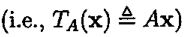 is a linear
traneformation.
(C) The image of the zero vector under any linear transformation is the zero vector.
(D) A function T : R
 is also a linear transfor-
mation.
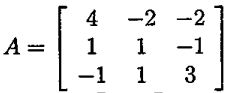 ?(A)
 (B)
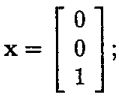 (C)
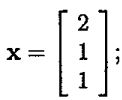 (D)
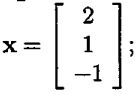
 .
(B) T : R2 →R2 where
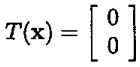 for any vector
 (C) T :P → P where T(f(x)) = f(x)(x2 + 1) for any polynomial
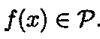 (D) T :
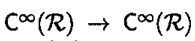 where T(f(x)) = f'(x)+ f(x) for any differentiable function
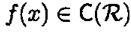 (E) None of the above.
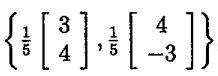 , for R2 with (x,y) -xTy.
(B) {cosz,sin x},for C[0,2π] with (f,g) =
 f(x)g(x)dx.
(C) {1,x,x2] for P3with
 (D)
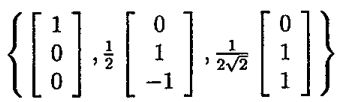 for R3 with (x,y)=xTMy where M =
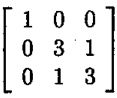 (E) None of the above.
 (E) The set of all n x n square matrices with trace 1, ie,
