所屬科目:研究所、轉學考(插大)◆分子生物學
1. The Watson and Crick model of a double-helical structure for DNA was based on evidence from (A) Atomic force microscopy. (B) Cryo-EM (electron microscopy). (C) NMR (nuclear magnetic resonance) spectroscopy. (D) X-ray crystallography.
2. Nucleotides in an RNA molecule are linked together through (A) Amide bonds. (B) Glycosidic bonds. (C) Hydrogen bonds. (D) Phosphodiester bonds.
3. Which of the following methods can be used for protein sequencing? (A) Mass spectrometry. (B) Sanger sequencing. (C) Two-dimensional (2D) gel electrophoresis. (D) Next generation sequencing (NGS).
4. Which of the following statements about the polymerase chain reaction (PCR) is false? (A) PCR is a technique to make many copies of a specific DNA fragment in vitro. (B) PCR requires one primer designed specifically for the DNA region of interest. (C) PCR relies on a thermostable DNA polymerase, Taq polymerase. (D) PCR is routinely used in DNA cloning, medical diagnostics, and forensic analysis of DNA.
5. The transcriptome is the set of all RNA molecules in one cell or a population of cells. Which of the following methods can be used for transcriptome analysis? (A) DNA microarray. (B) RNA sequencing (RNA-Seq). (C) Serial analysis of gene expression (SAGE). (D) All of the above.
6. When bound to DNA, repressor proteins usually prevent attachment of RNA polymerase to the _____.(A) operon. (B) operator. (C) promoter. (D) regulator.
7. _____ molecules deliver amino acids to ribosomes during translation. (A) Messenger RNA (mRNA). (B) Transfer RNA (tRNA). (C) Ribosomal RNA (rRNA). (D) Heterogeneous nuclear RNA (hnRNA).
8. Which of the following effects may be mediated by transposable elements? (A) Insertion into a gene, causing a mutation. (B) Activation of nearby genes. (C) Formation of genetic deletions. (D) All of the above.
9. ORF refers to (A) the location of the start site of transcription. (B) the region of a gene that codes for a protein or a functional RNA product. (C) the region of a gene that serves as the promoter. (D) the region between the ribosome binding site and translation initiation codon.
10. Two-dimensional gel electrophoresis (A) separates proteins based on their isoelectric pH. (B) separates proteins based on their size. (C) can be used to resolve thousands of proteins in a complex mixture. (D) All of the above
11. A reciprocal exchange in which a pair of DNA with the same nucleotide sequence break and rejoin in a crossover is called _____ recombination. (A) homologous (B) site-specific (C) replicative (D) None of the above
12. In order to express eukaryotic genes in a bacterium, the _____ must first be removed. (A) introns (B) exons (C) enhancers (D) 3' poly (A) sequence
13. What is one statement that would support the theory that all organisms are related? (A) The genetic code is almost universal. (B) Eukaryotes have mitochondria. (C) All organisms have nuclei. (D) Prokaryotes have circular chromosomes.
14. Which one of the following is not an element found in DNA? (A) Oxygen. (B) Sulfer. (C) Nitrogen. (D) Phosphate.
15. The heritable disorder Fragile X syndrome, a major cause of mental retardation, is caused by (A) production of enzymes that break the phosphate backbone. (B) X-ray. (C) presence of an extra chromosome in the sperm or egg. (D) duplication of multiple three-nucleotide repeats.
16. Excision repair corrects DNA by (A) detecting, removing, and replacing damaged or incorrect nucleotides in a single strand of DNA. (B) excising the incorrect base from a nucleotide. (C) removing extraneous groups such as methyl or oxygen added by mutagens. (D) correcting A=T to C-G transitions.
17. Histones and DNA have a strong attraction for each other because (A) DNA is positively charged and histones are negatively charged. (B) both DNA and proteins are hydrophobic. (C) DNA is negatively charged and histones are positively charged. (D) like substances share common charges.
18. Which one of the following is NOT a cis-regulatory element in gene transcription (A) bHLH-type protein. (B) promoter. (C) enhancer. (D) insulator.
19. In order to perform polymerase chain reactions (PCR), which of the following components is required? (A) DNA ligase. (B) Sense and antisense DNA primers encompassing the DNA region of interest. (C) A vector with a selectable marker. (D) An origin of replication specific for the bacterium Thermophilus aquaticus.
20. The Nobel Prize in Physiology or Medicine 2019 was awarded for the discovery of what? (A) Cancer therapy by inhibition of negative immune regulation. (B) How cells sense and adapt to oxygen availability. (C) Mechanisms for autophagy. (D) Molecular mechanisms controlling circadian rhythm.
21. What is NOT true about Sanger sequencing? (A) It was developed by Frederick Sanger and colleagues in 1977. (B) The most widely used sequencing method for approximately 40 years. (C) A method based on in vitro DNA digestion. (D) Incorporation of chain-terminating dideoxynucleotides.
22. What is an "Okazaki fragment"? (A) The strand of nascent DNA which is synthesized in the same direction as the growing replication fork. (B) A short single-stranded nucleic acid utilized by all living organisms in the initiation of DNA synthesis. (C) Short sequences of DNA nucleotides which are synthesized discontinuously and later linked together by the enzyme DNA ligase to create the lagging strand during DNA replication. (D) A particular sequence in a genome at which replication is initiated.
23 The following DNA sequence is a region of a human genome that expresses a protein. If you want to down regulate the gene expression of this protein by making a 30 bp deletion in DNA, which position would be the most appropriate? (A) B. (B) C. (C) E. (D) All of the above.
24. Following the figure in questions 3, if you want to truncate this protein by making a point mutation in DNA, which position would be the most appropriate? (A) B. (B) C. (C) E. (D) All of the above.
25. The first three bases of the 6-base recognition cleavage site of HindIII, a palindromic restriction enzyme, are AAG. What is the complete sequence of this 6 bp site? (A) AAGAAG. (B) AAGCTT. (C) AAGGAA. (D) AAGCUU.
26. Plasmids used in recombinant DNA technology typically (A) possess a gene for antibiotic resistance. (B) replicate independently of the host genome. (C) are circular double stranded molecules. (D) All of the above.
27. What is the advantage of adding SDS to gel electrophoresis? (A) SDS colors the proteins for visualization. (B) SDS reduces disulfide bonds. (C) SDS allows proteins to be separated on the basis of approximate mass. (D) None of the above.
28. For identification of a gene using Southern blot analysis, against which strand of DNA must the probe complement? (A) either the top or bottom strand. (B) only the coding strand. (C) only the template strand. (D) None of the above.
29. Which of the following affect(s) the sedimentation of a particle? (A) mass. (B) shape. (C) the density of the solution. (D) All of the above.
30. "Footprinting" or DNase protection is a technique used to identify (A) a region of DNA that has been damaged by mutation. (B) E. coli cells that contain a desired, cloned piece of DNA. (C) the position of a particular gene of a chromosome. (D) the specific binding site of a repressor, polymerase, or other protein on the DNA.
1. determine
2.progression
3. Instead
4.consequences
5. susceptible
6.Infections
7. created
8.probe
9.various
10.signals
 阿摩線上測驗
登入
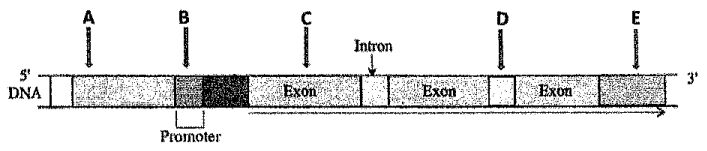 If you want to down regulate the gene expression of this protein by making a 30 bp deletion in DNA, which position would be the most appropriate? (A) B. (B) C. (C) E. (D) All of the above.