所屬科目:中山◆電機◆電磁學
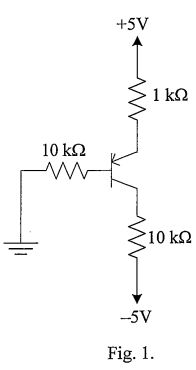
1. (15%) We want to analyze the circuit of Fig. 1 to determine the collector voltage Vc, collector current Ic, and emitter voltage VE. The minimum value of β is specified to be 30. (5%*3)
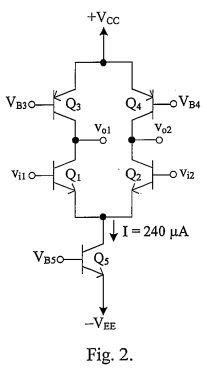
2. (25%) As shown in Fig. 2, a bipolar differential amplifier utilizes a current source (i.e., a single CE transistor Q5) to supply a bias current 240 µA, and current-source loads formed by pnp transistors (Q3and Q4). For all transistors, β = 100 and early voltage |VA| = 10 V. Find (a) gm of Q1, (b) differential gain Ad, (c) input resistance of differential mode Rid and common mode Ricm, (d) CMRR(dB) if the two load transistors exhibit a 1% mismatch in their ro. Thermal voltage is 25 mV. (5%*5)
(a) Find the overdrive voltage Vov and gm of Q1.
(b) Find the differential gain Ad and common mode gain Aicm if the drain resistors have 1% mismatch.
(c) If the input signal source has a small resistance Rsig and thus the frequency response is determined primarily by the output pole, estimate the 3-dB frequency fH.
(d) If, in a different situation, the amplifier is fed symmetrically with a signal source of 20 kΩ resistance (i.e., 10 kΩ in series with each gate terminal), use the open-circuit time-constants method to estimate fH. (5%*6)
4. (30%) Consider a bipolar active-loaded CE amplifier having the load current source implemented with a pnp transistor, Let the circuit be operating at a 1-mA bias current. The transistors are specified as follows: β(npn) = 200, early voltage VAn = 150 V, |VApl = 100 V, Cπ = 15 pF, Cµ = 0.4 pF, CL = 5pF, and base resistance rx = 200 Ω. The amplifier is fed with a signal source having a resistance of 30 kΩ. Determine (a) midband gain AM, (b) input capacitor Cin and high-frequency response fH using the Miller effect, (c) fH using open-circuit time constants, (d) the frequency of the transmission zero fz,and (e) the gain-bandwidth product. Thermal voltage is 25 mV. (5%*6)
 阿摩線上測驗
登入