所屬科目:研究所、轉學考(插大)◆工程數學
(a) Show that the input \(n\) signals are linearly independent.
(b) Please verify that if this mixer performs a linear transformation in this system.
(a) If the period of a set of periodic functions is \(2\pi\), what is the orthonormal basis of the vector space that these periodic functions belong to? You have to show the vectors in the basis are orthonormal to get full credit.
(b) From the spectral theorem, find a vector \(g(x)\) in a subspace spanned by only \(\{1, \cos(x), \cos(2x), \sin(x), \sin(2x)\}\) so that \(g(x)\) has the shortest distance to the function \(f(x) = x\) in the interval \([-\pi, \pi]\).Note: In this problem, you may need: \(\int x \sin ax dx = -\frac{x}{a} \cos ax + \frac{1}{a^2} \sin ax\) and \(\int x \cos ax dx = \frac{x}{a} \sin ax + \frac{1}{a^2} \cos ax\)
(a) The set \(S \triangleq \{ \mathbf{A} \mid \mathbf{A} \in \mathbb{R}^{n \times n}, \mathbf{A}^T = -\mathbf{A} \}\) is not a subspace.
(b) Let \(\mathbf{A}, \mathbf{B} \in \mathbb{R}^{n \times n}\). Suppose the system \(\mathbf{A}\mathbf{x} = \mathbf{0}_n\) has infinitely many solutions and \(\mathbf{B}\mathbf{x} = \mathbf{0}_n\) has only one solution. This implies the system \(\mathbf{A}\mathbf{B}\mathbf{x} = \mathbf{0}_n\) has exactly one solution.
(c) If \(\mathbf{A}\) has an eigenvector \(\mathbf{x}\) with eigenvalue \(\lambda\), then \(\exp(\mathbf{A})\) has \(\mathbf{x}\) as an eigenvector with the eigenvalue \(\exp(\lambda)\).
(d) If \(\mathbf{A}, \mathbf{B} \in \mathbb{R}^{n \times n}\) and \(\mathbf{A}\mathbf{B} - \mathbf{B}\mathbf{A} = \mathbf{A}\), then \(\mathbf{A}\) is singular.
(e) Consider the following linear equations characterized by \(\mathbf{A} \in \mathbb{R}^{m \times n}\):\[\mathbf{A}\mathbf{x} = \mathbf{b}.\]Then \(\widehat{\mathbf{x}} = \mathbf{A}^{\dagger}\mathbf{b} + \mathbf{v}\) is a solution to the above linear equations, where \(\mathbf{A}^{\dagger}\) is the pseudo-inverse of \(\mathbf{A}\) and \(\mathbf{v} \in \mathcal{N}(\mathbf{A})\) (null space of \(\mathbf{A}\)). If your answer is "False", please describe the physical meaning of \(\mathbf{A}\widehat{\mathbf{x}}\).
(a) Consider a new binary random variable \(A\) which is the binary sum of \(a_1\) and \(a_2\), i.e., \(A = a_1 \oplus a_2\). Please show that the log-likelihood ratio of \(A\) defined as , can be expressed as .
(b) Please show that the probability that \(\mathbf{a}\) contains an even number of 1s is \(\frac{1}{2} + \frac{1}{2} \prod_{\ell=0}^{d-1} (1 - 2p_1^{(\ell)})\).
(a) Derive the moment-generating function of \(X\).
(b) If the first moment and second moment of \(X\) are 2 and 20, respectively, find the moment-generating function \(M_Z(t)\) of the random variable \(Z = \frac{(X+6)}{2}\) based on the result obtained from (a).
(c) Based on the result obtained from (b), find the mean and variance of \(Z\).
(d) Find the correlation coefficient between \(X\) and \(Z^2\).
(e) What can you say about the range of the probability of \(Z \ge 10\)?
(f) Assume that Alice try to estimate the mean of \(Z\) based on a random sample \(Z_1, Z_2, \cdots, Z_N\) of size \(N\) taken from the distribution of \(Z\). Find the minimum sample size required to ensure that the estimation error is smaller than 0.5 with a probability of 0.9.
(a) Find \(f_X(x)\).
(b) Find \(f_{XY|A}(x, y)\).
(c) Find \(f_{Y|A}(y)\).
(d) Find \(E[Y|A]\).
 阿摩線上測驗
登入
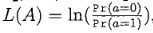 , can be expressed as
 .