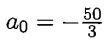
所屬科目:研究所、轉學考(插大)◆工程數學
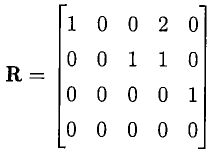
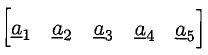
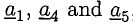
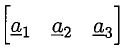
1. Letbe the reduced row echelon form of a matrix A = . Which of thefollowing statements is/are true?(A) is the 4 x 1 zero vector.(B) The three column vectors , are linearly independent.(C) The column space of R is the same as the column space of A.(D) Let B = be a submatrix of A. The reduced row echelon form of B isnot always a submatrix of R.(E) None of the above is true.R=
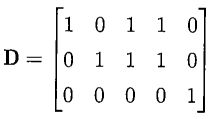
2. Continue from Question -. Which of the following statements is/are true?(A) The nonzero rows of R form a basis for col.(B) Let C be the reduced row echelon form of . Then is the identity matrix.(C) Let E be a 3 x 5 matrix and[10110]D = 01110100001be the reduced row echelon of E. We can obtain the intersection of the right nullspace of A and the right null space of E from R and D without knowing A and E.(D) Let Q be a 5 x 5 matrix and rank(Q) = 3. Then rank(AQ) = 3.(E) None of the above is true.
3.Let U and V be subspaces of and T be a linear transformation from to . Whichof the following sets is/are subspace(s) of ?(A) (B)(C)(D) (E) None of the above is true.
4.Let A, B, and C be n x n matrices for some positive integer n. Which of the followingstatements is/are true?(A) det( A ) = 0 implies det(R) == 0, where R is the reduced row echelon form of A.(B) If AB = CA - , then B = C.(C) If det(AB) 7 0, then A is invertible.(D) rank(AB)=rank(BA).(E) None of the above is true.
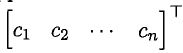
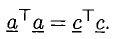
5. Let V be the vector space of all A ∈ , with the operations of matrix addition andmultiplication of a matrix by a real scalar. Let T be a linear transformation from V toY, and (B1,B2,... ,] be a basis for V. Suppose U is a linear transformation from D to given by U(c1B1 + c2B2 +.... +) = Which of the followingstatements is/are true?(A) Let(A1, A2,... ,] be linearly independent over R. The set {U(A1),U(A2),... ,}can be linearly dependent over .(B) Suppose the dimension of the range space of T is k: over IR. Then {T(B1),T(B2),... ,}are linearly independent over .(C) n=m.(D) Let c = U(B1) and a = U(T(B1), then (E) None of the above is true.
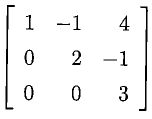
6. For the matrixwhich of the following statements is/are true?(A) rank( A ) = 3.(B) The sum of eigenvalues of A is 6.(C) A is similar to B =(D) The system of linear equations A x = has a solution.(E) None of the above is true.
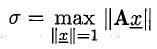
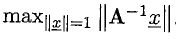
7. For a non-zero matrix A ∈ , deine(1)the maximum Frobenius norm ||A x llover all unit-norm vectors x . Which of the followingstatements is/are true?(A) σ2 is the maximal eigenvalue of .(B) If x0 is an optimal solution to equation (1), i.e, llAx0ll = σ, then there exists a vectorx1 such that Ax1 = 0 and ≠0.(C) Assune m = n and A is nonsingular. Then = .(D) Assume m = n. Then t A is singular only if σ ≥ 1.(E) None of the above is true.
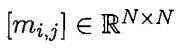
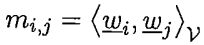
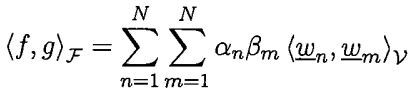
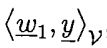
8. Let V together with the inner product (‧,‧)y be an inner product space over . For acollection of N linearly independent vectors [w1 ,...,] in V, let M = bethe corresponding Gram matrix, i.e, the (i, j)-th entry of M is given by Define the following set of real-valued functions f : V →which is a vector space over when combined with standard addition and scalar multiplica-M= 1.8m (2m,3)v tion of real-valued functions. For any f( x ) = in the vector space F, defineWhich of the following statements is/are true?(A) M is positive definite.(B) If m1,1 = 2, m2,2 = 1, and m1,2 = -, then is the vector norm induced by the inner product .(C) (f,g)s is an inner product for elements f,g ∈ F.(D) Given g(y) = , we have = f(ω1) for all f ∈ F.(E) None of the above is true.<f(z) =
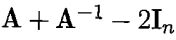
9. Which of the following staternents is/are true?(A) Let x : and y be two non-zero vectors in . The matrix is diagonalizable if≠0.(B) If A is symmetric and positive definite, then , is positive semi-definite.(C) For u,n ∈ such that =, where ⊕ is theoperation of direct sum of two vector spaces.(D) For the real matrix Q = , where u ∈ , we have det(Q) + rank(Q) = n.(E) None of the above is true.
10. Let P ∈ be the orthogonal projection matrix, with respect to the Euclidean innerproduct, of vectors in onto col( A ) for some nonzero matrix A ∈ . Which of thefollowing statements is/are true?(A) ≥rank(P).(B) P can have an eigenvalue larger than 2.(C) Px≠ x for all x e .(D) If k < n and ! e , the system of linear equations Ax = o has a unique least squaressolution.(E) None of the above is true.
11.Consider the first order differential equation xy'(x) = y(x) - with initialcondition y(2) = 0. Which of the following statements is/are true?(A) It is a linear differential equation for the dependent variable y.(B) y(x) is a parabolic function of x.(C) y'(x) =-x.(D) y"(x) =.(E) None of the above is true.
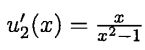
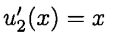
12. For the following homogeneous second order linear differential equation(x2-1)y"(x)-2xy''(x)+2y(x)=0for x > 1, given one solution y1(x) = x, the other linearly independent solution y2(x) canthen be derived by setting y2(x) = v(x)y1(x). Which of the following statements is/aretrue?(A)(x3+x)v"(x)+2v'(x)=0.(B) u(x) with u'(x) = corresponds to one of the possible solutions.(C) u(x) with u'(x) = corresponds to one of the possible solutions.(D) y(x) = 1 + x + x2 is one of the possible solutions.(E) None of the above is true.
13. Continue from Question 十=. Solve the following non-homogeneous second order lineardifferential equation(x2-1)y"(x)-2xy'(x)+2y(x)=x2-1for x > I using the variation of parameters, i.e,, set the particular solution aswhere y1(x) and y2(x) are homogeneous solutions from Question 十二. Which of thefollowing statements is/are true?(A)(B)(C) (D)(E) None of the above is true.
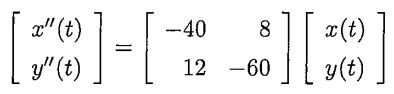
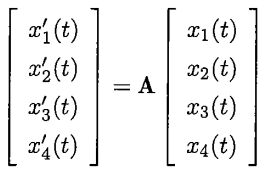
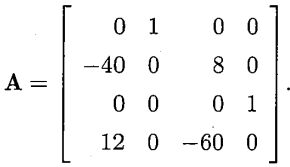
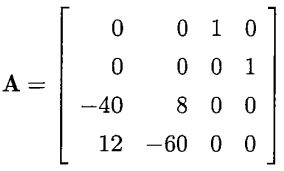
14. The following second order system
can be transformed into an equivalent first order system
for some real matrix A by introducing the four functions x1(t)= x(t),x2(t)=x'(t),x3(t) = y(t) and x4(t) = y'(t). Which of the following statements is/are true?(A) (B)(C) -36 is one of the eigenvalues of A.(D) 8 is one of the eigenvalues of A.(E) None of the above is true.
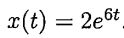
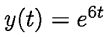
15. Continue from Question +e. Find the particular solution of the second order system inequation (2) with initial conditions z(0) = 2, x'(0) = 12, y(0) = 1 and y'(0) = 6. Whichof the following statements is/are true?(A) .(B) (t)=2cos(6t) +2sin(6t).(C).(D) y(t) = cos(6t) + sin(6t).(E) None of the above is true.
16. Consider the following second order differential equation3t2y"(t) + sin(t)y'(t) - cos(t)w(t) =0.
be two linearly independent Frobeniusseries solution for y(t) in the above differential equation when t > 0. Assuming r1≥ r2and a0 = 1, which of the following statements is/are true regarding the solution y1(t)?(A) r1 =1.(B) (C) (D) (E) None of the above is true.
17.Continue from Question 十六.Assuming b0 = 2, which of the following statements is/aretrue regarding the solution y2(t)?(A) (B) b1=0(C)(D)(E) None of the above is true.
18.Consider the following differential equation for the function y(t) defined for t ≥ 0where u(t) is the usual unit-step (Heaviside) function and where * is the usual convolutionaloperation of two functions. Assume y(t) = 0 for t < 0. Given the initial conditiony(0) = 1, which of the following staterents is/are true regarding the Laplace transformY(s) = ((t)] of solution y(t) in the above equation?(A) Y(s= )= -6(B) Y(s=1)=1(C) Y(s=2)=(D) Y(s=3)=(E) None of the above is true.
19. Continue from Question t十八. Which of the following statements is/are true regardingthe solution y(t)?(A) y'(1) =1(B) y'(π) =1(C) y"(1) = -1(D) y"(π)=0(E) None of the above is true.
20、Consider the following partial differential equation for the bivariate function v(x, t), 0 ≤ x ≤ 10, t ≥ 0subject to conditionsExpress the solution v(x, t) in the following form
for some constants , ∈ satisfying 0 ≤ r0<r1>r2<... > 0 for n = 1, 2,... Which of the following statements is/are true?(A)(B)(C) (D) (E) None of the above is true.
 阿摩線上測驗
登入
 . Which of the
 is the 4 x 1 zero vector.
 , are linearly independent.
 be a submatrix of A. The reduced row echelon form of B is
 .
 . Then
 is the identity matrix.
 and T be a linear transformation from
 to
 . Which
 ?




 , then B = C.
 , with the operations of matrix addition and
 ] be a basis for V. Suppose U is a linear transformation from D to
 given by U(c1B1 + c2B2 +.... +
 ) =
 Which of the following
 ] be linearly independent over R. The set {U(A1),U(A2),... ,
 }
 .
 }
 .

 has a solution.
 , deine
 (1)
 .
 ≠0.
 =
 .
 t A is singular only if σ ≥ 1.
 . For a
 ] in V, let M =
 be


 when combined with standard addition and scalar multiplica-

 , then
 is the vector norm induced by the inner product
 .
 , we have
 = f(
 . The matrix
 is diagonalizable if
 ≠0.
 is symmetric and positive definite, then
 , is positive semi-
 such that
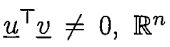 =
 , where ⊕ is the
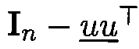 , where
 , we have det(Q) + rank(Q) = n.
 be the orthogonal projection matrix, with respect to the Euclidean inner
 onto col( A ) for some nonzero matrix A ∈
 . Which of the
 ≥rank(P).
 .
 , the system of linear equations A
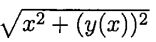 with initial
 .
 corresponds to one of the possible solutions.
 corresponds to one of the possible solutions.

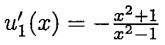

 .
 .



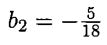
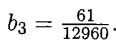

 ((t)] of solution y(t) in the above equation?
 )= -6


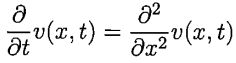 , 0 ≤ x ≤ 10, t ≥ 0


 , ∈
 satisfying 0 ≤ r0<r1>r2<...
 > 0 for n = 1, 2,... Which of the following statements is/are true?