所屬科目:研究所、轉學考(插大)-材料科學
1. What processing is often utilized to enhance the mechanical properties of metal during fabrication procedures? (A) grain growth, (B) thickness thinning, (C) recrystallization, (D) strain hardening, and (E) high-temperature annealing
2. When two atoms are separated in an equilibrium status in a solid, which description for the potential energy of the solid is correct? (A) at lowest, (B) at highest, (C) at the middle, (D) uncertain, and (E) none of the above.
3. Which is the slip system for the Face-Centered Cubic (FCC) structure? (A) {100}(110),(B) {100}(111), (C) {110}(110), (D) {110}(111), and (E) {111}(110)
4. Which one is correct in the following description about diffusion: (A) interstitial diffusion is usually not as fast as vacancy diffusion; (B) interstitial atoms are smaller, so their mobility is less; (C) copper-nickel interdiffusion belongs to interstitial diffusion, (D) carbon-iron interdiffusion belongs to interstitial diffusion, and (E) interstitial diffusion cannot occur at concentration equilibrium.
5. If it is hard to move the dislocation in metal, the metal may be (A) heavy, (B) fragile,(C) deformable, (D) at high-temperature annealing, and (E) immersion in oil.
6. Which one among the descriptions about deformation is correct: (A) elastic deformation is time-dependent and permanent, (B) elastic deformation is time- dependent and temporary, (C) inelastic deformation is time-independent and permanent, (D) inelastic deformation is time-dependent and temporary, and (E) none of the above.
7. How can you change the activation energy of diffusion in a solid? (A) to reduce temperature, (B) to short the processing time, (C) to change diffusing species, (D) to increase the concentration, and (E) it is not possible to change.
8. The number of atoms per unit cell in the face-centered cubic (FCC) structure is (A) 2,(B) 4, (C) 6, (D) 8, and (E) 10.
9. In a solid, atoms may be held together by (A) the repulse between the atomic cores, (B) electron share between adjacent pairs of atoms, (C) the proton share of the adjacent pairs of atoms, (D) the neutron share of the adjacent pairs of atoms, and (E) none of the above.
10. Which solid is isotropic if its structure is (A) amorphous, (B) HCP, (C) FCC, (D) polycrystalline, and (E) BCC.
11. Which one is not belong to interfacial defects? (A) grain boundaries, (B) phase boundaries, (C) twin boundaries, (D) external surfaces, and (E) point defect
12. Which beam does not suit for using in a diffractometer for the determination of crystal structures? (A) electron, (B) infrared ray, (C) x-ray, (D) neutron, and (E) none of the above.
13. The plastic deformation appeared on the ductility of a metal is often (A) at a high degree, (B) very little, (C) not occurred, (D) dependent, and (E) all of the above
14. During recovery, the dislocations in the solid may be at the condition of (A) motion, (B) a high-energy configuration, (C) the increase of density, (D) transition to another type, and (E) all of the above.
15. What is the driving force for steady-state diffusion? (A) concentration gradient, (B) concentration, (C) electrical properties of materials, (D) diffusion coefficient, and (E) applied electric field.
16. What is the consideration for making integrated circuit interconnects normally by aluminum but not by copper, silver, or gold that have higher electrical conductivities? (A) diffusion, (B) melt temperature of metals, (C) cost price, (D) metal strength, and (E) metal ductibility.
17. The proportional limit in the stress-strain curve is the initial departure from linearity happens at (A) the fracture point of materials, (B) the range of elastic deformation, (C) the point of phase transformation, (D) the point of yielding, and (E) the melting point.
18. The smaller grains in metal materials may increase the material strength because (A) grain boundaries is the barrier for dislocation motion, (B) grain boundary may change the dislocation's direction of motion, (C) grain boundary may make the discontinuity of slop planes, (D) smaller grains have more grain boundaries, and (E) all of the above.
19. The process of fatigue failure is characterized by the steps including (A) initial crack forms at the forced point once the load is applied, (B) the advancing creak from the initial stage has reached a critical size during the stress cycle, (C) the crack propagation is stopped by the plastic formation due to the interaction of dislocations, (D) increasing temperature owning to stress cycle melts the bend location, and (E) all of the above.
20. The most significant factor that affects the type of bonds of materials is (A) material chemistry, (B) material physics, (C) electronic configuration (D) Fermi level, and (E) atomic attractive force.
21. Vacancies play an important role in (A) deformation twinning, (B), cross-slip, (C) self-diffusion, (D), cold work, (E) re-crystallization.
22. Which is the type of dislocation belonging to among the defects in a crystal material: (A) point, (B) line, (C) boundary, (D) surface, (E) volume
23. Which material in the following can be strain-hardened after its plastic deformation at room temperature: (A) lead (Pb), (B) tin (Sn), (C) corundum (aluminum oxide), (D) steel (Fe), (E) polyethylene (PE).
24. Recrystallization is (A) used to increase the strength of the material, (B) classified as one of the stages in the process of cold work, (C) useful to increase the ductility, (D) to increase the density of dislocation, (E) on the purpose for grain growth.
25. Which material shows anisotropic property: (A) amorphous carbon, (B) Si, (C) Graphite, (D) Cu, (E) Ge.
26. Refer to the following the phase diagram of iron-carbon alloy, What is the eutectic point? (A) B (B) D (C) G (D) Η ( Ε ) Κ?
27. Which of the following technology is able to observe the distribution of vacancy and dislocations in a crystal materials: (A) optical microscopy, (B) Transmission Electron Microscopy (TEM), (C) Scanning Electron Microscopy (SEM), (D) X-ray diffraction (XRD), (E) None of the above.
28. For the precipitation hardening heat treatment, what microstructure will NOT be produced after precipitation? (A)Equilibrium supersaturation phase, (B)Meta-stable phase, (C)Supersaturation phase, (D)Equilibrium phase, (E) None of the above.
29. Which one is the main plastic deformation mechanisms of metals at low temperature? (A)Slip and creep, (B) Slip and twin deformation, (C) Creep and Grain boundary Sliding, (D) Slip and Grain boundary Sliding, (E) Twin deformation and Grain boundary Sliding.
30. For the steel, a measurement of the ability to form martensite is: (A)Tensile test,(B)Hardness test, (C)Creep test, (D)Hardenability test, (E)Fatigue test.
31. In a corrosive environment, which statement below is wrong: (A)Cold-worked metals are more susceptible to corrosion than noncold-worked, (B)Fe is more active than Au, (C)A small anode-to-cathode area ratio is good design, (D)For a metal corrosion process, metal acts as anode; oxygen or water acts as cathode, (E)None of above.
32. Which of the following processes can NOT be applied to improve the fatigue performance of a metallic component? (A)Induce residual compressive stress, (B)Nitriding (C)Shot peenig, (D) Carburizing, (E) Induce residual tensile stress.
33. Which is NOT the characterization of refractory metals? (A)High melting temperature, (B)Large elastic moduli, (C)High strength and hardness at ambient, (D)Low strength and hardness at elevated temperature, (E) Strong Interatomic bonding.
34. In general, which of the following crystal structures of metal is the most ductile? (A) BCC, (B) Teragonal, (C) FCC, (D) HCP, (E) None of the above.
35. Comparing the electrical conductivity of a crystalline metal and its noncrystalline counterpart, which one has higher resistivity?(A) crystalline one; (B) noncrystalline one; (C) unable to measure; (D) similar value; (E) none of the above.
36. What is the crystal structure of ferrite? (A) SC (B) BCC (C) FCC (D) HCP (E) Diamond.
37. What is the composition of pearlite? (A) Fe2O3 + ferrite (B) Fe3C + austenite (C) FeO2 austenite (D) SiC + ferrite (E) Fe3C + ferrite
38. Rapidly cool to 250°C, hold for 1,000 s, then quench to room temperature. The final microstructure consists of (A) 80% martensite and 20% austenite (B) 80% martensite and 20% pearlite (C) 100% martensite (D) 80% austenite and 20% pearlite (E) 20% austenite and 80% pearlite.
39. Rapidly cool to 700°C, hold for 25 s, then quench to room temperature. The final microstructure consists of (A) martensite and pearlite (B) martensite and proeutectoid ferrite (C) martensite and bainite (D) austenite and pearlite (E) austenite and proeutectoid ferrite.
40. Rapidly cool to 650°C, hold at this temperature for 3 s, rapidly cool to 398°C, hold for10 s, then quench to room temperature. The final microstructure consists of (A) ferrite and pearlite (B) bainite and martensite (C) ferrite and bainite (D) ferrite, pearlite and bainite (E) ferrite, bainite, martensite, and pearlite
 阿摩線上測驗
登入
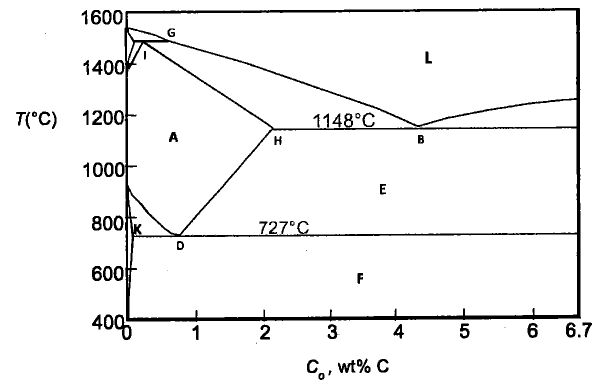 (A) B (B) D (C) G (D) Η ( Ε ) Κ?