所屬科目:清大◆化工◆化工熱力學及化學反應工程
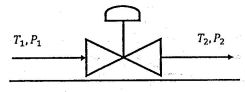
1. If the fluid is an incompressible liquid, which of the following statement
is true?(A) T2 >T1(B) T2 1(C) T2 =T1
2. If the fluid is an incompressible liquid, which of the following statement
is true?(A) U2 > U1(B) U2 1(C) U2 =U1
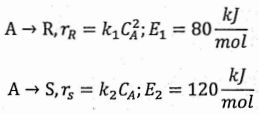
11. For the liquid phase parallel reactions:The desired product is R. The higher selectivity of R will be achieved, if. The reaction is conducted at (A) The low temperature in an ideal continuous stirred tank reactor (CSTR) (B) The high temperature in an ideal continuous stirred tank reactor (CSTR) (C) The low temperature in an ideal plug flow reactor (PFR) (D) The high temperature in an ideal plug flow reactor (PFR) mol
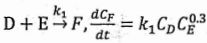
12. The desired liquid-phase reaction , is accompanied by the side reaction ,from dt the standpoint of favourable product distribution, the most desirable contacting scheme is (A) An ideal plug flow reactor (PFR) with the mainstream of '"D" and "E" (B) An ideal plug flow reactor (PFR) with the mainstream of "D" and side stream of "E" (C) An ideal plug flow reactor (PFR) with the mainstream of "E" and side stream of "D" (D) An ideal mixed flow reactor (MFR) with the mainstream of "D" and "E"
13. For the uni-molecular type elementary reactions, the fractional yield of B in MFR for the given conversion of A (A) remains constant with increase in k2/k1 (B) increases with the increase in k2/k1 (C) decreases with the increase in k2/k1 (D) increase linearly with increase in k2/k1
14. Consider the liquid phase reactions shown in the schematic below carried out in a flow reactor at steady state.Keeping the reaction system isothermal, the yield of the desired product can be maximized by maintaining Keeping the reaction system isothermal, the yield of the desired product can be maximized by maintaining (A) Low concentration of A and high concentration of B (B) The high concentration of A and high concentration of B (C) Low concentration of B and low concentration of B (D) The high concentration of A and low concentration of B
15. For the irreversible elementary reaction in parallel is, the rate of disappearance of reactant A is given by (A)(k1-k2)CA (B) (k1+k2)CA (C)0.5(k1+k2)CA (D) kICA
Problem 3 (10%) (a) (8) A vessel, divided into two parts by a partition, contains 4 mol of A gas at 350K and 30 bar on one side and 3 mol of B gas at 350K and 20 bar on the other. If the partition is removed and the gases mix completely to form a gas mixture also at 350K, what are the changes in enthalpy, entropy and Gibbs free energy? Assume both A and B gases are ideal gases with Cv = 2.5R. R = (b) (2) The enthalpy of a C-D binary system at fixed T and P is represented by the equation: H = 600xc + 400xD+xcxD(40xc+20xD). Is this binary system an ideal solution? Why or why not?
(c) Draw the curves of Gibb free energy Vs. composition for both gas and liquid phases at 75℃.
(d) Draw the curves of Gibb free energy VS. composition for both gas and liquid phases at 70℃.
(e) Draw the curves of Gibb free energy Vs. composition for both gas and liquid phases at 65℃.
Problem 5 (10%) A gas-phase, reversible reaction, , with both rate constants obeying the Arrhenius Law. Please show that the difference of activation energy between forward (k1) and backward (k2) rate constants is equal to the reaction enthalpy; i.e., indicate the activation energy of the forward and backward rate constants, respectively.
Problem 7(10%) The elementary irreversible gas phase catalytic reaction A-B is carried out isothermally in a batch reactor with rate constant of 0.2 dm3/kgcat *min at 300K. The catalyst deactivation follows a first order decay law (with decay rate constant of 0.1 at 300K) and is independent of the concentrations of both A and B. Calculate the conversion in the reactor after 10 minutes at 300 K. Additional Information:
Initial concentration of A = 1 mol/dm3
Batch reactor volume (V0) = 1 dm3 Catalyst weight (W)= 1 kg
 阿摩線上測驗
登入
 , is
accompanied by the side reaction
 ,from dt
the standpoint of favourable product distribution, the most desirable
contacting scheme is
(A) An ideal plug flow reactor (PFR) with the mainstream of '"D" and "E"
(B) An ideal plug flow reactor (PFR) with the mainstream of "D" and side
stream of "E"
(C) An ideal plug flow reactor (PFR) with the mainstream of "E" and side
stream of "D"
(D) An ideal mixed flow reactor (MFR) with the mainstream of "D" and
"E"
 , the
fractional yield of B in MFR for the given conversion of A
(A) remains constant with increase in k2/k1 (B) increases with the increase in k2/k1 (C) decreases with the increase in k2/k1 (D) increase linearly with increase in k2/k1
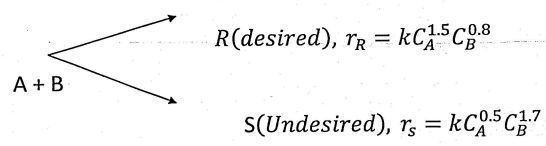 Keeping the reaction system isothermal, the yield of the desired product
can be maximized by maintaining
Keeping the reaction system isothermal, the yield of the desired product
can be maximized by maintaining
(A) Low concentration of A and high concentration of B
(B) The high concentration of A and high concentration of B
(C) Low concentration of B and low concentration of B
(D) The high concentration of A and low concentration of B
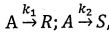 , the rate of disappearance of reactant A is given by
(A)(k1-k2)CA
(B) (k1+k2)CA
(C)0.5(k1+k2)CA
(D) kICA
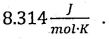 (b) (2) The enthalpy of a C-D binary
system at fixed T and P is represented by the equation: H = 600xc + 400xD+xcxD(40xc+20xD). Is this binary system an ideal solution?
Why or why not?
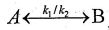 , with both rate constants obeying the Arrhenius Law. Please show that the difference of activation energy between forward (k1) and backward (k2) rate constants is equal to the reaction enthalpy; i.e.,
 indicate the activation energy of the forward and backward rate constants, respectively.
 If the rate constant (k) for this reaction is 3.50 L/mol-h at the operation temperature. The final conversion is 0.75. If the total volume of these three reactors is 9300 L, what is the volume flow rate (in L/h) to the first reactor? What are the conversions in reactors 1 and 2?
 at 300K) and is independent of the concentrations of both A and B. Calculate the conversion in the reactor after 10 minutes at 300 K. Additional Information:
 = 1 mol/dm3