所屬科目:研究所、轉學考(插大)◆工程數學
11. (10%) Consider a matrixWhich of the following is an eigenvalue of this matrix M? (A)1 (B)-3 (C)9 (D) -1+2j (E) -1+4j
12. (10%) Consider the matrix M in (t). It is known that M has four distinct eigenvalues, and let us denote the four corresponding cigenvectors as Which of the following mattices also has as its eigenvectors? (A) (B) (C) (D)(E)
13. (10%) Consider the subspace S = span( B ) spanned by the following elements in the vector space : Which of the following does not belong to S?(A)(B)(C)(D)(E)
14. (10%) Let S = span( B ) be a subspace of the vector space and B is defined as in (t). Consider the following mappings: Choose the correct statement(s) from the following. (A) Both T, and Tz are linear transforms from S to. (B) Ts is a linear transform from S to . (C) The range of T1is a subspace of and its dimension is 2. (D) The range of T2 is a subspace of and its dimension is 2. (E) The range of T3 is a subspace of and its dimension is 2.
15. (10%) For n > 1, let Sn denote the set of all symmetric matrices and Tn denote the set of all skew-symmetric matrices, that is, Tn = {A | A is a n x n matrix such that AT = -A}. Let U be a n x n matrix such that UTU = In. Furthermore, let Wu ={M I M is a n x n matrix such that UTMU is a diagonal matrix}. For a n xn matrix A, let Au denote the unique matrix B in Wu such that is minimized. Choose the correct statement(s) from the following. (A) Sn is a subspace of and its dimension is n. (B) T. is a subspace of and its dimension is n. (C) WU is a subspace of and its dimension is n. (D)(E)
1. (5%) Let A and B be two n x n syinmetric matrices, n ≥ 1. Then, rank(AB) = rank(BA).
4. (5%) Let A be a n x n invertible matrix, n≥ 1. Let u be an eigenvector of A. Then, u is also an eigenvector of .
5. (5%) Let A, B be n x n matrices, n ≥ 1, andλ be an eigenvalue of the matrix product AB. Then, λis also an eigenvalue of the matrix product BA.
6. (5%) Let A be a n x n symmetric matrix, n ≥ 1, and λ be an eigenvalue of A. Then, A is a real number.
7. (5%) Let A be a n x n skew-symmetric matrix, n ≥ 1, that is, AT = -A. Then, det(A)≥0.
8. (5%) Consider a system of linear equations At = b, where A is a 2 x 3 matrix, I is a 3 x 1 column vector, and b is a 2 X 1 column vector. LetIn other words, all entries of A are non-zero. Then, it is impossible to uniquely determine t1 from the above system of linear equations.
9. (5%) Let S1 and S2 be subspaces ofRn and S = S1+ S2, the sum of the two subspaces. Let D1 = , the set of elements in S but not in S2. Then, D1 is also a subspace, and its dimension dim(D1) = dim(S1).
10. (5%) Let S be a subspace of Rn, n > 1. Let dim(S) = m, 1 <m <n. Let A be a n xn diagonal matrix with positive diagonal entries, but not all entries are equal. Consider the following set: Then, T is also a subspace, and its dimension dim(T) = n - m.
 阿摩線上測驗
登入
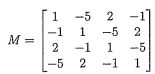 Which of the following is an eigenvalue of this matrix M? (A)1 (B)-3 (C)9 (D) -1+2j (E) -1+4j
 Which of the following mattices also has
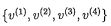 as its eigenvectors?
(A)
 (B)
 (C)
 (D)
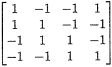 (E)
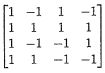
 :

 (B)
 (C)
 (D)
 (E)

 and B is defined as in (t). Consider the following mappings:
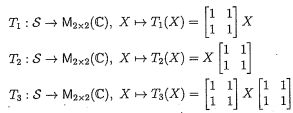 Choose the correct statement(s) from the following. (A) Both T, and Tz are linear transforms from S to
 is minimized. Choose the correct statement(s) from the following.
 and its dimension is n. (B) T. is a subspace of
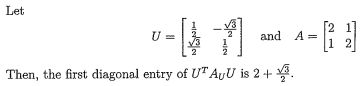 (E)
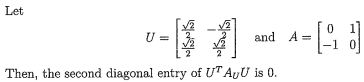
 .
 In other words, all entries of A are non-zero. Then, it is impossible to uniquely determine t1 from the above system of linear equations.
 , the set of elements in S but not in S2.
