所屬科目:研究所、轉學考(插大)◆流體力學及熱傳學
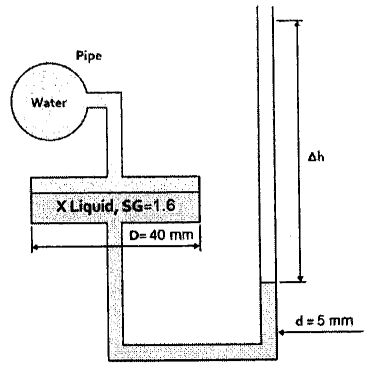
1.如圖所示系統可用來量測水壓力之增加值△p,試問:當系統其XLiquid 液面高度上升 80mm(△h=80mm)時,水槽壓力改變量△p為何? (25%)
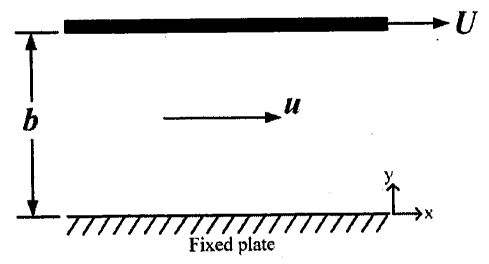
2. Two horizontal, infinite, parallel plates are spaced a distance b apart, please see the following figure. A viscous liquid is contained between the plates. The bottom plate is fixed (y = 0), and the upper plate (y = b) moves parallel to the bottom plate with a velocity U. Because of the no-slip boundary condition, the liquid motion is caused by the liquid being dragged along by the moving boundary. Assuming that there is no pressure gradient in the direction of flow (x-direction) and the flow is steady and incompressible without the y-component velocity. (a) Derive the governing equation of the above 2-D flow from the x-direction Navier-Stokes equation (see below). (b) Determine the velocity distribution between the plates. (c) Determine an expression for the flowrate per unit width passing between the plates. Express your answers of (b) and (c) in terms of b and U. (25%)
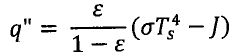
4. The net radiative heat flux at the surface of an opaque medium can be evaluated using the rollowing equation if the absorptivity of the medium is cqual to its emissivity where E is the emissivity, o the Stefan-Boltzmann constant, Ts the surface temperature and J the radiosity. This equation seems to predict a very large radiative heat flux for a blackbody that (5%) hasε = 1. Please explain.
5. What are the definitions of the following terms? (10%) (a) Friction coefficient; (b) Biot number; (c) Stanton number; (d) Nusselt number; (e) Prandtl number. [Example]: Reynolds number, ReD= puD/μ, where r: fluid density, u: flow velocity, D: tube diameter, and u: fluid viscosity.
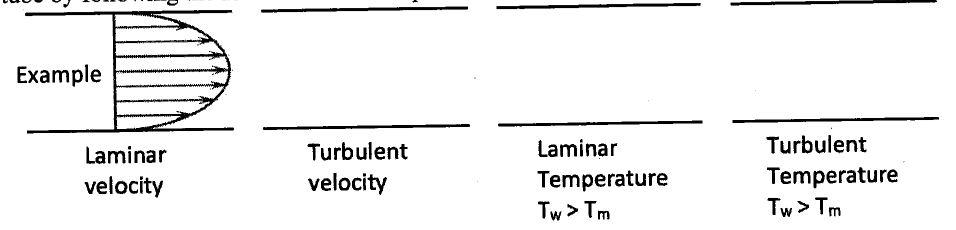
6. Please sketch the velocity and temperature profiles of laminar and turbulent flows in a circular tube by following the format of the example.(6%)
 阿摩線上測驗
登入