所屬科目:研究所、轉學考(插大)◆基礎熱傳學
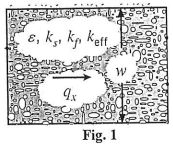
1. (10%) For a porous medium (Fig. 1), determine the range of the "effective" thermal conductivity (ε: Volume fraction of fluid, ks: Solid thermal conductivity, and kf. Fluid thermal conductivity.)
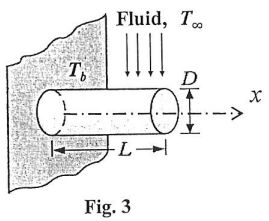
4. (20%) Derive the temperature distribution and fin efficiency for a pin fin, as shown in Fig. 3, with adiabatic boundary at x=L. The pin base temperature (x=0) is Tb. (Write down your assumption and derivation in detail.)
5. (20%) For a heat transfer problem, the energy equation can be simplified and expressed asnon-dimensionally, and the boundary and initial conditions are=forallt≥ 0, and θ(x, 0) = Solve the non-dimensional temperature θ.
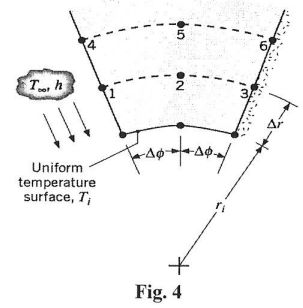
6. (15%) In a two-dimensional cylindrical configuration, the radial (△r) and angular (△Φ) spacings of the nodes are uniform. The inner boundary at r = riis of uniform temperature Ti. The boundaries in the radial direction are adiabatic (insulated) and exposed to surface convection (T∞, h), as illustrated in Fig. 4. Derive the finite-difference equations for (i) node 1, (il) node 2, and (iii) node 3.
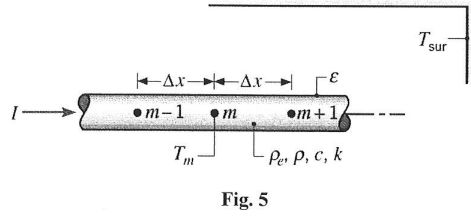
7.(15%) A thin rod of diameter D, shown in Fig. 5, is initially in equilibrium with its surroundings, a large vacuum enclosure at temperature Tsur. Suddenly, an electrical current I (Ampere) is passed through the rod having an electrical resistivity ρe (Ωㆍ m) and emissivity ε. Other pertinent thermophysical properties are identified in Fig. 5. Derive the transient, finite-difference equation for node m. (P.S.: The resistance: Length, A: Area)
 阿摩線上測驗
登入
 (ε: Volume fraction of fluid, ks: Solid thermal conductivity, and kf. Fluid thermal conductivity.)
 non-dimensionally, and the boundary and initial conditions are
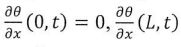 =forallt≥ 0, and θ(x, 0) =
 Solve the non-dimensional temperature θ.
 : Length, A: Area)