所屬科目:研究所、轉學考(插大)◆材料力學
1. (10 Points) A 6-m long by 50-mm diameter rod of aluminum alloy (E = 70 GPa, a = 22.5 x /℃, and v = 0.346) is attached at the ends to supports that yield to permit a change of 1.0 mm in the rod when stressed. When the temperature is 35℃, there is no stress in the rod. After the temperature of the rod drops to - 20 ℃, determine (a) the maximum normal stress in the rod and (b) the change in diameter of the rod.
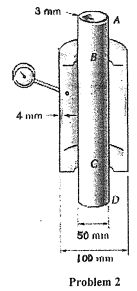
2. (10 Points) The brass pipe AD is fitted with a jacket used to apply a hydrostatic pressure of 3.5 MPa to portion BC of the pipe. Knowing that the pressure inside the pipe is 0.7 MPa, determine the maximumn normal stress in the pipe.
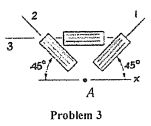
3. (20 Points) Determine the stress state and the corresponding von Mises cquivalent stress of the point A subjected to the plane-strain condition, knowing that the following strains have been obtained by the use of the rosette shown: ε1 = -50 x. Assume that Young's modulus and Poisson's ratio of the material are 200 GPa and 0.3, respectively.
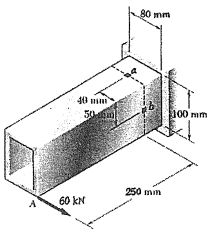
4. (20 Points) The structural tube shown has a uniform wall thickness of 8 mm. Knowing that the 60-kN load is applied 4 mm above the base of the tube, determine the stress state at point a.
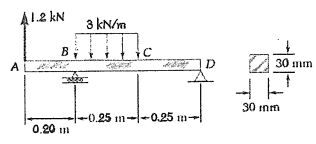
5. (20 Points) Knowing that the beam AD is made of a solid steel bar. Determnine (a) the slope at point B, (b) the deflection at point A. Use Young's modulus as 200 GPa.
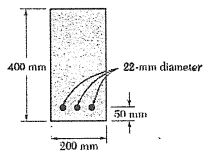
6. (20 Points) A concrete beam is reinforced by three stee! rods placed as shown. The modulus of elasticity is 20 GPa for the concrete and 200 GPa for the steel. Using an allowable stress of 9 MPa for the concrete and 140 MPa for the steel, determine the largest allowable positive bending moment in the beam.
 阿摩線上測驗
登入
 /℃, and v = 0.346) is attached at the ends to supports that yield to permit a change of 1.0 mm in the rod when stressed. When the temperature is 35℃, there is no stress in the rod. After the temperature of the rod drops to - 20 ℃, determine (a) the maximum normal stress in the rod and (b) the change in diameter of the rod.
 . Assume that Young's modulus and Poisson's ratio of the material are 200 GPa and 0.3, respectively.