所屬科目:研究所、轉學考(插大)◆總體經濟學
1 (5 points) Define st as output per effective worker, i.e., and k as capital per effiective worker, i.e, . Uise the constant return to scale production function to express the relationship between y and k.
2 (5 points) Derive the law of motion for capital per effective worker, express the relationship in terms of saving rate and depreciation rate and growth rate of labor-augmenting productivity. Compute the steady-state quantity of capital per effective worker and output per effective worker in terms of s, σ, andγs.
2 The labor search model (25 points) Assume the workers in the model are all in the labor force. That is, the workers are either employed or unemployed, with U denoting the fractions of workers who are unemployed, and (1 - U) the fraction who are employed. The jobs of the employed differ according to the wage that they are paid. Each period, there is a probability p that the unemployed worker can draw one job offer from the wage distribution, . The worker has the option to reject the offer, in which case, he or she receives unemployment compensation. Alternatively, the worker can accept the offer to work at w, in which case, he or she receives w each period. Let denote the expected value for a worker who has offer with wage w in hand. is an increasing and concave function of wage, u. In addition, Vu denotes the value of the unemployed worker, which is assunned to equal b. In the model, there will be fows between the pool of employed workers and the pool of unemployed worker. Some employed workers will be separated from their jobs and become unemployed, while some nnemployed workers will receive job offers that are suficiently attractive to accept. 1 (5 points) Let the reservation wage be defined as the wage such that the worker is indifferent between accepting and rejecting an offer. Please write down the equation that pins down the reservation wage in the model. Use the reservation wage to characterize the decision regarding accepting the job offer or not.
3. Asset Pricing (25 points) Consider an endowment economy with two periods, t = 0, 1. There are agents with mass one, and an agent endows units of consumption goods at the beginning of period t = 0, 1. The consumption good is nondurable and will vanish after it is consumed. The agent's lifetime utility iswhere ct is the consumption at period t, andis the time discount factor. There is a bond market that opens at period O, and agents can purchase or issue one-period real bonds at the market. A one-period real bond issued at period O matures at period 1, and the issuer of the bond must pay 1 unit of consumption goods to the bond holder when the bond matures. The bond market is competitive, Let bo denote an agent's net purchases of the bond, and let qo denote the equilibrium price of the one-period real bond in terrns of period O consumption goods. Then the agent's period O and period 1 budget constraints are Note that the agents are the only participants in the bond market, but there is no government or any other people outside the economy engaging in the market. (a) (10 points) Solve for the equilibrium price of the one-period real bond, qo.
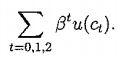
(b) (10 points) Now we change the model to make it three-period, so t = 0, 1,2. An agent endows units of consumption goods at the beginning of period t = 0, 1,2. The agent's lifetime utility becomes Besides the one-period real bond, an agent can also purchase or issue a two-period real bond at the credit market at period 0. The two-period real bond is a zero-coupon bond. That means the issuer of a two-period bond pays 1 unit of consumption goods to the bond holder at period 2, but the issuer does not pay any interest at period I to the bond holder. Solve for the equilibrium price of the two-period real bond at period 0.
(c) (5 points) Now we introduce one more good, the houses, into the economy. As in question (b), an agent endows units of consumption goods at the beginning of period t = 0, 1, 2. Moreover, an agent also owns e units of houses in the beginning of period 0. Houses are divisible, and houses provide living services to their holders: let h, denote an agent's holding of houses at the beginning of each period, then holding ht unit of houses generates ou(h.) units of utility to the agent. Where a > O represents the relative importance of housing utility to consumption utility. We assume that houses are perfectly durable, and that means houses do not vanish or depreciate over time or after they provide the living service. Let an agent's consumption be ct, and let her house holdings at the beginning of a period be ha, then the agent's lifetime utility After agents receive the living service in each period, the housing market opens. The housing market allows agents to exchange between houses and consumption goods. Let pt denote the price of houses in terms of consumption goods at period t. Solve for po and p1.
(b) (5 points) Now we extend the benchmark model to assume that housebolds are heterogeneous. Consider that half of the bouseholds are type 1, and half of the households are type 2, Type 1 and type 2 value consumptions differently, and this is captured by their difference in the parameter 7. Type I households' utility is and type 2 households' utility is
(c) (10 points) We further extend the model by introducing a government into the economy. The government charges a proportional tax on wage income. That is, suppose that a household's wage income is wn, then the government takes away tun from the household. The government transfers the tax revenue to all houscholds equally in a lump sum manner. How does the proportional tax on wage infuence the consumption equality? Explain your answer.
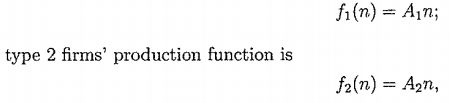
(d) (5 points) Now we go back to the benchmark economy with homogenous households; that is, now the parameter 7 is the same among households, and there is no government, tax, or transfer. However, we consider that firms are heterogeneous. That is, there are two types of firms. Type 1 firms' production function is and A1 > A2. Solve for the equilibrium wage rate and type 1 firms' and type 2 firrns' labor hiring in units of working hours.
 阿摩線上測驗
登入
 and k as capital per effiective
worker, i.e,
 . Uise the constant return to scale production function to express the
relationship between y and k.
 . The worker has the option to reject the offer, in which
case, he or she receives unemployment compensation. Alternatively, the worker can accept the offer
to work at w, in which case, he or she receives w each period. Let
 denote the expected value
for a worker who has offer with wage w in hand.
 units of consumption goods at the beginning of period t = 0, 1. The consumption
good is nondurable and will vanish after it is consumed. The agent's lifetime utility is

 is the time discount factor. There is a bond
market that opens at period O, and agents can purchase or issue one-period real bonds at the market.
A one-period real bond issued at period O matures at period 1, and the issuer of the bond must pay
1 unit of consumption goods to the bond holder when the bond matures.

 units of consumption goods at the beginning of period t = 0, 1,2. The agent's lifetime
utility becomes
 Besides the one-period real bond, an agent can also purchase or issue a two-period real bond at
the credit market at period 0. The two-period real bond is a zero-coupon bond. That means the
issuer of a two-period bond pays 1 unit of consumption goods to the bond holder at period 2,
but the issuer does not pay any interest at period I to the bond holder. Solve for the equilibrium
price of the two-period real bond at period 0.
 After agents receive the living service in each period, the housing market opens. The housing
market allows agents to exchange between houses and consumption goods. Let pt denote the
price of houses in terms of consumption goods at period t. Solve for po and p1.

 ? Explain your answer.