所屬科目:研究所、轉學考(插大)◆電磁學
1. In the following cross-section figure, four straight current-carrying wires are devised out of the page. IA = I, IB = 3I, IC = 2I, ID = 5I If a counter-clockwise Amperian loop enclosing wire A only gives = -μ₀I, what Amperian loop would give= 4μ₀I? (A) A clockwise loop that encloses wires A, B and C only. (B) A clockwise loop that encloses wires B, C and D only. (C) A counter-clockwise loop that encloses wires A and D only. (D) None of the above
2. A circular coil with a radius of R has N turns. A uniform magnetic induction B = B₀sin(ωt) passes perpendicularly through the coil. What is the time-dependent electromotive force produced in the coil? (A) -NπR²B₀ωcos(ωt) (B) NR²B₀cos(ωt) (C) N²πR²B₀ωcos(ωt) (D) None of the above
3. There is a current distribution with the density of J₀ A/m² in the volume between the planes y=a and y=-a. What is the magnetic flux density in the region of -a<y<a due to the current distribution? (A)(B) (C)(D) None of the above
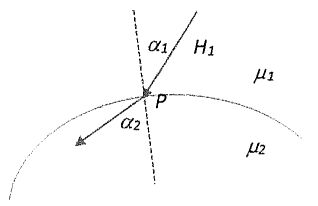
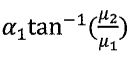
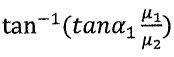
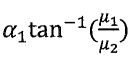
4. There is a common boundary in between two magnetic media with permeabilities μ₁ and μ₂ as shown in the following figure. The magnetic field intensity in the medium 1 at the point P has a magnitude H₁ and makes an angle α₁ with the normal, what is the angle α₂? (A) (B)(C)(D) None of the above
5. A rectangular metallic waveguide has dimension of a=3 cm and b=2 cm along x and y directions respectively. Now the waveguide is to transmit 12 GHz signal. How many guided modes can this waveguide support? (A) 1 mode (B) 2 modes (C) 4 modes (D) None of the above
6. A rectangular metallic waveguide has dimension of a and b along x and y directions respectively. Which of the following modes have the same cut-off frequency, assuming the dimensions a = 2b: (A) TE₀₁ & TM₀₁ (B) TE₂₀ & TM₀₁ (C) TE₁₁ & TM₁₁ (D) None of the above
7. Which of the following waveguide can support guided TEM mode: (A) Rectangular waveguide (B) Circular waveguide (C) Microstrip (D) None of the above
8. John tried to find the relation between wave vector and its components kx, ky, kz of guided modes in a hollow metallic waveguide via v² = vx² + vy² + vz² (eq.1), where v² = , and is the velocity of a guided mode in the waveguide. He used the formula vi =, i = x, y, z (eq.2), and then obtained (eq.3), which is different from the usual understanding of k² = kx² + ky² + kz² (eq.4). Which of the following statement is correct: (A) The eq.1 is not correct. (B) The eq.2 is not valid for the guided modes in this waveguide. (C) The eq.4 is not valid for the guided modes in this waveguide. (D) None of the above
9. Given a scalar function V =, please evaluate the rate of the increase of V at the point (1,2,0) along the vector of âz: (A) e³ (B) 0 (C) π/2 (D) None of the above
10. Given a material with conductivity of σ, the structure has constant cross section. The cross section area is S, and the distance is L. Please evaluate the resistance between the top and the bottom of this material. (A) (σS)/L (B) (σL)/S (C) L/(σS) (D) None of the above
11. Consider a layer structure of the structure as the figure shown below. This structure has three perfect conductor metal layers, and two insulator layers. One of the insulator layer is composed of Material1, the other insulator layer is composed of Material2 and Material3. The dielectric constant and the dielectric strength of the materials are listed in the Table below. This structure is infinitely extended in y direction; L1>>3μm; L2 >> 3μm; and L1=L2. Applying a voltage Vin between the top perfect conductor and the bottom perfect conductor from 0 V to 20 V, which material will breakdown first? (A) Material1 (B) Material2 (C) Material3 (D) None of the above
12. Given a material which has the positive charge fixed in this material, the charge density is ρ. The bottom metal is connected to the ground of the system (electric potential = 0). There is a voltage difference V₀ applied between the top and the bottom of the material. This material is infinitely extended in x and y directions. Therefore, the Poisson equation of the electric potential V(z) in this material can be reduced into the differential equation as:Please evaluate the electric potential V in the middle of this material (z=d/2). (A) V₀/2 (B) V₀/2 + d²·1/8 (C) V₀/2 - d²·1/8 (D) None of the above
13. The instantaneous expression for the electric field of a uniform plane wave propagating in the +z direction in the air is given by (z,t) = âx 4×10⁻⁵cos(6×10¹⁴t - k₀z + π/4) (V/m). What is the free-space wavenumber k₀? (A) 2 × 10⁶ (rad/m) (B) 1.2 × 10¹⁹ (rad/m) (C) 4π × 10⁶ (rad/m) (D) None of the above
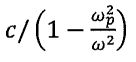
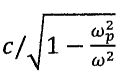
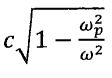
14. Assume the permittivity of plasma is given by ε = ε₀, where ωp is the plasma angular frequency. The plasma is nonmagnetic, so the permeability is μ₀. What is the group velocity for a plane electromagnetic wave traveling in this plasma? (A) (B) (C)(D) None of the above
15. A plane electromagnetic wave is incident normally from air onto the surface of a lossless dielectric medium. Assume the intrinsic impedance of air is η₁, and the intrinsic impedance of the dielectric medium is η₂. What is the reflection coefficient? (A) (B) (C)(D) None of the above
16. A plane electromagnetic wave is incident from air onto the surface of a dielectric medium. The dielectric medium is lossless, nonmagnetic and has a relative permittivity εr of 2.25. Assume the angle of incidence is 30°. Which one of the following is closest to the angle of refraction? (A) 36° (B) 19° (C) 23° (D) 12°
17. Suppose that there is a 50 Ω transmission line of length 100 m with an attenuation coefficient of 10⁻² Np/m. A receiver with an impedance of 75 Ω is connected at the load end of the transmission line. If the minimum power that the receiver must receive in order to interpret the transmitted electronic signal is 10⁻⁵ W, what is the minimum required input power to the transmission line? Choose the answer that is closest to your estimated value. (A) 92×10⁻⁶ W (B) 76×10⁻⁶ W (C) 55×10⁻⁶ W (D) 28×10⁻⁶ W
18. The input impedance of an open-circuited lossless coaxial cable of length ℓ=2λz/3 long (λz is the wavelength along the cable) would be (A) infinite (B) nonzero, finite, and purely real (C) zero (D) None of the above
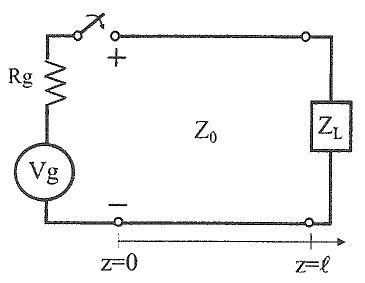
19. A generator composed of a voltage source Vg and a series resistance Rg=50 Ω is connected to a lossless transmission line with Z₀=50 Ω and length ℓ as shown below. The phase velocity on the transmission line is 2×10⁸ m/s. The initial conditions of voltage and current of the line are all zeros. Assume a step voltage from the generator with Vg is applied at t=0. The voltage recorded at the sending end of the transmission line (z=0) is 5 V from 0 s to 6 μs and then the voltage drops to 3 V at t = 6 μs. What is the length ℓ of the transmission line? (A) 600 m (B) 900 m (C) 1200 m (D) None of the above
20. A transmission line with the transmission line parameters R,G,L,C, has a length ℓ. The transmission line is terminated by a load with a complex impedance RL+jXL. Assume that a DC voltage source V₀ is connected at the input end of the line, and all parameters are known at zero frequency. Consider the following four cases: (1) R=G=0, (2) R≠0, G=0, (3) R=0, G≠0, (4) R≠0, G≠0. If we are calculating the steady state power dissipated by the load, which of the descriptions below is correct? (A) All cases have the same values. (B) Three of the cases have the same values. (C) Two of the cases have the same values. (D) None of the above
 阿摩線上測驗
登入
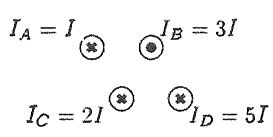 If a counter-clockwise Amperian loop enclosing wire A only gives
 = -μ₀I, what Amperian loop would give
 = 4μ₀I? (A) A clockwise loop that encloses wires A, B and C only. (B) A clockwise loop that encloses wires B, C and D only. (C) A counter-clockwise loop that encloses wires A and D only. (D) None of the above
 A/m² in the volume between the planes y=a and y=-a. What is the magnetic flux density in the region of -a<y<a due to the current distribution? (A)
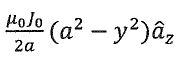 (B)
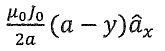 (C)
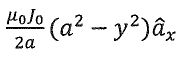 (D) None of the above
 (A)
 (B)
 (C)
 (D) None of the above
 and its components kx, ky, kz of guided modes in a hollow metallic waveguide via v² = vx² + vy² + vz² (eq.1), where v² =
 , and
 is the velocity of a guided mode in the waveguide. He used the formula vi =
 , i = x, y, z (eq.2), and then obtained
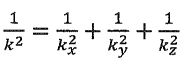 (eq.3), which is different from the usual understanding of k² = kx² + ky² + kz² (eq.4). Which of the following statement is correct: (A) The eq.1 is not correct. (B) The eq.2 is not valid for the guided modes in this waveguide. (C) The eq.4 is not valid for the guided modes in this waveguide. (D) None of the above
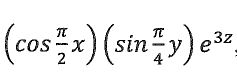 , please evaluate the rate of the increase of V at the point (1,2,0) along the vector of âz: (A) e³ (B) 0 (C) π/2 (D) None of the above
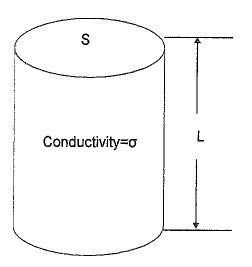 (A) (σS)/L (B) (σL)/S (C) L/(σS) (D) None of the above
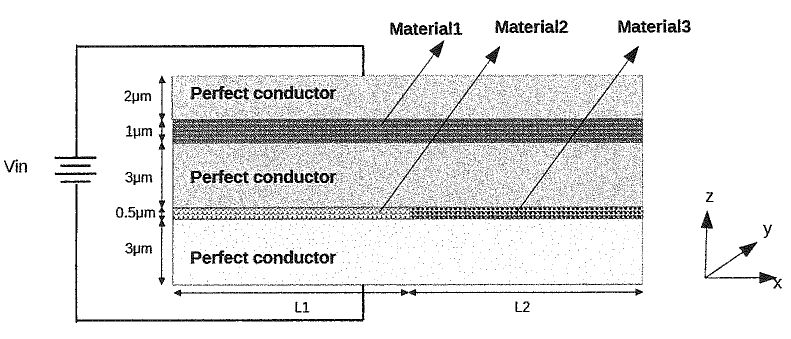
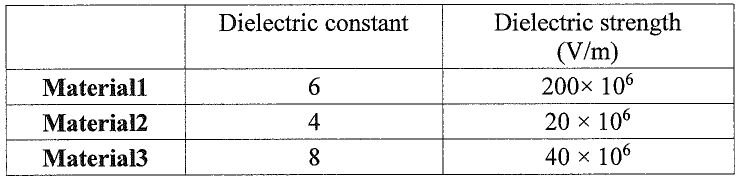 (A) Material1 (B) Material2 (C) Material3 (D) None of the above
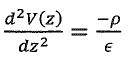
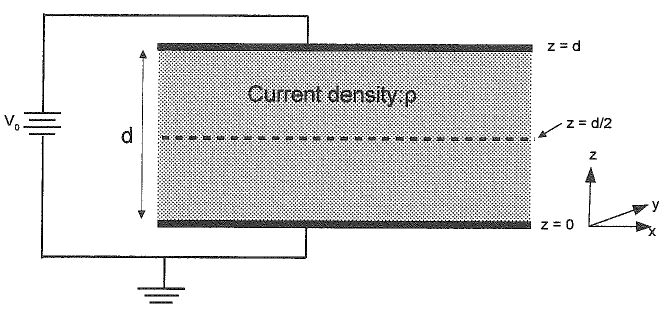 (A) V₀/2 (B) V₀/2 +
 d²·1/8 (C) V₀/2 -
 d²·1/8 (D) None of the above
 (z,t) = âx 4×10⁻⁵cos(6×10¹⁴t - k₀z + π/4) (V/m).
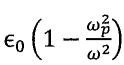 , where ωp is the plasma angular frequency. The plasma is nonmagnetic, so the permeability is μ₀. What is the group velocity for a plane electromagnetic wave traveling in this plasma? (A)
 (B)
 (C)
 (D) None of the above
 (B)
 (C)
 (D) None of the above
 (A) 600 m (B) 900 m (C) 1200 m (D) None of the above