所屬科目:【阿摩】未分類題庫
21. Let$$\mathbf{A} = \begin{bmatrix} x & 2 & 2 \\ 4 & 2x & -6 \\ -3 & -3 & x \end{bmatrix}$$For what values of x, will the matrix A be singular?(AB) 1, 2, 3; (AC) -1, 2, 3; (AD) 1, -2, 3; (AE) 1, 2, -3; (BC) -1, -2, 3; (BD) -1, 2, -3; (BE) 1, -2, -3; (CD) -1, -2, -3.
22. Let$$\mathbf{A} = \begin{bmatrix} 1 & 3 & 2 & 0 & 1 \\ 0 & 0 & 4 & 4 & 4 \\ 0 & 0 & 1 & 1 & 1 \\ 0 & 0 & 2 & 2 & 2 \end{bmatrix}$$What is the dimension of the null space of the matrix A?(AB) 1; (AC) 2; (AD) 3; (AE) 4; (BC) 5; (BD) 6; (BE) 7; (CD) 8; (CE) 9; (DE) 0.
23. Let $\mathbf{u}1 = \begin{bmatrix} 2 \\ 1 \end{bmatrix}, \mathbf{u}2 = \begin{bmatrix} 7 \\ 4 \end{bmatrix}$, and $\mathbf{v}1 = \begin{bmatrix} 7 \\ 5 \end{bmatrix}, \mathbf{v}2 = \begin{bmatrix} 4 \\ 3 \end{bmatrix}$. Which of the following is the transition matrix from the basis $\{\mathbf{v}1, \mathbf{v}2\}$ to the basis $\{\mathbf{u}1, \mathbf{u}2\}$?(AB) $\begin{bmatrix} 4 & -7 \\ -1 & 2 \end{bmatrix} \begin{bmatrix} 7 & 4 \\ 5 & 3 \end{bmatrix}$; (AC) $\begin{bmatrix} 2 & 7 \\ 1 & 4 \end{bmatrix} \begin{bmatrix} 7 & 4 \\ 5 & 3 \end{bmatrix}$; (AD) $\begin{bmatrix} 3 & -4 \\ -5 & 7 \end{bmatrix} \begin{bmatrix} 2 & 7 \\ 1 & 4 \end{bmatrix}$; (AE) $\begin{bmatrix} 7 & 4 \\ 5 & 3 \end{bmatrix} \begin{bmatrix} 2 & 7 \\ 1 & 4 \end{bmatrix}$;(BC) $\begin{bmatrix} 4 & -7 \\ -1 & 2 \end{bmatrix} \begin{bmatrix} 3 & -4 \\ -5 & 7 \end{bmatrix}$; (BD) $\begin{bmatrix} 2 & 7 \\ 1 & 4 \end{bmatrix} \begin{bmatrix} 3 & -4 \\ -5 & 7 \end{bmatrix}$; (BE) $\begin{bmatrix} 3 & -4 \\ -5 & 7 \end{bmatrix} \begin{bmatrix} 4 & -7 \\ -1 & 2 \end{bmatrix}$; (CD) $\begin{bmatrix} 7 & 4 \\ 5 & 3 \end{bmatrix} \begin{bmatrix} 4 & -7 \\ -1 & 2 \end{bmatrix}$.
24. Given the following three points $(x1 = 1, y1 = 4)$, $(x2 = 2, y2 = 8)$, $(x3 = 3, y3 = 8)$, compute the best least squares fit by a linear function $y = c1 + c2x$. What is the value of $c_2$?(AB) -4; (AC) -3; (AD) -2; (AE) -1; (BC) 0; (BD) 1; (BE) 2; (CD) 3; (CE) 4.
25. Which of the following is the set of the eigenvalues of $\mathbf{A} = \begin{bmatrix} 0 & -1 & -1 \\ 0 & 1 & 1 \\ 2 & 2 & -1 \end{bmatrix}$?(AB) $\{-1, 0, 1\}$; (AC) $\{-1, -1, 0\}$; (AD) $\{0, 1, 1\}$; (AE) $\{-1, 1, 1\}$; (BC) $\{-1, -1, 1\}$; (BD) $\{1, 1, 1\}$.
1. If \( \mathbf{A}\mathbf{A}^{-1} = \mathbf{I} \), then \( \mathbf{A} \) must be equal to \( \mathbf{I} \) or \( -\mathbf{I} \). (I: the identity matrix)
2. The determinant of matrix \( \mathbf{A} \) is nonzero if and only if the reduced row echelon form of \( \mathbf{A} \) is the identity matrix.
3. A triangular matrix is singular if and only if one of its diagonal entries is zero.
4. If two augmented matrices \( (\mathbf{A}|\mathbf{b}) \) and \( (\mathbf{B}|\mathbf{c}) \) are row equivalent, then the determinants of \( \mathbf{A} \) and \( \mathbf{B} \) are equal.
5. \( \mathbf{R}^3 \) is a subspace of \( \mathbf{R}^5 \).
6. If \( \mathbf{A} \) is an \( m\times n \) matrix, then 2A and \( 3\mathbf{A}^{\mathrm{T}} \) have the same rank.
7. Let \( \mathbf{A} \) be an \( m\times n \) matrix. The linear system \( \mathbf{A}\mathbf{x} = \mathbf{b} \) has at most one solution for every \( \mathbf{b}\in \mathbb{R}^m \) if and only if the column vectors of \( \mathbf{A} \) are linearly independent.
8. Let \( L: \mathbf{R}^n \to \mathbf{R}^n \) be a linear transformation. If \( L(\mathbf{x}1) = L(\mathbf{x}2) \), then \( \mathbf{x}1 = \mathbf{x}2 \).
9. Any two matrices with the same diagonal are similar.
10. If \( L: V \to V \) is a linear transformation and \( L(\mathbf{v}1) = L(2\mathbf{v}2) \), then \( (\mathbf{v}1 - 2\mathbf{v}2) \in \ker(L) \).
11. If \( \mathbf{A} \) is an \( m\times n \) matrix, then \( \mathbf{A}\mathbf{A}^{\mathrm{T}} \) and \( \mathbf{A}^{\mathrm{T}}\mathbf{A} \) have the same nullity.
12. If \( \mathbf{Q} \) is an orthogonal matrix, then \( |\mathbf{Q}^{\mathrm{T}}| = 1 \).
13. If \( \mathbf{x} \) and \( \mathbf{y} \) are unit vectors in \( \mathbf{R}^n \) and \( |\mathbf{x}^{\mathrm{T}}\mathbf{y}| = 1 \), then \( \mathbf{x} \) and \( \mathbf{y} \) are linearly independent.
14. Let \( \mathbf{A} \) and \( \mathbf{B} \) be \( n\times n \) matrices. If there exists a nonsingular matrix \( \mathbf{S} \) such that \( \mathbf{B} = \mathbf{S}^{-1}\mathbf{A}\mathbf{S} \), then they have the same eigenvalues.
15. If \( \mathbf{A} \) and \( \mathbf{B} \) are \( n\times n \) matrices with the same characteristic polynomial, then they are similar.
16. The rank of an \( n \times n \) matrix \( \mathbf{A} \) is equal to the number of nonzero eigenvalues of \( \mathbf{A} \), where eigenvalues are counted according to multiplicity.
17. The rank of an \( n \times n \) matrix \( \mathbf{A} \) is equal to the number of nonzero singular values of \( \mathbf{A} \), where singular values are counted according to multiplicity.
18. Let \( \mathbf{A},\mathbf{B},\mathbf{C} \), and \( \mathbf{D} \) be matrices. The computation of \( ((\mathbf{AB})\mathbf{C})\mathbf{D} \) requires the same number of floating-point operations as the computation of \( (\mathbf{AB})(\mathbf{CD}) \)
19. If \( \mathbf{A} \) is a nonsingular matrix and a numerically stable algorithm is used to compute the solution of a linear system \( \mathbf{A}\mathbf{x} = \mathbf{b} \), then the relative error in the computed solution still could large.
20. If \( \mathbf{A} \) is an \( n\times n \) matrix, then \( \| \mathbf{A}\| 1 = \| \mathbf{A}^{\mathrm{T}}\|{\infty} \)
4. (10%) Answer the questions about functions. First, how many functions are there from a set with eight elements to a set with three elements? Second, how many onto functions are there from a set with eight elements to a set with three elements?
5. (10%) Let \( X = \{1, 2, 3, \ldots, 9\} \). Algorithm A lists all 6-permutations of \( X \) in increasing lexicographic order. Algorithm B prints all 6-combinations of \( X \) in increasing lexicographic order where each combination is printed as an increasing sequence. First, find the next five permutations that will be generated by algorithm A after the permutation 321978. Then, find the next five combinations that will be generated by algorithm B after the combination 123689.
6. (10%) Solve the recurrence relation \( a_n = (4 / n)(a_0 + a_1 + \dots + a_{n-1}) \) where \( a_0 = 3 \).
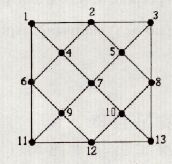
7. (20%) Given the graph shown below, answer the following questions and prove your answers. Does it have a Euler circuit? Does it have a Euler path? Does it have a Hamilton circuit? Does it have a Hamilton path?
26. (5%) Let \( \mathbf{U} \) be an \( n \times n \) unit upper triangular matrix. It is known that \( \mathbf{U} \) is nonsingular. Now, \( \mathbf{U}^{-1} \) is derived by transforming \( [\mathbf{U} \mathbf{I}] \) into \( [\mathbf{I} \mathbf{U}^{-1}] \) via row operations. Use the above derivation method to prove that \( \mathbf{U}^{-1} \) is also unit upper triangular.
(27) (10%) Let \( \mathbf{A} \) be a symmetric positive definite matrix with Cholesky decomposition \( \mathbf{A} = \mathbf{R}_{1}^{\text{T}}\mathbf{R}_{1} = \mathbf{R}_{2}^{\text{T}}\mathbf{R}_{2} \). By using the uniqueness of LDU factorization, prove that the upper triangular matrices \( \mathbf{R}_{1} = \mathbf{R}_{2} \).
 阿摩線上測驗
登入