所屬科目:學士後西醫◆資訊科學
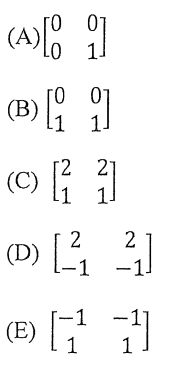
3. (5%) Let B=[(1,1),(2,1)3 be an ordered basis of R2. Suppose P is the orthogonal projection onto spanf(0,1)]. What is the matrix representation [P]β of P in B?
5. (5%) Which of the following number can make the matrix B positive definite ? (A)-1 (B) 0 (C) 1 (D) 2 (E) i U112 B
6. (5%) Determine (A) 1 (B)-1 (C) 0 (D) i (E) Does not exist
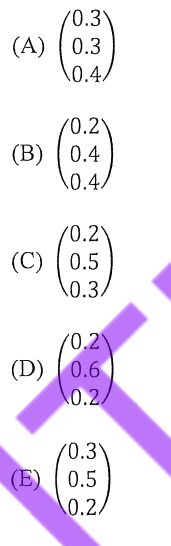
7. (5%) Consider a regular transition matrix for a three-state Markov chain, with the 10.3 initial probability vector Find the proportions of objects eventually.
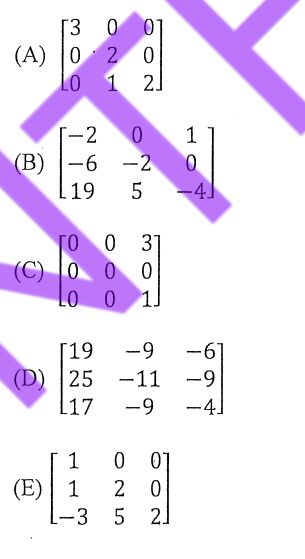
10. (5%) Which of the following matrices is diagonalizable?
14.(5%) Which one is NOT an eigenvalue of (A)1 (B) 2 (C) 3 (D) 4 (E) 5 O I 4 -2]
15.(5%) Let Which value of a can make A defective? (A) No value of a can make A defective (B) -2 (C) 2 (D) 0 6 1 10 (E) 1
16. (5%) Kim is at a train station, waiting to make a phone call. Two public telephone booths, next to each other, are occupied by two callers, and 1 1 persons are waiting in a single line ahead of Kim to call. If the duration of each telephone call is an independent exponential random variable with λ= 1/3, what is the variance of Kim's waiting time?Kim's waiting time is defined as the time interval from now to the moment that a phone is available for Kim to make his call. (A) 18 (B) 27 (C) 99/4 (D) 99 (E) 108
19. (5%) A traffic light can be in one of the three states: Green (G), Red (R), and Yellow (Y). The light changes in a random fashion. At any one time, the light can be in only one state. The experiment consists of observing the state of the light. Let a random variable X(') be defined as follows: X(G)=-1, X(R)=0, X(Y) = π; assume that P(G) = P(Y) = 0.5 P(R), what is P(X ≦ 3)? (A)1/4 (B) 1/2 (C) 3/4 (D)1 (E) 0
20.(5%) Let X1,X2, ....Xn be n identical and independently distributed exponential random variables with fxi(x) = e-xu(x), u(x) = 1 for x ≧ 0,0 otherwise. The maximum value for the probability density function, fzn(z), of the random variable Zn = max(Xi, X2,.... Xn) occurs at z =? (A) In(n) (B) In(-1) (C) In(1/n) (D) (1 -e-1)n (E) n(1-e-1)n
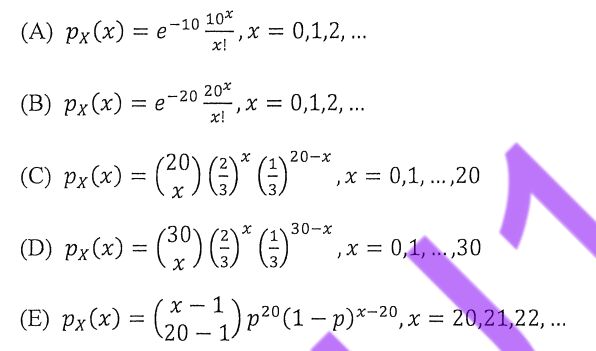
21.(5%) Y1, Y2, ... are independent and identically distributed random variables; the moment generating function of each of them is Let X= Find this probability mass function of X, px(X)
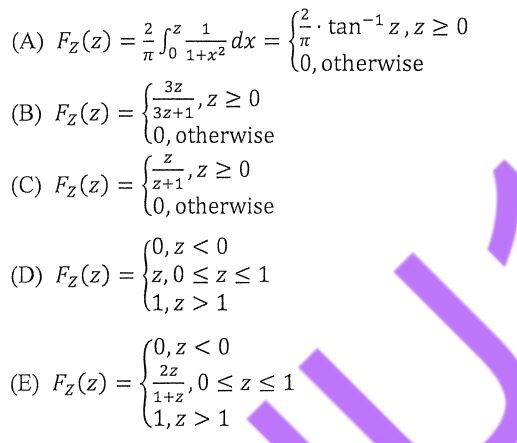
23.(5%) The two random variables, X and Y, are independent and exponentially X distributed, each with mean , Find Fz(z), which is the cumulative distribution function of Z.
24.(5%) We have some earthquake data that occurred in a region over years, summarized in the following table: Assume that earthquakes are independent rare events and their occurrences are homogeneous over time. Under these assumptions, the number of earthquake events follows Poisson distribution. Estimate the probability of having earthquakes with magnitude M 2 5 in the next month. (A)3.8% (B)21.3% (C) 48.7% (D)66.7% (E) unable to evaluate
26. (5%) Hospital A is experimenting with an AI-assisted system for judging the status (+ or -) of a certain disease. A pilot study is conducted to compare the results assessed by the AI system and a trained doctor. 50 patients are recruited, and the results are reported in the following table: The goal of the study is to verify if the assessment from the AI system is consistent with that from a trained doctor. Which of the following statistical test can be used to answer the question? (A) 5 independent 2 sample t-test (B) paired 2 sample t-test (C) chi-squared test (D) signed-rank test (E) F test
28. (5%) From the general knowledge, the population occurrence rate of asthma is 0.1 for children who visit hospitals. A pediatrician moved his clinic to a new place and he found 9 children with asthma among 50 appointments in his first day at the new place. If the 50 appointments are considered as Bernoulli random variables with O and 1 outcomes, the total number of asthma children, indicated as X, should follow a Binomial distribution with probability 0.1 under the general condition. He then makes the following guesses. Which one is a correct inference for the occurrence rate at the new place? (A) If the occurrence rate holds the same as other places, the standard deviation of each Bernoulli random variable in this problem is . The standard deviation of X should be 50 x 0.3=15 (B) Since 9/50=0.18 is greater than 0.1, there must be an increase of the occurrence rate (C) If the occurrence rate is greater than 0.1, we should also see the proportion of asthma children to be greater than 0.1 in the next day (D) Since P(X=9)=0.033 is smaller than 0.05, we will decide this as an unusual situation, and the evidence supports an increased occurrence rate. The threshold 0.05 can be applied when the number of appointments is 70 in a day (E) Since P(X≧9)=0.058 is greater than 0.05, we do not have to worry too much about the situation, and it might be a random fluctuation from day to day. The threshold 0.05 can be applied when the number of appointments is 70 in a day
29. (5%) A histogram of a dataset X is plotted in Figure (i). The 1st quartile, median and the 3'd quartile of the data are 10, 25, and 50. Which of the following statements is correct? i) (A) The truncated mean of the central 50% data should be (10+50)/2=30 (B) If another variable Y is positively correlated with X, the distribution of Y must be skew to the right as the distribution of X (C) The mode is greater than 25 (D) Since it is a skewed distribution, we can model the data with a x distribution (E) Suppose we randomly draw 30 samples with replacement from this dataset and take average to get X. The distribution of X is more likely to be the function f3(x) in Figure (ii) rather than the function f1(x) or f2(x) 110 130
 阿摩線上測驗
登入
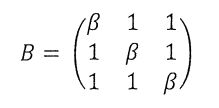 (A)-1 (B) 0 (C) 1 (D) 2 (E) i U112 B
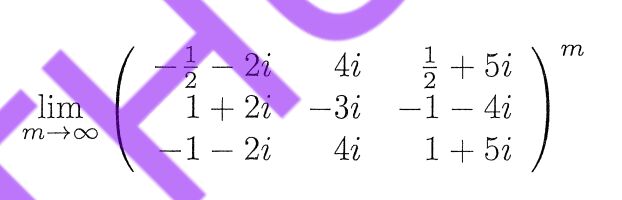 (A) 1 (B)-1 (C) 0 (D) i (E) Does not exist

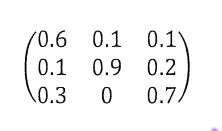 Find the proportions of objects eventually.
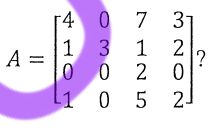 (A)1 (B) 2 (C) 3 (D) 4 (E) 5 O I 4 -2]
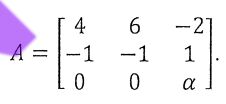 Which value of a can make A defective? (A) No value of a can make A defective (B) -2 (C) 2 (D) 0 6 1 10 (E) 1
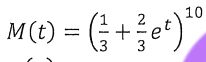 Let X=
 Find this probability mass function of X, px(X)
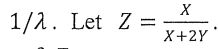 , Find Fz(z), which is the cumulative distribution function of Z.
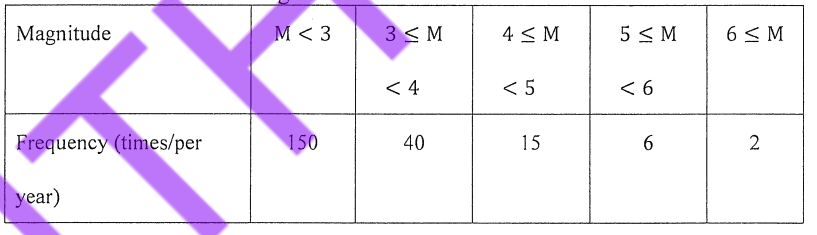 Assume that earthquakes are independent rare events and their occurrences are homogeneous over time. Under these assumptions, the number of earthquake events follows Poisson distribution. Estimate the probability of having earthquakes with magnitude M 2 5 in the next month. (A)3.8% (B)21.3% (C) 48.7% (D)66.7% (E) unable to evaluate
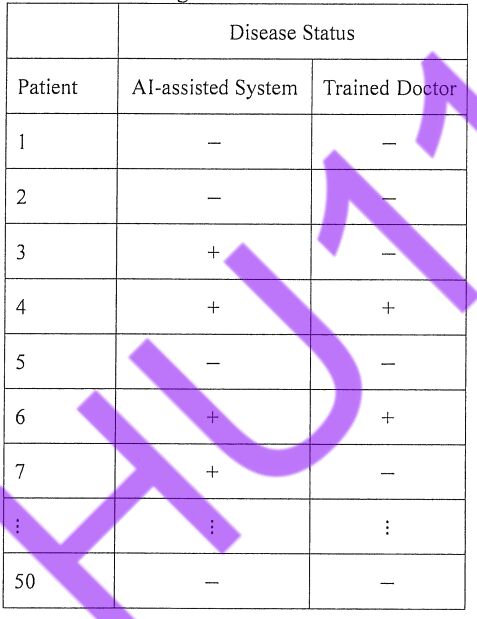 The goal of the study is to verify if the assessment from the AI system is consistent with that from a trained doctor. Which of the following statistical test can be used to answer the question? (A) 5 independent 2 sample t-test (B) paired 2 sample t-test (C) chi-squared test (D) signed-rank test (E) F test
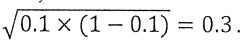 . The standard deviation of X should be 50 x 0.3=15 (B) Since 9/50=0.18 is greater than 0.1, there must be an increase of the occurrence rate (C) If the occurrence rate is greater than 0.1, we should also see the proportion of asthma children to be greater than 0.1 in the next day (D) Since P(X=9)=0.033 is smaller than 0.05, we will decide this as an unusual situation, and the evidence supports an increased occurrence rate. The threshold 0.05 can be applied when the number of appointments is 70 in a day (E) Since P(X≧9)=0.058 is greater than 0.05, we do not have to worry too much about the situation, and it might be a random fluctuation from day to day. The threshold 0.05 can be applied when the number of appointments is 70 in a day
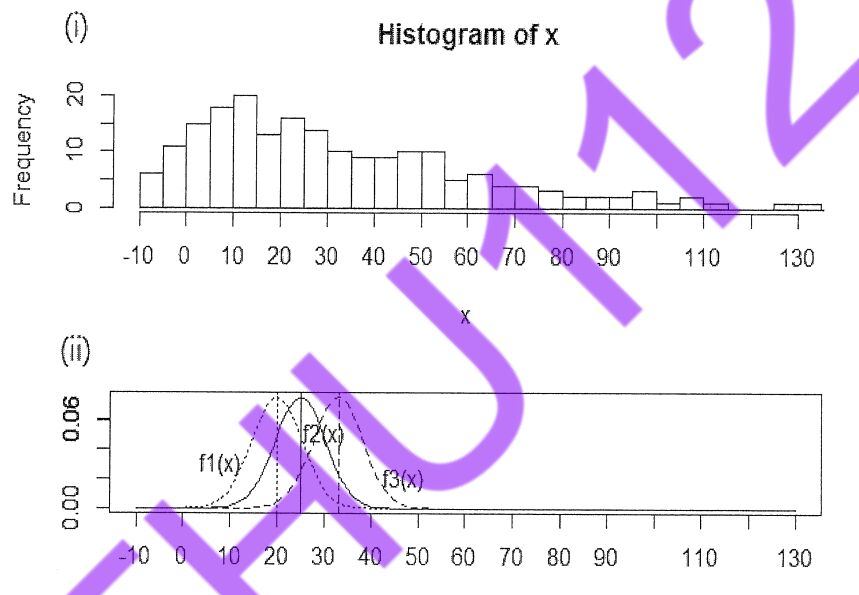 (A) The truncated mean of the central 50% data should be (10+50)/2=30 (B) If another variable Y is positively correlated with X, the distribution of Y must be skew to the right as the distribution of X (C) The mode is greater than 25 (D) Since it is a skewed distribution, we can model the data with a x distribution (E) Suppose we randomly draw 30 samples with replacement from this dataset and take average to get X. The distribution of X is more likely to be the function f3(x) in Figure (ii) rather than the function f1(x) or f2(x) 110 130