所屬科目:研究所、轉學考(插大)-經濟學
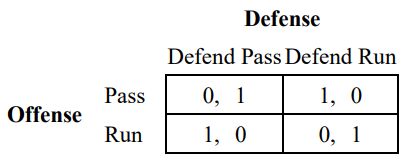
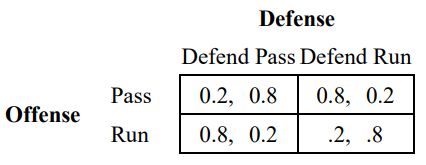
1. A football team has the chance of scoring the game-winning touchdown on the last play of the game. It can either run or pass. The defense can play for the run or play for the pass. The following normal form lists the payoffs from the game made up by this last play. The payoffs are probabilities of winning the game. The Nash equilibrium is (A) the offense runs and the defense plays for the run. (B) the offense passes and the defense plays for the pass. (C) the offense runs and the defense plays for the pass. (D) both pick their choice at random with equal probability.
2. A football team has the chance of scoring the game-winning touchdown on the last play of the game. It can either run or pass. The defense can play for the run or play for the pass. The following normal form lists the payoffs from the game made up by this last play. The payoffs are probabilities of winning the game. What is the defense’s dominant strategy? (A) Defend the run. (B) Defend the pass. (C) Defend both play at random with equal probability. (D) The defense does not have a dominant strategy.
3. Two games that differ only in the timing of moves—one simultaneous, the other sequential move—can sometimes have completely different subgame-perfect equilibria. Why? (A) The second mover can choose non-credible threats. (B) The first mover can choose an action that it would deviate from if its action were secret. (C) Subgame-perfect equilibrium cannot be applied to simultaneous games. (D) The simultaneous version of the game has more proper subgames.
4. A lake supports a delicious variety of fish. The land around the lake is owned by two fishing companies, so by state law both are free to fish as much as they like. Let FA and FB be the number of fish each catches, respectively. Suppose the price of fish is 100 – FA – FB. Given this demand curve, it turns out that marginal revenue is 100 – 2FA – FB for company A and 100 – FA – 2FB for company B. What is the total number of fish by both in the Nash equilibrium? (A) 30 (B) 45 (C) 60 (D) 90
5. In analyzing the gains and losses from international trade, to say that country M is a small country is to say that (A) country M can only import goods; it cannot export goods. (B) country M’s choice of which goods to export and which goods to import is not based on the principle of comparative advantage. (C) only the domestic price of a good is relevant for country M; the world price of a good is irrelevant. (D) country M is a price taker.
6. When a country allows trade and becomes an importer of bottled water, which of the following is not a consequence? (A) The gains of domestic consumers of bottled water exceed the losses of domestic producers of bottled water. (B) The gains of domestic producers of bottled water exceed the losses of domestic consumers of bottled water. (C) The price paid by domestic consumers of bottled water decreases. (D) The price received by domestic producers of bottled water decreases.
7. When a country that imports a particular good imposes an import quota on that good, (A) producer surplus decreases and total surplus decreases in the market for that good. (B) domestic sellers and domestic buyers become better off. (C) the domestic quantity supplied decreases. (D) producer surplus increases and total surplus decreases in the market for that good.
8. Import quotas and tariffs produce some common results. Which of the following is not one of those common results? (A) The domestic price of the good increases. (B) Producer surplus in the domestic country always increases. (C) A deadweight loss is experienced by the domestic country. (D) Producer surplus of domestic producers decreases.
9. When an externality is present, the market equilibrium is (A) efficient, and the equilibrium maximizes the total benefit to society as a whole. (B) efficient, but the equilibrium does not maximize the total benefit to society as a whole. (C) inefficient, but the equilibrium maximizes the total benefit to society as a whole. (D) inefficient, and the equilibrium does not maximize the total benefit to society as a whole.
10. Negative externalities lead markets to produce (A) greater than efficient output levels and positive externalities lead markets to produce smaller than efficient output levels. (B) smaller than efficient output levels and positive externalities lead markets to produce greater than efficient output levels. (C) greater than efficient output levels and positive externalities lead markets to produce efficient output levels. (D) efficient output levels and positive externalities lead markets to produce greater than efficient output levels.
11. A monopolist has total cost TC = Q2 + 10Q + 100 and marginal cost MC = 2Q + 10. It faces demand Q = 130 – P (so its marginal revenue is MR = 130 – 2Q). Its profit-maximizing output (A) 30. (B) 25. (C) 20. (D) 10.
12. If the government requires a natural monopoly to price at marginal cost, (A) monopoly firms will earn zero economic profits because the price of the good equals the cost of producing that good. (B) monopoly firms will operate at a loss because P < AC. (C) more firms will be able to enter the market. (D) producer surplus will increase because quantity supplied is greater.
13. The production function q = K 1/2L 1/2 (A) exhibits constant returns to scale and constant marginal productivities for K and L. (B) exhibits diminishing returns to scale and diminishing marginal productivities for K and L. (C) exhibits constant returns to scale and diminishing marginal productivities for K and L. (D) exhibits diminishing returns to scale and constant marginal productivities for K and L.
14. Suppose demand can be written as Q = 5. The elasticity of demand is (A) increasing as price rises. (B) decreasing as price rises. (C) constant regardless of prices and perfectly inelastic. (D) constant regardless of prices and unit elastic.
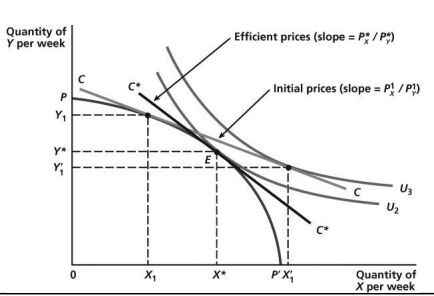
15. The following graph shows the production possibility frontier for a country and the indifference curves for the consumers in that country. At a price ratio given by the line CC, there is (A) an excess demand for both goods. (B) an excess demand for good X and an excess supply for good Y. (C) an excess supply for good X and an excess demand for good Y. (D) an excess supply for both goods.
二、 問答與計算,共 55 分 1. (10 分) Assume that these equations characterize a large open economy: (1) Y = 5,000. (2) Y = C + I + G + NX. (3) C = (1/2) (Y − T). (4) I = 2,000 − 100r. (5) NX = 500 − 500ε (6) CF = −100r. (7) CF = NX. (8) G = 1,500. (9) T = 1,000. where NX is net exports, CF is net capital outflow, and ε is the real exchange rate. Solve these equations for the equilibrium values of C, I, NX, CF, r, and ε. (Hint: You can reduce the total number of equations to two through repeated substitutions. These two equations will be functions of r and ε. Check your work by seeing that all of these equations balance, given your answers.)
(1) (6分)計算全面均衡下的匯率、產出與淨出口。
(2) (10分)請畫圖並計算在浮動匯率制度下,當政府支出增加50時,均衡產出、匯率、貨幣供給 量及淨出口為多少?
(3) (10分)請畫圖並計算在固定匯率制度下,當政府支出增加50時,均衡產出、匯率、貨幣供給 量及淨出口為多少?
(1) (6分) 請計算獨占廠商的產量及價格。
(2) (5分) 請計算完全競爭市場下的產量及價格。
(3) (8分) 請證明社會無謂損失剛好是獨占廠商利潤的一半。
 阿摩線上測驗
登入