所屬科目:研究所、轉學考(插大)-經濟學
1. Suppose that the total labor force is 100 individuals with 10 unemployed. The unemployment rate is . Now assume that 10 people drop out of the labor force and that 10 remain unemployed. The new unemployment rate is . (A) 11 percent; 10 percent (B) 10 percent; 11 percent (C) 10 percent; 9 percent (D) 9 percent; 10 percent
2. The Ricardo-Barro effect holds that (A) government budget deficits have no effect on the real interest rate. (B) a government budget deficit induces a decrease in saving that magnifies the crowding out effect. (C) a government budget deficit crowds out private investment. (D) equal increases in taxes and government expenditures have no effect on equilibrium real GDP.
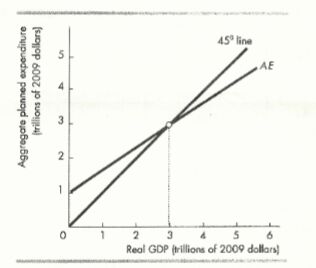
3. Suppose the price level is fixed. If investment increases by $1 trillion and the aggregate expenditure curve is shown in the figure above, equilibrium expenditure will increase by (A) $1 trillion. (B) less than $1 trillion. (C) $3 trillion. (D) indeterminate from the information given.
4. Which of the following is NOT a characteristic of monopolistic competition? (A) There is product differentiation in the market. (B) Firms set the price of their product equal to their marginal cost. (C) Firms may make an economic profit in the short run. (D) There is easy entry and exit.
5. There are 6 firms in a market and the market shares of the firms are 40 percent, 30 percent, 10 percent, 8 percent, 7 percent, and 5 percent. The four-firm concentration ratio is equal to (A) 2664. (B) 2738. (C) 88. (D) 100.
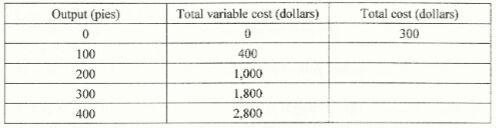
6. The above table gives some of the costs of the Delicious Pie Company. What is the average total cost of producing 200 pies? (A) $6.50 (B) $5.00 (C) $650 (D) More information is needed to calculate the average total cost.
7. Real business cycle theory says that the factor leading to the business cycle is represented by changes in (A) only aggregate demand. (B) the growth rate of the quantity of money. (C) animal spirits. (D) productivity.
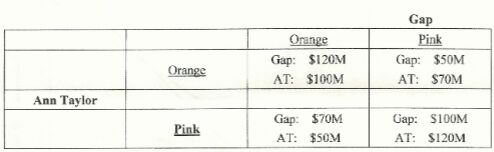
8. Ann Taylor and Gap are two clothing companies that must decide on the leading color palette for next season. Their sales depend on the choice of color they make as well as the choice their competitor makes. Their sales are summarized in the payoff matrix above. Using the payoff matrix (A) the Nash Equilibrium is for one company to choose pink while the other company chooses orange. (B) the only Nash Equilibrium is for both companies to choose pink. (C) there are two Nash Equilibria: either both companies choose pink or both choose orange. (D) the only Nash Equilibrium is for both companies to choose orange.
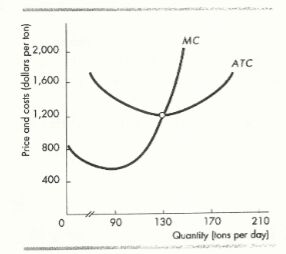
9. The figure above shows the costs for the typical grower in the perfectly competitive turnip market. Currently, the price is $1,000 for a ton of turnips. In the long run, the market supply of turnips will (A) increase and the turnip grower's economic profit will decrease. (B) increase and the turnip grower's economic profit will increase. (C) decrease and the price of a ton of turnips will rise to $1,200. (D) decrease and the price of a ton of turnips will fall to $600.
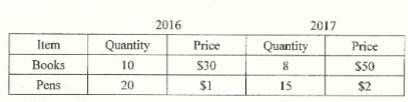
10. In 2016, consumers in Dexter consumed only books and pens. The prices and quantities for 2016 and 2017 are listed in the table above. The reference base period for Dexter's CPI is 2016. What is the cost of the CPI basket in 2017? (A) $430 (B) $540 (C) $335 (D) $320
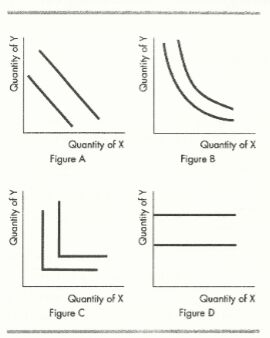
11. Consider the indifference maps shown above. If X and Y are perfect substitutes, your indifference curves between them would look like those in (A) Figure A. (B) Figure B. (C) Figure C. (D) Figure D.
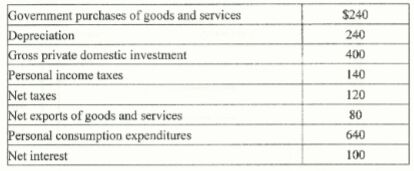
12. From the data in the above table, GDP equals (A) $1,120. (B) $1,290. (C) $1,280. (D) $1,360.
13. If the velocity of circulation is 6 and the quantity of money is $3 trillion, what is nominal GDP? (A) $6 trillion (B) $2 trillion (C) $333 billion (D) $18 trillion
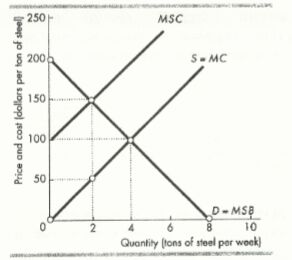
14. The above figure shows the marginal social benefit, marginal private cost and marginal social cost of producing steel. There is a marginal external _ of _ per ton. (A) benefit; $200 (B) benefit; $100 (C) cost; $100 (D) cost; $200
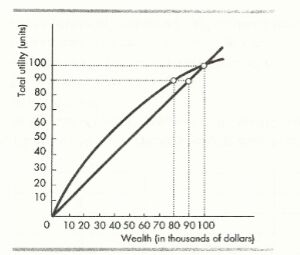
15. Bruce Copperwood's utility of wealth curve is illustrated in the above figure. Bruce is presently employed at a salary of $100,000. There is a 10 percent probability that Bruce will be totally disabled, in which case he will have no wealth. The maximum amount that Bruce is willing to pay for a disability insurance policy that would pay him $100,000 in the case of total disability is (A) $10,000. (B) $90,000. (C) $80,000. (D) $20,000.
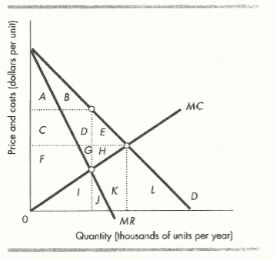
16. Which area in the above figure equals the producer surplus under perfect price discrimination? (A) \( A + B + C + D + E + F + G + H + I + J + K \) (B) \( C + D + E + F + G + H \) (C) \( A + B + C + D + E + F + G + H + I + J + K + L \) (D) \( A + B + C + D + E + F + G + H \)
17. Consider the market for dollars. If the exchange rate rises from 2 pesos per dollar to 4 pesos per dollar (A) there is a downward movement along the supply curve for dollars. (B) the supply curve of dollars shifts rightward. (C) the supply curve of dollars shifts leftward. (D) there is an upward movement along the supply curve for dollars.
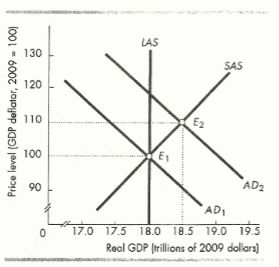
18. In the above figure, the inflationary gap when $AD_2$ is the aggregate demand curve equals (A) the difference between 110 and 100. (B) LAS minus SAS at a price level of 100. (C) the difference between $18.5 trillion and $18.0 trillion. (D) \( AD_{1} \).
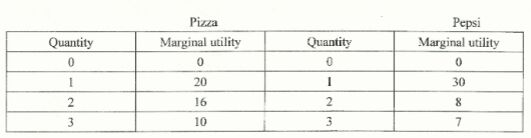
19. The above table shows Priscilla's marginal utility from the two goods she consumes, pizza and Pepsi. A slice of pizza costs $4 and a can of Pepsi $2. Suppose Priscilla has $12 to spend. Which of the following leads Priscilla to switch her choices of pizza and Pepsi? (A) an increase in Priscilla's income. (B) an increase in the price of pizza to $6 per slice. (C) a decrease in the price of Pepsi to $1 per can. (D) All of the above will cause Priscilla to change her choices.
20. During 2017, the country of Economia had a real GDP of $115 billion and the population was 0.9 billion. In 2016, real GDP was 105 billion and the population was 0.85 billion. In 2017, real GDP per person was (A) $128. (B) $124. (C) $117. (D) $135.
 阿摩線上測驗
登入
 (A) government budget deficits have no effect on the real interest rate. (B) a government budget deficit induces a decrease in saving that magnifies the crowding out effect. (C) a government budget deficit crowds out private investment. (D) equal increases in taxes and government expenditures have no effect on equilibrium real GDP.
 (A) 2664. (B) 2738. (C) 88. (D) 100.
 (A) only aggregate demand. (B) the growth rate of the quantity of money. (C) animal spirits. (D) productivity.
 (A) the Nash Equilibrium is for one company to choose pink while the other company chooses orange. (B) the only Nash Equilibrium is for both companies to choose pink. (C) there are two Nash Equilibria: either both companies choose pink or both choose orange. (D) the only Nash Equilibrium is for both companies to choose orange.
 (A) increase and the turnip grower's economic profit will decrease. (B) increase and the turnip grower's economic profit will increase. (C) decrease and the price of a ton of turnips will rise to $1,200. (D) decrease and the price of a ton of turnips will fall to $600.
 (A) $430 (B) $540 (C) $335 (D) $320
 (A) Figure A. (B) Figure B. (C) Figure C. (D) Figure D.
 (A) $6 trillion (B) $2 trillion (C) $333 billion (D) $18 trillion
 (A) benefit; $200 (B) benefit; $100 (C) cost; $100 (D) cost; $200
 (A) $10,000. (B) $90,000. (C) $80,000. (D) $20,000.
 (A) there is a downward movement along the supply curve for dollars. (B) the supply curve of dollars shifts rightward. (C) the supply curve of dollars shifts leftward. (D) there is an upward movement along the supply curve for dollars.
 (A) the difference between 110 and 100. (B) LAS minus SAS at a price level of 100. (C) the difference between $18.5 trillion and $18.0 trillion. (D)