所屬科目:研究所、轉學考(插大)◆遺傳學
1. Why did Mendel perform reciprocal crosses?(A) To obtain enough plants to perform the experiments that Mendel wanted.(B) To test a hypothesis that stated the ovum carries all the information for progeny.(C) To be able to breed plants year-round.(D) To determine whether the inheritance of a trait depends on which parent carries the trait.(E) To determine which trait is dominant and which is recessive.
2. If a trait is controlled by two different genes, a possible interaction between alleles of these genes can be called (A) dominance.(B) codominance. (C) incomplete dominance.(D) epigenetics. (E) epistasis.
3.A disease is caused by homozygosity for the g allele (G is the corresponding wild-type allele). However, the penetrance of the disease is 75%. Two individuals known to be heterozygotes have a child. What is the probability that the child exhibits the disease? (A) 3/16 (B) 1/8 (C) 3/4 (D) 9/16(E) 1/4
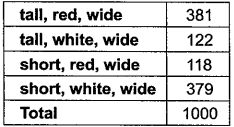
4. In peas, tall (T) is dominant to short (f), red flowers (R) is dominant to white flowers (r), and wide leaves (W) is dominant to narrow leaves (w). A tall plant that has red flowers and wide leaves is crossed to a short plant that has white flowers and narrow leaves. The resulting progeny are shown in the table.If two or more of the genes are linked, what is the map distance that separates them?(A) None of the genes is linked to another.(B) 50 m.u.(C) 24 m.u.(D) 12 m.u.(E) 4 m.u.
5.Nondisjunction can occur at either the first or second division of meiosis. XYY individuals would most likely arise from nondisjunction at the _________ meiotic division in the_________.(A) second; mother(B) first; mother(C) second; father(D) first; father(E) More than one of the choices could give rise to XYY individuals.
6. Individuals with an XXY karyotype are_________in humans and_________ in fruit flies.(A) male; male(B) female; female(C) male; intersexual(D) male; female(E) female; male
7. Which of the following is NOT true of DNA?(A) It is acidic.(B) It contains deoxyribose.(C) It is found in cell nuclei.(D) It contains phosphate.(E) It contains amino acids.
8.The protein that progressively unwinds DNA ahead of each replication fork is called(A) primase. (B) helicase. (C) topoisomerase.(D) telomerase. (E) ligase.
9.What radiolabeled substance did Hershey and Chase use to label the protein component of the bacteriophage in their study to determine whether protein or DNA was necessary for phage production?(A) Nitrogen; N(D) Phosphorus; P(B) Carbon; C(E) lodine; I(C) Sulfur; S
10.The antiparallel polarity of the two DNA strands within the double helix affects DNA replication in that(A) it takes twice as long to replicate two strands sequentially from 5' to 3'.(B)circular bacterial DNA does not have polarity, so a single strand can be copied twice.(C) DNA polymerases on each strand synthesize DNA in the 5'-to-3' direction, and one strand is synthesized discontinuously.(D) each portion of the double helix must be unwound twice so that both strands are replicated continuously.(E) Only one strand of DNA at any replication origin can be synthesized.
11. Why is a variegated plant considered heteroplasmic? (A)All of the plant's cells have mutant and wild-type chloroplast DNAs.(B) The plant has mutant and wild-type chloroplast DNAs distributed amongst the cells indifferent ratios.(C)All of the plant's cells have mitochondria and chloroplasts. (D)The plant has only two types of cells, one with only mutant chloroplast DNAs and one with only wild-type chloroplast DNAs. (E) None of above
12. Oocyte nuclear transfer can be used to(A) create embryos for stem cell therapy.(B) allow females with any genetic disease to have unaffected offspring.(C) allow females with mitochondrial diseases to have unaffected offspring.(D) allow parents to control all of the phenotypic characteristics of their children.(E) allow parents to select the gender of their children.
13. What is the relationship between methylation and genomic imprinting? (A) Differential methylation of DNA in males and females results in only one of the parental alleles being transcriptionally active in the offspring. (B) Reversible methylation of DNA inherited from the father results in the paternal alleles being (C) expressed only late in development. Reversible methylation of DNA inherited from the mother results in the maternal alleles being expressed only late in development. (D) DNA methylation silences the alleles inherited from both parents, so no alleles are transcriptionally active. (E) DNA methylation does not regulate gene expression.
14. What is true about the mutations within a complementation group?(A) They produce the same mutant phenotypе.(B) They do not complement each other and are in the same gene.(C) They complement each other and are in the same gene.(D) They complement each other and are in different genes.(E) They do not complement each other and are in different genes.
15.What evidence supports the hypothesis that humans originated in Africa? (A) One Y chromosome lineage that originated 1,000 years ago is found in 8% of modern-day Asian men. (B)Alleles of nuclear genes are less variable in African populations than in other populations. (C)Mitochondrial DNA sequence variation is higher in African populations than in other populations. (D) H. sapiens genomes contain some alleles from Neanderthal genomes. (E) None of above.
16.Which interaction is NOT involved in maintaining tertiary structure in protein molecules?(A) covalent bonds(B) hydrogen bonds(C) hydrophobic interactions(D) electrostatic interactions(E) All of the choices may be involved in maintaining tertiary structure in proteins.
17. Which statement about sickle-cell disease is false?(A) The sickle-cell hemoglobin molecule contains an amino acid substitution.(B) Individuals who are heterozygous for the sickle-cellallele cannot make hemoglobin.(C) The red blood cells of an individual with sickle-cell disease distort and elongate.(D) The hemoglobin molecules of an individual with sickle-cell disease clump together.(E) All of above are true.
18.Transcription and translation can be coupled in bacteria but not eukaryotes because (A) no nuclear membrane exists in eukaryotes. (B)no nuclear membrane exists in prokaryotes. (C) eukaryotic chromosomes are found in nucleoids. (D) the bacterial DNA is in a single chromosome. (E) the bacterial RNA is short.
19. In bacteria, the transition from transcriptional initiation to elongation involves (A) binding of sigma factor. (B) release of sigma factor. (C) binding of rho factor. (D) binding of RNA polymerase to DNA. (E) release of RNA polymerase from DNA.
20.Which of the following is one of the assumptions of the Hardy-Weinberg law?(A) The ability of all genotypes to survive and reproduce is the same.(B) Migration occurs into or out of the population.(C) Mutations appear in the gene pool at high frequency.(D) Non-random mating occurs within the population.(E) The population is small.
21. Normal alleles of tumor suppressor genes function to encode proteins that(A) promote transition from G1-to-S.(B) can slow the rate of cell division.(C) increase the rate of mutagenesis.(D) activate oncogenes.(E) associate with growth factors at the cell surface.
22. The two chromatids of each replicated chromosome must separate from one another and segregate during (A) mitosis. (B) meiosis I. (C) meiosis II. (D) both mitosis and meiosis I. (E) both mitosis and meiosis II.
23. An organism's genome is (A) the sequence of its genes for brain cells. (B) the sequence of its genes for the heart. (C) the DNA content of its sex chromosomes. (D) the DNA content of its mitochondrial genes. (E) the DNA content and sequence of all of its genes.
24.If a double-stranded DNA molecule is amplified by PCR, how many double-stranded DNA molecules will exist after FIVE cycles? (A) 6 (B) 8 (E) 64 (C) 10 (D) 32
25. In the first step of chromosomal compaction, naked DNA is packaged into nucleosomes. The next level of chromosomal compaction is the formation of DNA loops which is accomplished primarily by (A) nucleosomes. (B) remodeling complexes. (C) condensins. (D) histone H1. (E) histone H4.
二、名詞解釋(每題5分共25分) ※本大題請於試卷內之「非選擇題作答區」標明題號依序作答 1. Single nucleotide polymorphism
2. Reading frame
3. Testcross
4. RNA interference
5. Telomer
 阿摩線上測驗
登入