所屬科目:研究所、轉學考(插大)◆經濟學原理
1. If a country can produce more of one good without producing less of another good that people value more highly, then ________. (A) resource use is inefficient (B) resource use is efficient (C) the opportunity cost is the lowest possible (D) the resources used have the highest possible value
2. In game theory, strategies include ________. (A) the payoff matrix (B) all possible actions and payoffs of each player (C) only the winning action of each player (D) all possible actions of each player
3. If the Fed unexpectedly increases the growth rate of the quantity of money, the short-run Phillips curve (A) shifts rightward. (B) does not shift. (C) shifts leftward. (D) becomes vertical.
4. Which of the following is a characteristic of the market structure for monopolistic competition? (A) barriers to entry (B) a large number of firms compete (C) each firm produces a differentiated product (D) Both answers B and C are correct.
5. The consumption function relates the consumption expenditure decisions of households to (A) the nominal interest rate. (B) investment decisions of firms. (C) the level of disposable income. (D) saving decisions of households.
6. Because of automatic stabilizers, when real GDP increases (A) government expenditures decrease and tax revenues increase. (B) government expenditures equal tax revenues. (C) the economy will automatically go to full employment. (D) government expenditures increase and tax revenues decrease.
7. If good growing conditions increase the supply of strawberries and hot weather increases the demand for strawberries, the quantity of strawberries bought ________. (A) increases and the price might rise, fall or not change (B) increases and the price rises (C) doesn't change but the price rises (D) doesn't change but the price falls
8. Assuming long-run external economies exist, when demand increases in a perfectly competitive market, in the long run, the price of the product (A) equals the initial price (before the increase in demand) and the quantity increases. (B) equals the initial price (before the increase in demand) and the quantity decreases. (C) falls below the initial price (before the increase in demand) and the quantity increases. (D) rises above the initial price (before the increase in demand) and the quantity increases.
9. The main sources of cost-push inflation are (A) money wage rates and the cost of raw materials. (B) increases in aggregate demand and real wage rates. (C) money wage rates and increases in aggregate demand. (D) real wage rates and the cost of raw materials.
10. Unregulated monopolies can often earn an economic profit in the long run because (A) barriers to entry prevent competing firms from entering the market. (B) they receive government subsidies. (C) they have high costs. (D) the risks of running a monopoly are high.
11. Which of the following allow banks to minimize the cost to a business of borrowing? I. Borrowing long and lending short. II. Raising funds from a large number of depositors. III. Creating money by lending all their reserves. (A) I and III (B) II only (C) I only (D) II and III
12. Along a straight-line demand curve, as the price falls the (A) elasticity of demand is constant. (B) demand becomes less elastic. (C) demand becomes more elastic. (D) demand is always unitary elastic.
13. The idea that governments make choices that are inefficient in a political system in which voters are rationally ignorant is called (A) public choice theory. (B) principle of minimum differentiation. (C) social interest theory. (D) None of the above answers is correct.
14. Which of the following is one of the Fed's policy goals? (A) price level stability (B) monetary base (C) discount rate (D) help the President win reelection
15. If real GDP is $2 billion and planned aggregate expenditure is $2.25 billion, inventories will (A) pile up and output will decrease. (B) be depleted and output will decrease. (C) be depleted and output will increase. (D) pile up and output will increase.
16. Long-run aggregate supply will decrease for all of the following reasons EXCEPT (A) decreased human capital. (B) decreased capital. (C) reduction in the level of technology. (D) reduced money wages.
17. In the short run, a decrease in the quantity of money (A) shifts the aggregate demand curve rightward. (B) shifts the long-run aggregate supply curve rightward. (C) shifts the long-run aggregate supply curve leftward. (D) shifts the aggregate demand curve leftward.
18. Demand is inelastic if (A) the smaller angle between the vertical axis and the demand curve is less than 45 degrees. (B) a leftward shift of the supply curve raises the total revenue. (C) large shifts of the supply curve lead to only small changes in price. (D) the good in question has close substitutes.
19. Joshua consumes only apples and bread and is in consumer equilibrium. Joshua reads that eating bread is healthy, so his total utility from each loaf of bread increases. At his new consumer equilibrium Joshua would consume (A) the same quantity of apples and the same quantity of bread. (B) fewer apples and more bread. (C) some combination of apples and bread corresponding to a lower ratio of the marginal utility of bread to the marginal utility of apples. (D) more apples and less bread.
20. When the total product curve is drawn in a figure that measures employment along the horizontal axis, it is a graph that shows the (A) minimum cost of producing a given amount of output using different techniques. (B) minimum output attainable for each quantity of labor employed. (C) maximum output attainable for each quantity of labor employed. (D) maximum profit attainable for each unit of output sold per unit of labor employed.
21. An example of a nominal variable is (A) aggregate working hours. (B) the price level. (C) the real wage rate. (D) the level of unemployment.
22. Sue consumes apples and bananas. Suppose Sue's income doubles and the prices of apples and bananas do not change. Sue's budget line will (A) remain unchanged. (B) shift leftward but its slope will not change. (C) shift rightward and become steeper. (D) shift rightward but its slope will not change.
23. A characteristic of monopolistic competition is (A) the absence of advertising. (B) a high capital-output ratio. (C) a low ratio of fixed to variable costs. (D) product differentiation.
24. A change in the full-employment quantity of labor ________ the short-run aggregate supply curve and ________ the long-run aggregate supply curve. (A) does not shift; shifts (B) shifts; shifts (C) does not shift; does not shift (D) shifts; does not shift
25. The correct ranking of the four basic market structures from low HHI to high HHI is (A) perfect competition, monopolistic competition, oligopoly, monopoly. (B) monopoly, oligopoly, monopolistic competition, perfect competition. (C) monopoly, monopolistic competition, oligopoly, perfect competition. (D) perfect competition, oligopoly, monopolistic competition, monopoly.
26. If the quantity of money increases when the economy is at full employment, aggregate demand ________. In the long run, the price level ________ and real GDP will ________. (A) increases; real GDP increases; increase further (B) decreases; real GDP decreases; increase to potential GDP (C) increases; the price level rises; return to potential GDP (D) decreases; the price level falls; return to potential GDP
27. Firm A can produce a unit of output with 10 hours of labor and 5 units of material. Firm B can produce a unit of output with 5 hours of labor and 10 units of material. Firm C can produce a unit of output with 10 hours of labor and 10 units of material. If the prices of labor and material are $10 per hour and $5 per unit, respectively, which of these firms is the most technologically efficient? (A) firm A only (B) firm B only (C) firm C only (D) Firms A and B could both be technologically efficient.
28. The real interest rate ________ the expected inflation rate ________ the nominal interest rate, approximately. (A) minus; equals (B) equals; minus (C) equals; plus (D) plus; equals
29. If there is a collusive agreement in a duopoly to maximize profit, then the price will (A) be the same as the price set by a monopoly. (B) equal the marginal cost of production. (C) be the same as the price set by a competitive industry. (D) equal the average total cost of production.
30. Marginal utility theory concludes that a decrease in the price of a good increases the quantity demanded and (A) decreases the demand for complements. (B) increases the demand for substitutes. (C) increases income. (D) increases total utility.
31. The unregulated, single-price monopolist illustrated in the figure above has a total cost of (A) $8.00 per day. (B) $32.00 per day. (C) $16.00 per day. (D) $40.00 per day.
32. The above figure depicts a firm in monopolistic competition. At the profit maximizing level of output, excess capacity for the firm is equal to (A) 16 units per day. (B) 8 units per day. (C) 0 units per day. (D) 4 units per day.
33. An economy is at point A in the figure. Investment increases. The economy will move to point ________ in the short run and to point ________ in the long run. (A) B; C (B) D; C (C) D; A (D) B; A
34. In the above figure, if income is $8, the initial price of a soft drink is $1, and the initial price of a milkshake is $2, a decrease in the price of a milkshake to $1 will move the consumer from point ________ to point ________. (A) a; c (B) b; c (C) a; b (D) a; d
35. Two software firms have developed an identical new software application. They are debating whether to give the new application away free and then sell add-ons or sell the application at $30 a copy. The payoff matrix is above and the payoffs are profits in millions of dollars. What is Firm 1's best strategy? (A) Give away the application only if Firm 2 gives away the application. (B) Give away the application regardless of what Firm 2 does. (C) Sell the application at $30 a copy regardless of what Firm 2 does. (D) Give away the application only if Firm 2 sells the application.
(a) What happens to Taiwan's potential GDP?
(b) In the short run, what happens to aggregate supply and aggregate demand?
(c) What are the new short-run equilibrium real GDP and price level?
(d) In the long run, what happens to the short-run aggregate supply and aggregate demand?
(e) What are the new long-run equilibrium real GDP and price level?
(a) What is the price of natural gas supplied by West Coast Gas? How many cubic feet does the company sell? What is the firm's economic profit per month?
(b) How does the regulation affect total surplus?
(c) Is the regulation in the social interest? Explain.
 阿摩線上測驗
登入
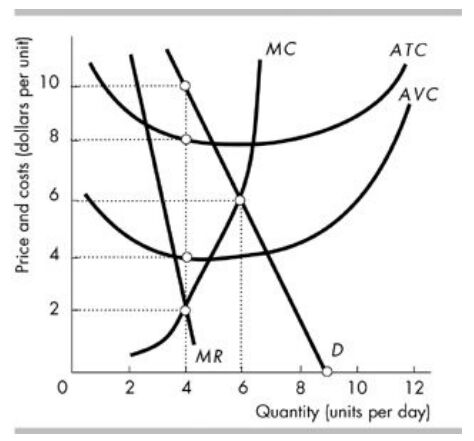 (A) $8.00 per day. (B) $32.00 per day. (C) $16.00 per day. (D) $40.00 per day.
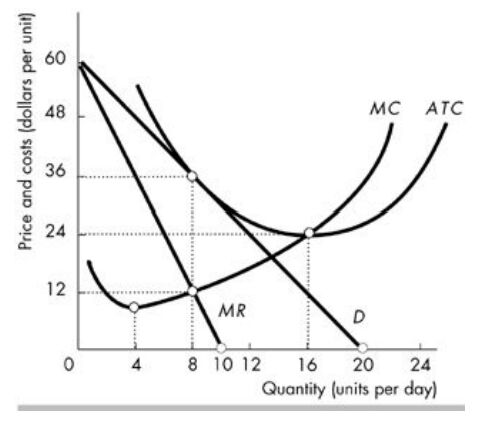 (A) 16 units per day. (B) 8 units per day. (C) 0 units per day. (D) 4 units per day.
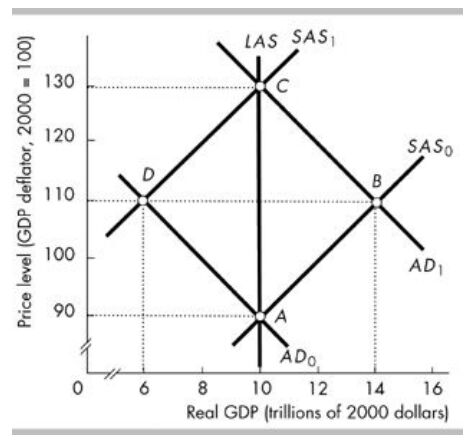 (A) B; C (B) D; C (C) D; A (D) B; A
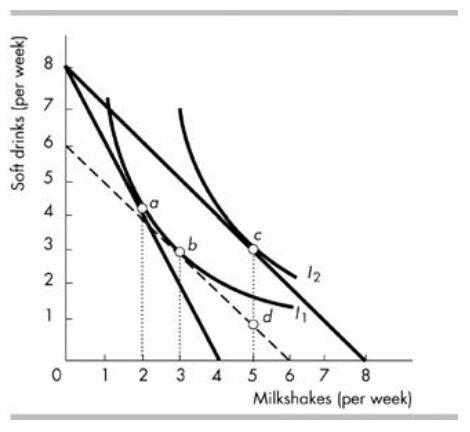 (A) a; c (B) b; c (C) a; b (D) a; d
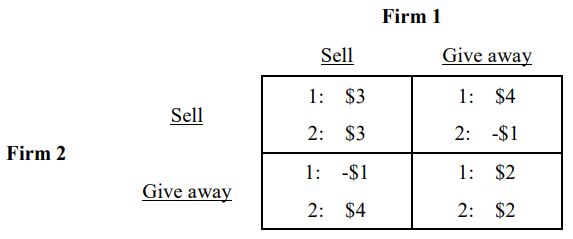 (A) Give away the application only if Firm 2 gives away the application. (B) Give away the application regardless of what Firm 2 does. (C) Sell the application at $30 a copy regardless of what Firm 2 does. (D) Give away the application only if Firm 2 sells the application.