所屬科目:研究所、轉學考(插大)◆生物化學
1. The α-helix and β-strand are: (A) primary structure, (B) secondary structure, (C) tertiary structure, (D) quaternary structure, (E) regular structure.
2. What is the active form of methionine and acts as an intracellular methyl group donor? (A) S-adenosylhomocysteine, (B) homocysteine, (C) S-adenosylmethionine, (D) 5-methylthioadenosine, (E) None of the above.
3. What is the overall net charge on the peptide Arg-Gly-Ser-Lys-Glu-Asp at pH 7.0? (A) +2, (B) +1, (C) -2, (D) -1, (E) 0.
4. A Ramachandran plot shows (A) the amino acid residues which have the greatest degree of rotational freedom, (B) the sterically allowed rotational angles between R groups and α-carbons in a peptide, (C) the sterically allowed rotational angles between Cα and the amide nitrogen (Cα-N) as well as between Cα and the amide carbonyl carbon (Cα-CO), (D) the sterically allowed rotational angles about the amide nitrogen (NH) and CO, (E) the amino acid residues that form α-helix, β-sheet, etc.
5. The two enzymes that catalyze the bulk of the nitrogen flow from amino acids to ammonium ion are? (A) transaminases and dehydratases, (B) transaminases and glutamate dehydrogenase, (C) transaminases and amino acid oxidase, (D) glutamate dehydrogenase and dehydratases, (E) amino acid oxidase and dehydratases.
6. Molecules of a given protein have all EXCEPT: (A) a fixed amino acid composition, (B) a defined amino acid sequence, (C) an invariant molecular weight, (D) a nucleotide sequence from which they are encoded, (E) a sequence read from C-terminal end to N-terminal end.
7. The peptide bond has partial ________________ character. (A) hydrogen bond, (B) double bond, (C) triple bond, (D) van der Waals bond, (E) all of the above.
8. A polypeptide "ala-ser-val-asp-leu-gly-glu" is folded into an α-helix. Which amino acid is the carbonyl group of alanine hydrogen bonded? (A) serine, (B) aspartic acid, (C) valine, (D) leucine, (E) glutamic acid.
9. Which amino acid acts as a helix breaker due to its unique structure? (A) histidine, (B) tyrosine, (C) arginine, (D) serine, (E) proline.
10. Biological molecules denaturation will occur in all EXCEPT: (A) dramatic increase in temperature, (B) change in ionic strength, (C) refrigeration, (D) addition of strong acid or base, (E) none, all will denature biological macromolecules.
11. Upon hydrolysis to generate one phosphate, which statement about standard Gibbs free energy change at pH 7.0 is always true? (A) AMP releases more energy than ATP. (B) ATP releases more energy than ADP. (C) ATP (no Mg+2) releases more energy than ATP at 50 mM Mg+2. (D) glucose-1-phosphate releases more energy than glucose-6-phosphate. (E) None of above.
12. Stereochemistry of biological molecules. (A) enantiomers have one chiral center. (B) diastereomers are mirror images of each other. (C) epimers differ only in one chiral center. (D) enantiomers are mirror images. (E) none of above.
13. Ribose is mainly produced by (A) glycolysis pathway. (B) pentose phosphate pathway. (C) citric acid cycle. (D) oxidative phosphorylation. (E) protein metabolism.
14. To synthesize one molecule of palmitate from acetyl-CoA and malonyl-CoA, how many electrons are involved? (A) 2 x 6 = 12. (B) 2 x 8 = 16. (C) 4 x 7 = 28. (D) 4 x 8 = 32. (E) 1 x 16 = 16.
15. The driving force(s) for fatty acid biosynthesis from acetyl-CoA: (A) ATP, carboxylation, decarboxylation. (B) ATP, NADH, carboxylation. (C) ATP, NADPH, decarboxylation. (D) ATP, carboxylation, decarboxylation, NADH. (E) ATP, carboxylation, decarboxylation, NADPH.
16. The driving force(s) for cholesterol biosynthesis from acetyl-CoA: (A) ATP, carboxylation, decarboxylation. (B) ATP, NADH, carboxylation. (C) ATP, NADPH, decarboxylation. (D) ATP, NADH, carboxylation, decarboxylation, pyrophosphate hydrolysis. (E) ATP, NADPH, carboxylation, decarboxylation, pyrophosphate hydrolysis.
17. The driving force(s) for inosine monophosphate biosynthesis from ribose-5-phosphate: (A) ATP, carboxylation, decarboxylation. (B) ATP, carboxylation, pyrophosphate hydrolysis. (C) ATP, NADPH, carboxylation, pyrophosphate hydrolysis. (D) ATP, NADPH, decarboxylation, pyrophosphate hydrolysis. (E) ATP, NADPH, carboxylation, decarboxylation, pyrophosphate hydrolysis.
18. Based on the chemical formulae of various membrane phospholipids. Which statement about charge character is true? (A) PC, PE positive, PS, PI neutral in charge, (B) PC, PE neutral, PS, PI negative in charge, (C) PC, PE negative, PS, PI neutral in charge, (D) PC positive, PE negative, PS, PI neutral in charge, (E) none of above. Note P stands for phosphatidyl.
19. About transaldolase and transketolase (A) Both transfer one-carbon unit, (B) Both transfer two-carbon unit, (C) Both transfer three-carbon unit, (D) Transaldolase transfer two-carbon, transketolase transfer three-carbon, (E) transaldolase transfer three-carbon, transketolase transfer two-carbon.
20. Glycolysis is enhanced by (A) glucose-1-phosphate, (B) fructose-1,6- bisphosphate, (C) fructose-2,6-bisphosphate, (D) glucose-6-phosphate and fructose-1,6-bisphosphate, (E) fructose-1,6-bisphosphate and fructose-2,6- bisphosphate.
21. Phosphofructokinase is most inhibited at (A) low [ATP], (B) 1 mM ATP and 0.1 mM AMP, (C) 1 mM ATP, (D) 0.1 mM ATP and 1 mM AMP, (E) 1 mM AMP.
22. The Q-cycle of mitochondrial electron transport takes place in (A) complex I, (B) complex II, (C) complex III, (D) complex IV, (E) complex V.
23. The small, peripheral membrane protein in the electron transport system of chloroplast is (A) plastocyanin, (B) plastoquinone, (C) Fe-S cluster, (D) NADP, (E) cytochrome b.
24. In ATP synthase, energy is required to change its conformation, causing (A) ADP and Pi to be bound, (B) ADP and Pi to be released, (C) ADP and Pi to form ATP, (D) ATP to be released, (E) ATP to be bound.
25. In the reaction catalyzed by glyeraldehyde-3-phosphate dehydrogenase, the phosphate group comes from (A) Pi, (B) ATP, (C) glyeraldehyde-3-phosphate, (D) pyrophosphate, (E) ADP.
26. In the reaction of the Calvin Cycle:
3CO2 + 9ATP + X NADPH → glyceraldehyde-3-phosphate + 9ADP + 9Pi + X NADP+ X = (A)2, (B)4, (C)6, (D)8, (E)10.
27. (A) citrate, (B) a-ketoglutarate, (C) succinate, (D) fumarate, (E) oxaloacetate can be synthesized from pyruvate without going through acetyl-CoA.
28. Which citric acid cycle intermediate can be used to synthesize sterols and fatty acids? (A) citrate, (B) oxaloacetate, (C) malate, (D) isocitrate, (E) α-ketoglutarate.
29. Which phosphorylated compounds has the most negative standard free energy of hydrolysis? (A) ATP, (B) phosphoenolpyruvate, (C) glucose-6-phosphate, (D) phosphocreatine, (E) pyrophosphate.
30. The immediate electron donor to P680+ is a (A) leucine, (B) tryptophan, (C) serine, (D) histidine, (E) tyrosine residue.
31. Nucleotides have a nitrogenous base linked to a sugar by a: (A) α-anhydride bond, (B) β-ester bond, (C) α-N-amide bond, (D) B-N-acetal (glycosidic) bond, (E) α-N-hemiacetal bond.
32. The pitch, or distance required to complete one helical turn in B-DNA is (A) 33.2 Å, (B) 45.6 Å, (C) 38.4 Å, (D) 24.6 Å, (E) 28.4 Å.
33. What is this molecule below (and its conformation)? (A) anti A, (B) syn U, (C) anti T, (D) anti G, (E) syn C.
34. The function of DNA topoisomerases is: (A) packaging DNA into nucleosomes, (B) forming cruciform DNA, (C) unwinding G:C rich areas in DNA, (D) breaking one or more strands of DNA, winding them tighter or looser, and rejoining the ends, (E) promoting DNA hybridization.
35. Successive base pairs in B-DNA show a rotation with respect to each other (so-called helical twist) of (A) 34°, (B) 36°, (C) 38°, (D) 32°, (E) 40°.
36. If the rate constant for the enzyme catalyzed reaction is 1 x 10⁵/sec and the rate constant for the uncatalyzed reaction is 2 x 10/sec, the catalytic power of the enzyme is: (A) 2, (B) (C) (D) 5 x 10⁹, (E)
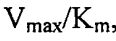
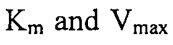
37. All of the following statements are true about the relationships between [S], and EXCEPT: (A) As [S] is increased, v approaches the limiting value, , (B) = /2, (C) The rate of the reaction, v, follows a first order rate equation v = K'[A] and K' = (D) The rate of product formed, v, is at when [S] >> , (E) assist in finding the rate of the enzyme catalyzed reaction only if the reaction is irreversible.
38. In uncompetitive inhibition: (A) I combines only with ES, (B) I combines only with E, (C) I combines with E and ES, (D) I combines with EP, (E) none of the above.
39. Formation of the ES complex results in (A) entropy gain, (B) enthalpy gain, (C) entropy loss, (D) enthalpy loss, (E) none of the above.
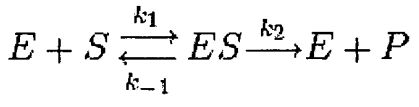
40. Which statement is correct about the Michaelis-Menten constant, , for the kinetic mechanism below?(A) It is numerically equal to the substrate concentration required to achieve one half the maximum velocity, (B) It's defined as ,(C) It is approximately equal to the dissociation constant for the enzyme-substrate complex to E + P, (D) The value of is constant for an enzyme regardless of the specific substrate molecule used to determine it, (E) Its numeric value has the units of .
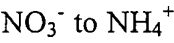
41. What is nitrogen fixation? (A) the reduction of , (B) the formation of from N2 gas, (C) the oxidation of to N2, (D) the oxidation of to (E) the formation of .
42. What reaction does glutamate dehydrogenase (GDH) catalyze? (A) the reductive amination of a-ketoglutarate to yield glutamate, (B) phosphorylation of carbamate to yield carbamoyl-phosphate, (C) the amidation of the y-carboxyl group of glutamate to form glutamine, (D) the deadenylation of glutamine synthetase, (E) the adenylation of glutamine synthetase.
43. All of the following act in feedback inhibition of glutamine synthetase (GS) in prokaryotes EXCEPT? (A) AMP, (B) glucosamine-6-phosphate, (C) histidine, (D) proline, (E) CTP.
44. All of the following are characteristics of phenylketonuria EXCEPT? (A) excretion of phenylpyruvate, (B) air oxidation causes urine to turn dark on standing, (C) treated by putting patient on a diet low in phenylalanine, (D) untreated patients suffer severe mental retardation, (E) deficiency or defect in phenylalanine hydroxylase.
45. All are characteristics of xanthine oxidase EXCEPT? (A) present in large amounts in liver, intestinal mucosa and milk, (B) uses molecular oxygen and produces H2O2, (C) involved in production of urea, (D) possesses an electron-transport chain with FAD, Fe-S cluster and molybdenum cofactor (E) all are true.
46. Which of the following is the mechanism of action of 5-fluorouracil? (A) competitive inhibitor of dihydrofolate reductase, (B) suicide substrate for thymidylate synthase, (C) competitive inhibitor of ribonucleotide reductase, (D) non-competitive inhibitor of thioredoxin reductase, (E) none of the above.
47. The reaction, ATP + AMP → 2ADP, is catalyzed by: (A) adenylate phosphorylase, (B) AMP-phosphotransferase, (C) ADP mutase, (D) adenylate kinase, (E) none are true.
48. All of the following molecules belong to reactive oxygen species EXCEPT? (A) hydrogen peroxide, (B) superoxide radical, (C) hydroxyl ion, (D) hypochlorite ion, (E) sulfonate.
49. Which of the following equipment is not essential for current proteomics study? (A) mass spectrometry, (B) isoelectric focusing electrophoresis, (C) liquid chromatograph, (D) surface plasma resonance, (E) SDS-PAGE.
50. Which one is the most sensitive strategy to detect proteins in gel? (A) coomassie blue stain, (B) silver stain, (C) fluorescent stain, (D) colloidal coomassie blue stain, (E) all the same in sensitivity.
(A)
(B)
(C)
(D)
(E)
(F)
(G)
(H)
2. For the reduction half- reaction: → NADH +Write an reduction potential equation of this reaction that can predict the dependence on the concentrations of the redox couple and the pH.
3. (A) If an enzyme has a Vmax of 15 mM/min, what is the velocity if the substrate is present at ½ of the Km?
(B) Draw a typical Lineweaver-Burk double-reciprocal plot that derived from the Michaelis-Menten Equation. (1) Show X and Y axes (2) What is the y-intercept and x-intercept?
(C) Why is DNA more stable than RNA?
(A) ____
(B)____
(C) ____
(D) ____
(E) ____
(A) Name any other well-known polyketide drug. (2%)
(B) Give two reasons why you agree with the above finding (4%).
(C) Give two reasons why you do not agree with the above finding (4%).
 阿摩線上測驗
登入
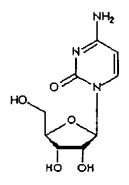 (A) anti A, (B) syn U, (C) anti T, (D) anti G, (E) syn C.
 /sec, the catalytic power of the enzyme is: (A) 2, (B)
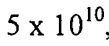 (C)
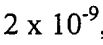 (D) 5 x 10⁹, (E)
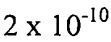
 and
 EXCEPT: (A) As [S] is increased, v approaches the limiting value,
 , (B)
 =
 /2, (C) The rate of the reaction, v, follows a first order rate equation v = K'[A] and K' =
 (D) The rate of product formed, v, is at
 when [S] >>
 , (E)
 assist in finding the rate of the enzyme catalyzed reaction only if the reaction is irreversible.
 , for the kinetic mechanism below?
 (A) It is numerically equal to the substrate concentration required to achieve one half the maximum velocity, (B) It's defined as
 ,(C) It is approximately equal to the dissociation constant for the enzyme-substrate complex to E + P, (D) The value of
 is constant for an enzyme regardless of the specific substrate molecule used to determine it, (E) Its numeric value has the units of
 .
 , (B) the formation of
 from N2 gas, (C) the oxidation of
 to N2, (D) the oxidation of
 to
 (E) the formation of
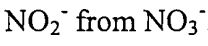 .
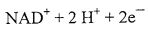 → NADH +
 Write an reduction potential equation of this reaction that can predict the dependence on the concentrations of the redox couple and the pH.