所屬科目:研究所、轉學考(插大)◆普通化學
1. A beam of light with an intensity of 15 W is. incident on a copper plate (work function is7.43xl0-19 J). Electrons with a minimum wavelength of 3.75x10 -10 m are ejected from the surface of the copper. Calculate the frequency of the incident light. [Hint: Plank constant = 6.626 x 10⁻³⁴J·s] (A)3.7lx1015Hz (B) 3.71 x 10¹⁶ Hz,(C) 3.71 x 10¹⁷ Hz,(D) 3.71 x 10¹⁸Hz(E) none of above
2. If a new light source (its energy is7.19x10-19 J) with an intensity of 35 Wis incident on the copper surface, what is the maximum number of electrons that can be ejected from a 6.0 second pulse of light? (A)O, (B) 3.71x10 16 ,(C) 3.7lx10 17,(D) 3.7lx10 18,(E) none of above
3. Order the following atoms and ions in order of increasing atomic radius: Cl,Te,Te2-,S (A) Cl< Te< S < Te2-, (B) Cl< S < Te2- <Te, (C) Te2- <Te< S <CL, (D) Cl< S <Te< Te2 (E)none of above
4. How many electrons in a single atom can have the following two quantum numbers: n = 7, mI =-3? (A)2, (B)4, (C)6, (D)8, (E) none of above
5. Calculate the pH in a,solution prepared by dissolving 0.050 mol of acetic acid (CH3COOH) and 0.20 mol of sodium acetate (NaCH3COO) in water and adjusting the volume to 500 mL. The pKa for acetic (CH3COOH) is 4.75.
[Hint: log(0.25) = -0.602] (A)4.35, (B)S.35, (C)6.35, (D)7.35, (E) none of above
6. A 10.0 mL sample of 0.20 M HNO2(aq ) solution is titrated with 0.10 M NaOH(aq)• (Ka of HNO2 is 4.3x10 -4 ).Initial mol of NO2- is 0.0667 M. Calculate_ the pH at the equivalence point. (Hint: log(I.Z47x 10-6=-5.9I (A)S.1, (B)6.1, (C)7.1, (D)S.1, (E) none of above
7. . Consider the formation of MgO( s) • Assume that △H° and △S° are independent of temperature. Calculate the temperature at which the formation of MgO switches. from spontaneous to non-spontaneous or vice versa?
[Hint: Mg(s) 十➔MgO(s) ;△H° = -602kJ I mo!; △S° = -1081 I K · mol] (A)2,574K, (B)3,574K, (C)4,574K, (D)5,574K, (E) none of above
8. Oxygen at pressures that are not too high obeys the equation P(V - b) = RT, Where P is pressure; V is volume, R is 8.314 JK-1mol-¹, T is temperature, b =0.021dm³/mol, Estimate the fugacity of oxygen at 25°C and 1 bar pressure.
[Hint: The equation of state is Where P1 is 0 bar] (A) (B) (C)(D) (E)
9.The equilibrium constant for an association reaction A+B ABis 1.8x10³ dm³ / mol at 25°C and 3.45×10³ dm³ / molat 40°C. Assuming AHto be independent of temperature, calculate △H0=? [Hint: =0.651 (A)33.67 J/mol; (B) 336.7 J/mol; (C) 3367 J/mol; (D) 33.67 kJ/mol; (E) 336.7 kJ/mol;
10. A solution contains 1.50 g of solute in 30.0 g of benzene and its freezing point is 3.74°C. The freezing point of pure benzene is 5.48°C. Calculate the molar mass of the solute. [Hint: Freezing point depression constant (Kf) for benzene is 4.9°C.kg/ mol] (A)1.47g/mol, (B)14.7g/mol, (C)147g/mol, (D)1,470g/mol, (E)14.7kg/mol
11. Toluene (methylbenzene) and water are immiscible. If boiled together under an atmosphere pressure of 755.0 Torr at 83°C, what is the ratio of toluene to water (Wtoluene/Wwater)in the distillate? The vapor pressure of pure toluene and water 83°C are 322.0 Torr and 400.6 Torr, respectively. (Wtoluene/Wwater)=(A) 1.11, (B) 2.11, (C) 3.11, (D) 4.11, (E) 5.11
12. An aqueous solution of gold(III) nitride, Au(NO3)3, was electrolyzed with a current of0.0250A until 1.200g of Au (atomic weight 197.0) had been deposited at the cathode. Calculate the quantity of electricity passed.
[Hint: The reaction at the cathode is 3e- + Au³+ → Au; The equation for the libration of O₂ is 2H2O→O2+4H+ +4e-] (A)1.76 C, (B) 17.6C, (C) 176C, (D) 1,760C, (E) 17,600C
13. The Electromotive Force (emf) ofthe cell Pt,H2(lbar)|HCI(0.01m) AgCl(s)|Ag is 0.2002V at 25°C, is –8.665×10⁻⁵V/K.
[Hint: The electrode reactions of cell are ;The cell reaction is + AgCl(s) → Ag + H+ +Cl-; e =1.602x10⁻¹⁹C]
The Gibbs energy change of the cell reaction is △ G = (A) -1.932 J/mol ,(B) -19.32 J / тol ,(C) -193.2 J/mol,(D) -1,932 J/mol ,(E) -19,320 J/ mol
14. What is the degree of the degeneracy if the three quantum numbers m,n,and n, can have the values 1, 2, and 3? (A) 2, (B) 4, (C) 6, (D) 8, (E) 10
15. KF has an ionic bond with a bond length of 0.217nm. Calculate the AE in kj/mol, for the formation of a KF bond from the neutral atoms K and F. For this calculation, assume that the potassium and fluorine ions are point charges. Ionization Energy and Electron Affinity for K and F are provided in the table below.
[Hint: Overall: K+F →KF ; ε0= 8.854×10⁻¹² C2/J-m; e =1.602×10⁻¹⁹ C]
(A) -5.50×10-² J/mol, (B) -55 J/mol, (C) -550 J/mol, (D) -550 kJ/mol, (E) -5,500 kJ/mol
16. Among_______ , which one is ionic crystal?(A) NaCl, (B) SiO2, (C) CH4, (D) CO2 and (E) Fe
17. Among ________, which one has highest melting point?(A) NaCl, (B) SiO2, (C) CH4, (D) CO2 and (E) Fe
18. The structure of the amino acid histidine is provided below. For the indicated bond b,
What could form the bonds ofN-C bond, b? (A)σ(N : 2sp2 ; C : 2sp2)(B) π(N: 2py;C: 2py) (C) π(N:2px;C:2px), (D) σ(N:2sp3 ;C:2sp3 );(E) σ(O: 2sp3 ;H: ls)
19. Determine the bond order (BO) of the cyanide molecule, CN and the cyanide ion, CN-1 Bond order (BO) of (A) CN is 0.5; CN-1 is 1, (B) CN is 1.5; CN-1 is 2, (C) CN is 2.5; CN-1 is 3 , (D) CN is 3.5; CN-1 is 4, (E) CN is 4.5; CN-1 is 5
20. Consider the reaction below for the conversion nitrogen dioxide to nitric oxide and O2. Calculate the △H° (per mole of O2 formed) for the reaction at 298 K.
[Hint:2NO2(g) → 2NO(g) +O2(g);△H0formation (NO2(g))= 33k.J I mol;△H0formation (NO(g)) = 90k.J /mo/] (A)114.1 J, (B) 1.141 kJ, (C) 11.41 kJ, (D) 114.1 kJ, (E) 1,141 kJ
21. Which of the following has the highest energy per photon? (A) infrared, (B)blue light, (C)green light, (D)orange light, (E)red light
22. Metals rarely lose electrons in chemical reacti(:ms because (A) their electron affinities are too high. (B) their ionic radii become too small. (C) their ionization energies are too small. (D) their size is too small. (E).their ionization energies are too high.
23. What is the shape of ? (A)T-shaped, (B)trigonal pyramidal , (C)seesaw, (D)tetrahedral, (E) trigonal planar
24. A plot of the Maxwell distribution for the same gas against temperature shows that (A) at high temperatures, most molecules have speeds close to their average speed. (B) as the temperature increases, a high proportion of molecules have very slow speeds. (C) as the temperature decreases, the spread of speeds widens.(D)as the temperature decreases, a high proportion of molecules have very high speeds. (E) at low temperatures, most molecules have speeds close to their average speed.
25. Which of the following statements is true? (A) 1,1-Dichloro-2-methyl-1-propene has a. . higher boiling point than trans-2,3-dichloro-2-butene. (B)CH4 has a higher boiling point than CCl4. (C)o-Dichlorobe11:zene has a lower boiling point than p-dichlorobenzene.(D)HI has a lower boiling point than HBr. (E) Butane, C4H10, has a higher boiling point than acetone, CH3COCH3.
26. How do alloys solidify and melt? (A)At precise temperature. (B)Over a range of temperatures. (C)At temperature. (D)At exact low temperature. (E)None of above. strict high
27. Gamma-rays cause radiation damage when they interact with matter by producing (A) ions and free radicals, (B) isotopes, (C) daughter products,(D)oxidation, (E) reduction.
28. Which of the following has the lowest standard molar entropy? (A) C(graphite), (B) p 4(s), (C) S8(s), (D) C60(s), (E) C(diamond)
29. Which of the following liquids freeze at a lower temperature when pressure is applied? (A)water, (B)acetic acid, (C)benzene, (D)methanol, (E)carbon tetrachloride
30. Which of the following 0.10 M aqueous solutions has the lowest pH? (A) B(OH)3, (B) HIO, (C) C2H5NH3Cl ,(D)C6H5OH
31. Choose the effective pH range of an aniline/anilinium chloride buffer. The value of the Kb for aniline is 4.3 x 10⁻¹⁰. (A)3.6"'5.6, (B) 8.4~10.4, (C) l.1~3.1, (D) 5.1~7.1, (E) 10.1~12.1
32. If the standard potentials for the couples Cu2+ /Cu, Ag+ /Ag, and Fe2+ /Fe are +0.34, +0.80, and -0.44 V, respectively, which is the strongest reducing agent? (A) Fe, (B) Ag, (C) Ag + , (D) Cu, (E) Fe2 +
33. If the rate of reaction increases by a factor of 9.6 when the concentration of reactant increases by a factor of 3.1, the order of the reaction with respect to this reactant is (A) 1.5, (B) 3, (C) 4,(D)2, (E) 1
34. Which of the foil owing does not act as a Lewis acid? (A) Na2O, (B) NO, (C) NO2,(D)SO3, (E) CO2
 阿摩線上測驗
登入
 ➔MgO(s) ;△H° = -602kJ I mo!; △S° = -1081 I K · mol] (A)2,574K, (B)3,574K, (C)4,574K, (D)5,574K, (E) none of above
 Where P1 is 0 bar] (A)
 (B)
 (C)
 (D)
 (E)

 ABis 1.8x10³ dm³ / mol at 25°C and 3.45×10³ dm³ / molat 40°C. Assuming AHto be independent of temperature, calculate △H0=? [Hint:
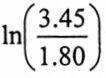 =0.651 (A)33.67 J/mol; (B) 336.7 J/mol; (C) 3367 J/mol; (D) 33.67 kJ/mol; (E) 336.7 kJ/mol;
 is –8.665×10⁻⁵V/K.
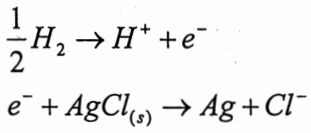 ;The cell reaction is
 + AgCl(s) → Ag + H+ +Cl-; e =1.602x10⁻¹⁹C]
 (A) -5.50×10-² J/mol, (B) -55 J/mol, (C) -550 J/mol, (D) -550 kJ/mol, (E) -5,500 kJ/mol

 ? (A)T-shaped, (B)trigonal pyramidal , (C)seesaw, (D)tetrahedral, (E) trigonal planar