所屬科目:研究所、轉學考(插大)◆生物化學
1. Choose the correct description. (A) Rhinoceros horn is hard and tough because it has high glucosamine content. (B) D-glucose is an anomer of L-glucose. (C) Lipoprotein is a dominant feature of the outer membrane of the cell wall of gram-negative bacteria. (D) Dithiothreitol could break the disulfide bond. (E) The peptide alanylglutamylglycylalanylleucine has five peptide bonds.
2. A repeating structural unit in a multimeric protein is known as a(n): (A) domain. (B) motif. (C) oligomer. (D) protomer. (E) subunit.
3. Please choose the correct answer from the following descriptions:
(1) Amylose is unbranched; amylopectin and glycogen contain many (a1→4) branches.
(2) Starch is the most abundant polysaccharide in nature.
(3) Dextran is homopolysaccharide.
(4) The galactose unit of the compound Gal(ẞ1→4)Glc residue is at the reducing end.
(5) D-glucose and D-glucuronic acid is different on C6.
(A) 1, 2, and 5 are incorrect . (B) 2 and 3 are correct. (C) 2 and 5 correct. (D) 1 and 3 are correct. (E) 1, 2, and 4 are incorrect .
4. Both water and glucose share an -OH that can serve as a substrate for a reaction with the terminal phosphate of ATP catalyzed by hexokinase. Glucose, however, is about a million times more reactive as a substrate than water. The best explanation is that: (A) Glucose has more -OH groups per molecule than does water. (B) The larger glucose binds better to the enzyme; it induces a conformational change in hexokinase that brings active-site amino acids into position for catalysis. (C) The -OH group of water is attached to an inhibitory H atom, while the glucose -OH group is attached to С. (D) Water and the second substrate, ATP, compete for the active site resulting in a competitive inhibition of the enzyme. (E) Water normally will not reach the active site because it is hydrophobic.
5. Which of the following is not correct concerning 2,3-bisphosphoglycerate (BPG)? (A) It binds at a distance from the heme groups of hemoglobin. (B) It binds with lower affinity to fetal hemoglobin than to adult hemoglobin. (C) It increases the affinity of hemoglobin for oxygen. (D) It is an allosteric modulator. (E) It is normally found associated with the hemoglobin extracted from red blood cells.
6. A monoclonal antibody differs from a polyclonal antibody in that monoclonal antibodies: (A) are labeled with chemicals that can be visualized. (B) are produced by cells from the same organism that produced the antigen. (C) are synthesized by a population of identical, or "cloned," cells. (D) are synthesized only in living organisms. (E) have only a single polypeptide chain that can recognize an antigen.
7. Which of the following statements of electron transport chain is not true ? (A) Complex I contains copper ions. (B) The final reduced species in the electron transport chain in mitochondria is H2O. (C) The P/O ratio refers to the number of moles of ATP produced for each mole of oxygen atoms consumed in electron transport. (D) Cytochrome c is a macromolecule which is loosely bound to the outer surface of the inner mitochondrial membrane. (E) None of the above.
8. Iron deficiency in a cell can adversely affect electron transport at which of the following sites: (A) Cytochrome b and cytochrome c. (B) Coenzyme Q and FADH2. (C) NADH and FADH2. (D) Coenzyme Q and NADH. (E) All sites in electron transport are affected.
9. Which one of the following statements about glycolysis is correct : (A) Conversion of glucose to glyceraldehyde-3-phosphate is an exergonic reaction. (B) Conversion of glucose-6-phosphate to fructose-6-phosphate is a cleavage reaction. (C) Conversion of glyceraldehyde-3-phosphate to give 1,3-bisphosphoglycerate is a dehydration reaction. (D) Conversion of dihyroxyacetone phosphate to glyceraldehyde-3-phosphate is an isomerization reaction. (E) Conversion of 2-phosphoglycerate to give phosphoenolpyruvate is an oxidation reaction.
10. Which one of the following is not associated with the oxidation of substrates by the citric acid cycle? (A) CO2 production. (B) Pyridine nucleotide oxidation. (C) Flavin reduction. (D) Lipoic acid present in some of the enzyme systems. (E) All of the above are involved.
11. Which one is not related with cardiovascular disease? (A) Cholesterol. (B) Caveolin. (C) Avastin. (D) HMG-CoA reductase. (E) Lovastatin.
12. Joseph intended to donate his blood after a meal, but was found with a milky blood. Which plasma lipoprotein might be responsible for this phenomenon? (A) Chylomicrons. (B) VLDL. (C) LDL. (D) HDL. (E) ACAT.
13. The compound that consists of deoxyribose linked by an N-glycosidic bond to N-1 of cytosine is: (A) a deoxyribonucleoside. (B) a purine nucleotide. (C) a pyrimidine nucleotide. (D) deoxycytidine monophosphate. (E) cytidine.
14. Deamination of the nucleotide base adenine yields nucleotide base: (A) xanthine. (B) inosine. (C) uracil. (D) hypoxanthine. (E) xanthylate.
15. The proportion of the human genome that is translated into protein is: (A) less than 0.5%. (B) roughly 1.5%. (C) roughly 10%. (D) roughly 15%. (E) roughly 25%.
16. The enzyme that catalyzes the conversion of GMP to GDP is: (A) nucleoside diphosphate kinase. (B) ribonucleotide reductase. (C) adenylate kinase. (D) guanine phosphoribosyltransferase. (E) nucleoside monophosphate kinase.
17. Which of the following descriptions about human hormones is false ? (A) Prostaglandins are examples of eicosanoid hormones. (B) The tropic hormones (such as thyrotropin, somatotropin, and luteinizing hormone) are produced and released by the anterior pituitary. (C) NO is derived from amino acid asparagine. (D) Eicosanoids are paracrine hormones. (E) Catecholamines are derived from amino acid tyrosine.
18. Which of the following descriptions is false ? (A) The double helix of DNA in the B-form is stabilized by nonspecific base-stacking interaction between two adjacent bases in the same strand. (B) The phosphodiester bond that joins adjacent nucleotides in DNA associates ionically with metal ions, polyamines, and proteins. (C) The phosphodiester bond that joins adjacent nucleotides in DNA is susceptible to alkaline hydrolysis. (D) The pentoses in nucleic acids do not undergo interconversion of the straight-chain form and the ring form. (E) The size and base composition of a double-stranded DNA are factors that affect the 'melting temperature of DNA.
19. In liver mitochondria, catalyzes the reaction to release the amino group from glutamine; the products are glutamate and ammonia. (A) glutaminase. (B) glutamate dehydrogenase. (C) glutamate aminotransferase. (D) glutamine aminotransferase. (E) glutamine amidotransferase.
20. In the activated-methyl cycle for the synthesis of methionin and S-adenosylmethionine (adoMet), the methyl donor for the regeneration of methionin from homocystein is: (A) S-adenosylmethionine. (B) N5-methyltetrahydrofolate. (C) N5-formyltetrahydrofolate. (D) glutathione. (E) -methylenetetrahydrofolate.
21. A mutation in one gene that counteracts the effects of a mutation in another gene is known as a: (A) temperature-sensitive mutation. (B) recessive mutation. (C) suppressor mutation. (D) conditional mutation. (E) None of these.
22. In RNA interference studies, the double-stranded RNA: (A) disrupts the target DNA sequence. (B) results in the destruction of the target mRNA. (C) destroys the target protein. (D) All of the above. (E) None of the above.
23. Which of the following is a typical feature of prokaryotic genes? (A) Polycistronic messenger RNAs. (B) Complex transcription units. (C) Introns. (D) A and C. (E) None of the above.
24. Splice sites in pre-mRNA are marked by two universally conserved sequences contained: (A) in the middle of the intron. (B) at the ends of the exons. (C) at the ends of the introns. (D) in the middle of the exon. (E) None of the above.
25. Diastereomers are: (A) mirror-image, nonsuperimposable stereoisomers. (B) non-mirror-image, nonsuperimposable stereoisomers. (C) mirror-image, superimposable stereoisomers. (D) stereoisomers with one or more double bonds. (E) None of the above.
26. Please choose the correct answer from the following descriptions:
(1) The non-amino acid part of a conjugated protein is called its prosthetic group.
(2) a-keratin is a protein in which the polypeptides are mainly in the a-helix conformation.
(3) Arg side-chain is an imidazole group and has important role in maintaining pH in blood.
(4) Every turn of a-helix is 10 A in length.
(5) Phenylisothiocyanate could only be used to determine the first amino acid of a protein. (A) 1 and 2 are correct. (B) 1, 4, and 5 are incorrect. (C) 1, 3, and 5 are incorrect. (D) 2 and 5 are correct. (E) 3 and 4 are correct.
27. Please choose the correct answer from the following descriptions:
(1) All amino acids in nature are L-amino acids.
(2) The pl value of the peptide "GAILLSDN" is lower than that of the peptide "VPRYTTN".
(3) Paralogous genes are presumed to have been derived by gene duplication followed by gradual changes in the sequences of both copies.
(4) Collagen is full of a-helix structure and has Gly-X-Pro repeating sequence.
(5) Trypsin could hydrolyze the "X-K" peptide bond. (A) 1, 3, and 5 are correct. (B) 2 and 5 are correct. (C) 3, 4, and 5 are correct. (D) Only 3 is correct. (E) 1, 4, and 5 are incorrect.
28. Please choose the correct answer from the following descriptions:
(1) For naming the RS system, -CH2OH group has higher priority than -CHO group.
(2) Cyanogen bromide could be used to cleave the "X-C" peptide bond.
(3) The role of glycogen is energy storage in bacteria and animal cells.
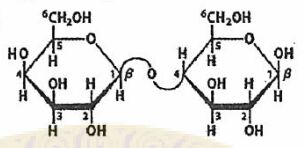
(4) The structure of lactose is
(5) Within 20 common amino acids, Thr and Leu are the only two amino acids with two chiral centers. (A) 2 and 4 are incorrect . (B) 3 and 4 are correct. (C) 1, 3, and 5 are correct. (D) 3 and 5 are correct. (E) 1, 2, and 4 are incorrect .
29. Which of the following pairs of bonds within a peptide backbone show free rotation around both bonds? (A) Ca-C and N-Ca. (B) C=O and N—С. (C) C=O and N-Ca. (D) N-C and Ca-C. (E) N-Ca and N—C.
30. All of the following contribute to the large, negative, free-energy change upon hydrolysis of "high-energy" compounds except : (A) electrostatic repulsion in the reactant. (B) low activation energy of forward reaction. (C) stabilization of products by extra resonance forms. (D) stabilization of products by ionization. (E) stabilization of products by solvation.
31. In a plot of I/V against 1/[S] for an enzyme-catalyzed reaction, the presence of a competitive inhibitor will alter the: (A) curvature of the plot. (B) intercept on the 1/[S] axis. (C) intercept on the I/V axis. (D) pK of the plot. (E)
32. Which one of the following statements is not true : (A) The first step in glycogen breakdown does not require ATP. (B) ATP is an allosteric factor for controlling glycogen phosphorylase b. (C) Low blood glucose will promote dephosphorylation of pyruvate kinase. (D) Phosphorylated glycogen phosphorylase and glycogen synthase can both be dephosphorylaed by the same phosphatase. (E) Complete breakdown of glycogen catalyzes by glycogen debranching enzyme.
33. Which one of the following statements about gluconeogenesis is not true ? (A) If the reactions of gluconeogenesis were simply the reactions of glycolysis in reverse, the process would be energetically unfeasible (highly endergonic). (B) The conversion of pyruvate to phosphoenolpruvate in gluconeogenesis requires both pyruvate carboxylase and phosphoenolpyruvate carboxykinase. (C) The first step in the synthesis of glucose from lactate in the liver is oxidation of the lactate to pyruvate. (D) Ingesting sodium succinate cannot promote gluconeogenesis. (E) None of the above.
34. Which one of the following statements statements about the citric acid cycle is not true : (A) Oxaloacetate is used as a substrate but is not consumed in the cycle. (B) In the presence of malonate, one would expect succinate to accumulate. (C) Succinate dehydrogenase channels electrons directly into the electron transfer chain. (D) The condensing enzyme is subject to allosteric regulation by ATP and NADH. (E) All enzymes of the cycle are located in the cytoplasm, except succinat dehydrogenase, which is bound to the inner mitochondrial membrane.
35. Which of the following statements is true :
(1) In glyoxylate cycle, conversion of isocitrate to succinate replaces the two reductive reactions of the TCA cycle.
(2) Isocitrate dehydrogenase catalyzes the conversion of isocitrate to succinate and glyoxylate. (3) Glyoxylate + acetyl-CoA → Coenzyme A + malate catalyzed by malate synthase.
(4) Glyoxylate + acetyl-CoA → Coenzyme A + malate occurs in mitochondria.
(5) Using glyoxylate cycle, plants can use the acetyl-CoA produced in fatty acid metabolism to produce oxaloacetate and other intermediates for carbohydrate synthesis. (A) 3 and 5. (B) 1, 3, and 5. (C) 1, 2, 3, and 5. (D) 1, 3, 4, and 5. (E) All of the above.
36. Which one is not correct ? (A) Insulin mobilizes GLUT4 in muscle and adipose tissue. (B) Glucose is cotransported with across intestinal epithelial cells. (C) Glucose passes intestinal epithelial cells into the blood via GLUT2. (D) ATPase pump outward. (E) AQP-2 is regulated by vasopressin to allow glycrerol or urea to pass.
37. Free fatty acids in the liver have four possible fates. Which one is not correct ? They can be (A) metabolized by ẞ oxidation in mitochondria. (B) stored as triacylglyderol in lipid droplets. (C) used to form phosphotidylcholine. (D) packaged with apoB into VLDL. (E) turned into acetyl-CoA in the cytosol.
38. Assuming that you are attending a triathlon, which one will not occur? (A) Ketone bodies are accumulating in the brain. (B) Proton pump is increasing concentration in the stomach. (C) Bicarbonate is increasing in the blood. (D) Aquaporin is lowering its water reabsorption in the renal tubes. (E) Malonyl-CoA is inhibiting ẞ oxidation.
39. Which of the following statements is false ? (A) Animals can produce tyrosine directly from phenylalanine. (B) 1-Dopa is an intermediate in the conversion of tyrosine to epinephrine. (C) Bile pigments are formed in the degradation of heme. (D) Histidine undergoes amination to histamine. (E) Asparagine can be synthesized by amidation of aspartate, thus it is not an essential amino acid in human.
40. Which of the following descriptions is false ? (A) When a solution of double-stranded DNA is heated at neutral pH, the absorption of ultraviolet (260 nm) light may increase. (B) Double-stranded regions of RNA can form between two self-complementary regions of the same single strand of RNA. (C) Lowering the ionic strength of a solution of double-stranded DNA will decrease the melting temperature of the DNA: (D) The Hoogsteen (non Watson-Crick) interaction, which can result in triple-helical DNA structures, are primarily hydrophobic interactions involving the bases. (E) In nucleotides and nucleic acids, syn and anti conformations relate to rotation around the sugar-base bond.
41. Which of the following statements is correct of the biosynthetic pathways for purine and pyrimidine nucleotides?
(1) The amino acid aspartate is directly involved in the purine biosynthetic pathway.
(2) 5-Phosphoribosyl-1-pyrophosphate (PRPP) is a synthetic precursor for UMP.
(3) Orotic acid is an essential precursor for purine nucleotides.
(4) Inosinate is the precursor for the synthesis of pyrimidine nucleotides.
(5) The carbamoyl phosphate required in pyrimidine biosynthesis is made in the cytosol by carbamoyl phosphate synthetase II. (A) 1 and 4. (B) 1, 2, and 3. (C) 4 and 5. (D) 1, 2, and 5. (E) 2 only.
42. The primary source of one-carbon units for tetrahydrofolate in the cells is the carbon removed in the conversion of :(A) methionine to homocystein. (B) serine to pyruvate.(C) N-methyltetrahydrofolate to tetrahydrofolate.(D) serine to glycine.(E) S-adenosylmethionine to S-adenosylhomocystein.
43. Which of the following statements regarding plasmid cloning vectors is correct ?
(1) Foreign DNA fragments up to 30,000 base pairs cannot be cloned in a typical plasmid vector. (2) Plasmid vectors must carry promoters for inserted gene fragments.
(3) The copy number of plasmids may vary from a few to several hundred.
(4) In the laboratory, microinjection is commonly used to introduce recombinant plasmids into bacterial cells.
(5) The replication origin (ori sequence) in plasmid cloning vectors is a sequence required for packaging recombinant plasmids into bacteriophage. (A) 1 and 2. (B) 3 and 5. (C) 1, 2, and 4. (D) 1 and 3. (E) 3 only.
44. Which of the following sequences is required in an expression vector (for use with E. coli) that is not essential in a general cloning plasmid?
(1) replication origin (2) a bacterial promoter and its associated operator
(3) a ribosomal binding site (4) a transcription termination sequence
(5) antibiotic resistance gene (A) 1 and 2. (B) 2, 4, and 5. (C) 2, 3, and 4. (D) 2 and 4. (E) 2 only.
45. Many important neurotransmitters are primary or secondary amines, derived from amino acids through decarboxylation. For example, glutamate decarboxylation gives rise to y-aminobutyrate (GABA). These amino acid decarboxylation reactions require the coenzyme: (A) pyridoxal phosphate (PLP). (B) biotin. (C) . (D) tetrahydrofolate. (E) nicotinamide adenine dinucleotide (NAD).
46. The enzymes having the prosthetic group of pyridoxal phosphate (PLP) participate in a variety of reactions at the a carbons of amino acids. These reactions include:
(1) racemization (2) decarboxylation (3) transmination
(4) methylation (5) acetylation (A) 3 and 4. (B) 1, 2, and 3. (C) 3 and 5. (D) 1 and 3. (E) 3 only.
47. Serine can be converted directly into pyruvate. The reaction, catalyzed by serine dehydratase, requires the coenzyme: (A) pyridoxal phosphate (PLP). (B) biotin. (C) . (D) tetrahydrofolate. (E) nicotinamide adenine dinucleotide (NAD).
48. Which of the following descriptions about human metabolism is correct ?
(1) The Cori cycle is the synthesis of alanine from pyruvate in skeletal muscle and the synthesis of pyruvate from alanine in liver.
(2) Glucokinase in the liver acts in the conversion of liver glycogen to glucose 1-phosphate.
(3) The largest energy store in a well-nourished human is liver glycogen.
(4) Among its numerous metabolic effects, the protein leptin makes muscle and liver cells more sensitive to insulin.
(5) The hormone insulin decreases appetite. (A) 1 and 4. (B) 2 and 5. (C) 1 and 3. (D) 4 and 5. (E) 4 only.
49. The enzyme telomerase uses mechanisms that involve: (A) repeating sequences at the telomeres. (B) having RNA oligonucleotides to act as templates as part of the enzyme. (C) allowing the end of the chromosome to get a little shorter each time a cell divides. (D) both repeating sequences at the end of chromosomes and RNA oligonucleotides to act as templates as part of the enzyme. (E) All of the above.
50. To study the function of the essential cytosolic Hsc70 genes in yeast, researchers constructed a shuttle vector in which a copy of the Hsc70 gene was ligated to the GAL1 promoter. The vector was then introduced into haploid yeast cells in which all four copies of the Hsc70 genes had been disrupted. Following introduction of the vector, you would expect that: (A) the yeast cells would grow on both glucose and galactose media. (B) the yeast cells would grow on glucose but not galactose medium. (C) the yeast cells would grow on galactose but not glucose medium. (D) on transfer to either glucose or galactose medium, the vector-carrying cells would eventually stop growing because of insufficient Hsc70 activity. (E) None of the above.
 阿摩線上測驗
登入
 of DNA.
 -methylenetetrahydrofolate.

 across intestinal epithelial cells. (C) Glucose passes intestinal epithelial cells into the blood via GLUT2. (D)
 ATPase pump
 outward. (E) AQP-2 is regulated by vasopressin to allow glycrerol or urea to pass.
 concentration in the stomach. (C) Bicarbonate is increasing in the blood. (D) Aquaporin is lowering its water reabsorption in the renal tubes. (E) Malonyl-CoA is inhibiting ẞ oxidation.
 of the DNA: (D) The Hoogsteen (non Watson-Crick) interaction, which can result in triple-helical DNA structures, are primarily hydrophobic interactions involving the bases. (E) In nucleotides and nucleic acids, syn and anti conformations relate to rotation around the sugar-base bond.
 . (D) tetrahydrofolate. (E) nicotinamide adenine dinucleotide (NAD).
 . (D) tetrahydrofolate. (E) nicotinamide adenine dinucleotide (NAD).