所屬科目:研究所、轉學考(插大)-微積分
2.為何? (A)-3/2(B)-1/2(C)1/2(D)3/2(E)發散。
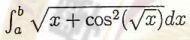
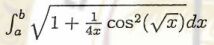
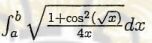
3. Which of the following integrals gives the length of the graph y = between x = a and r = b, where 0 < a < b? (A)(B)(C)(D)(E)。
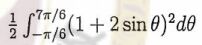
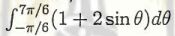
4. Which of the following integrals represents the area enclosed by the smaller loop of the graph of r = 1 + 2 sin 0? (A)(B)(C)(D)(E)。
6. Which expression represents the volume of the solid generated when the region between the following two curves y=6-x2 and y=x2/2over the interval [0,2] is rotated around the x-axis? (A)(B) (C)(D) (E) 。
7. The function f satisfies the equation Evaluate f(π/3). (A) 6.196 (B) 2 (C) 3.098 (D) 4 (E) 3.055*
8. The function g(x) is the derivative of. What is the derivative of the inverse of g(x) at x = 3? (A) 4 (B) 1/4(C) 12 (D) 1/3 (E) 1/12
9.當存在其值為一3。請問下列哪個選項是正確的? (A)a=0(B)a?=9(C)a=-3(D)a=3(E)以上皆非。
10.當。請問下列哪個選項是正確的? (A)k=3(B)k= 1(C)a=1/6(D)a<b(E) c=3
11.當f(x,y)=x2+y2+y2texp(2-y),且F(T,3,z)=f(xy)一z。請問下列哪些選項 是正確的? (A) (B)(C)∇F at the point (1,2,-1) is (1,3, -1)T. (D) The tangent plane to the graph of the function F(x, y) at the point (1, 1,3) is 3(c-1)+ (V-1)- (z-3)=0. (E) The minimum value of f(c, y) is 0.
12.當f(t,y)=3x2y+y3+6xy,請問下列哪些選項是正確的? (A)(B)∇f(r,y)=(0,0)的解只有四個。 (C)f(x,y)的局部極大發生在(0,0)(D)(-2,0)為f(x,y)的鞍點(saddle point) (E)
13. A region A is bounded by the hyperbolas (雙曲線) xy = 1 and xy = 2, and the curves xy2 = 3 and xy2 = 4. The area of A is denoted by area.. Use the change of variables u = ry and u = ay', the area of the image of the region A in the coordinate space determined by (u,v) under the transformation is called areat. 請問下列哪些選項是正確的? (A) areao =In4-1n3(B)(C) (D) The Jacobian determinant (E)
14. Let S denote the solid enclosed by x2 + y2 + z2 = 2z and z2 = x2+y2. (A) The length of of the curve determined by {(x, y, z) : x2+y2+z2 = 2z and z2 = x2 + y2} is 2π. (B) The volume of S is less than less than 2m/3. (C) The volume of S is equal to w.(D)當使用球面坐標系(r,θ,Φ),即x=rsinθcosΦ,y=rsinθsinΦ,z=rcosΦ時, S的體積等於 (E)S的表面積大於4π。
15. (8分) Show that the line integral Sc dy is independent of path and evaluate the given integral for any path from (2,π/6) to (0, -2).
 阿摩線上測驗
登入
 為何?
(A)-3/2(B)-1/2(C)1/2(D)3/2(E)發散。
 between
x = a and r = b, where 0 < a < b?
(A)
 (B)
 (C)
 (D)
 (E)
 。
 (B)
 (C)
 (D)
 (E)
 。
 (B)
 (C)
 (D)
 (E)
 。
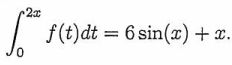 Evaluate f(π/3). (A) 6.196 (B) 2 (C) 3.098 (D) 4 (E) 3.055*
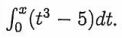 . What is the derivative of the
inverse of g(x) at x = 3?
(A) 4 (B) 1/4(C) 12 (D) 1/3 (E) 1/12
 存在其值為一3。請問下列哪個選項是正確的?
(A)a=0(B)a?=9(C)a=-3(D)a=3(E)以上皆非。
 。請問下列哪個選項是正確的?
(A)k=3(B)k= 1(C)a=1/6(D)a<b(E) c=3
 (B)
 (C)∇F at the point (1,2,-1) is (1,3, -1)T. (D) The tangent plane to the graph
of the function F(x, y) at the point (1, 1,3) is 3(c-1)+ (V-1)- (z-3)=0.
(E) The minimum value of f(c, y) is 0.
 (B)∇f(r,y)=(0,0)的解只有四個。
(C)f(x,y)的局部極大發生在(0,0)(D)(-2,0)為f(x,y)的鞍點(saddle point)
(E)

 (C)
 (D) The Jacobian determinant
 (E)

 (E)S的表面積大於4π。
 dy is independent
of path and evaluate the given integral for any path from (2,π/6) to (0, -2).