所屬科目:研究所、轉學考(插大)-微積分
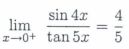
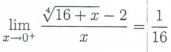
1. Which of the following must be true? (A) (B) (C) (D)
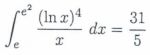
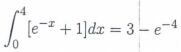
2. Which of the following must be true? (A) (B) (C) (D)
3. Which of the following must be true? (A) The series converges for all p≠0$ (B) The series converges absolutely (C) The series converges (D) The series diverges
4. Set f(x, y) = x2 + 2y2. Which of the following must be true? (A) f(x, y) is concave upward on the line $y = -x (B) the relative minimum of f(x, y) subject to the constraint x + y = 1 is (C) the absolute minimum of f(x, y) on its domain does not exist (D) the minimum rate of change of f(x, y) at the point P(1, -1) is
二、填空題1. Find the arc length of the curve x = from y = 0 to y = 1. (a) _______
3. Find the volume of the solid obtained by rotating about the x-axis the region under the curve y = sinx cosx on the interval $[0,π/2}]. (c) _______
5. If f is a continuous function such that for all x, find an explicit formula for f(x). (e) _______
6. Find the interval of convergence of the series . (f) _______
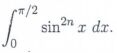
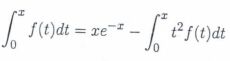
三、計算題 1. (a) (5 分) Derive the formula
(b) (5 分) Use the above formula to evaluate
2. Use the surface integral in Stokes' Theorem to calculate the flux of the field F = (x - y) i + (y-z) j + (z - x) k across the surface S:r (Φ,θ) = (2 sinΦcosθ) i + (2 sinΦsinθ) j + 2 cosΦ k, 0 ≤ Φ ≤ π/2,0 ≤ θ ≤ 2π in the direction of the outward unit normal n.
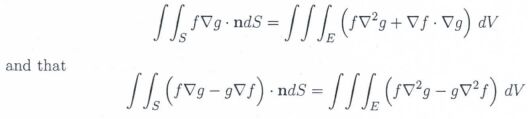
3. Suppose that f and g are scalar functions with continuous first- and second-order partial derivatives throughout a region E that is bounded by a closed piecewise smooth surface S. Show that
 阿摩線上測驗
登入
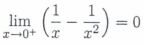 (B)
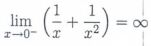 (C)
 (D)
 (B)
 (C)
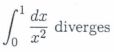 (D)
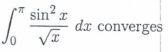
 converges for all p≠0$ (B) The series
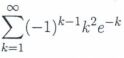 converges absolutely (C) The series
 converges (D) The series
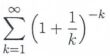 diverges
 (C) the absolute minimum of f(x, y) on its domain does not exist (D) the minimum rate of change of f(x, y) at the point P(1, -1) is

 from y = 0 to y = 1. (a) _______
 . (f) _______