阿摩線上測驗
登入
首頁
>
學士後西醫-有機化學
> 102年 - 102 學士後西醫:有機化學#27324
102年 - 102 學士後西醫:有機化學#27324
科目:
學士後西醫-有機化學 |
年份:
102年 |
選擇題數:
80 |
申論題數:
0
試卷資訊
所屬科目:
學士後西醫-有機化學
選擇題 (80)
I. Choose one correct answer for the following questions 【單選題】每題 1 分,共計 60 分,答錯 1 題倒扣 0.25 分,倒扣至本大題零分為止,未作答,不給分亦不扣分。
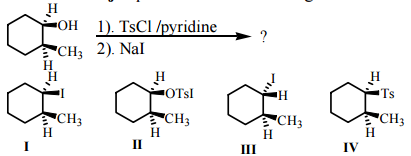
1. What is the major product obtained from the following reaction sequence?
(A) I (B) II (C) III (D) IV (E) V
2. The hydroboration-oxidation procedure can be successfully employed for synthesis of deuterated derivatives, by using BD3 instead of BH3. What major product would you expect from the following reaction?
(A) I (B) II (C) III (D) IV (E) V
3. Predict the major product for the following reaction.
(A) I (B) II (C) III (D) IV (E) Both I and III
4. The following atoms are commonly encountered in organic molecules. For which is it not possible to isolate enantiomers due to rapid inversion? (A) trivalent phosphorus (B) trivalent nitrogen (C) divalent sulfur (D) trivalent sulfur (E) both B and C
5. Which of these alkyl halides can NOT be used to prepare amines using Gabriel synthesis? (A) 1-bromopentane (B) 1-bromo-3-methylbutane (C) 2-bromo-3-methylpentane (D) 1-bromo-2,3-dimethylbutane (E) 2-bromo-2,3-dimethylbutane
6. Which of the following structures is a Fischer projection of (2S,3S,4R)-hexane-2,3,4-triol.
(A) I (B) II (C) III (D) IV (E) V
7. Treatment of (S)-6-chloro-1-methyl-1-cyclohexene with H3O is expected to produce which of the following product(s)?
(A) I and III (B) II (C) II and V (D) IV (E) I, III and V.
8. Which of the following substituent has the highest priority according to the Cahn-Ingold-Prelog system?
(A) –COOH (B) –CHO (C) –CH
2
OH (D) –CH
3
(E) -H
9. What is the IUPAC name of the expected major product formed upon reaction of HCl with 3-methyl-1-butene?(A) 1-Chloro-2-methylbutane (B) 1-Chloro-3-methylbutane (C) 2-Chloro-2-methylbutane (D) 2-Chloro-3-methylbutane (E) 1-Chloropentane
10. Which sequence correctly ranks the following substrates in order of increasing reactivity in an SN1 reaction?
(A) 3 < 2 < 1 (B) 2 < 3 < 1 (C) 2 < 1 < 3 (D) 1 < 3 < 2 (E) 1 < 2 < 3
11. A pure sample of (S)-phenylalanine has a specific rotation of +70
o
. A mixture of the two enantiomers of phenylalanine gives a specific rotation of -7.0
o
. What are the percentages of the S and R enantiomers in the mixture? (A) 75 % S, 25 % R (B) 65 % S, 35 % R (C) 55 % S, 45 % R (D) 45 % S, 55 % R (E) 35 % S, 65 % R
12. Predict the major product when pyridine is treated with a mixture of nitric acid and sulfuric acid (A) 2-nitropyridine (B) 3-nitropyridine (C) 4-nitropyridine (D) 2,3-dinitropyridine (E) 2,4-dinitropyridine
13. Predict the product(s) for the following reaction.Diethylheptanedioate
?
(A) I (B) II (C) III (D) IV (E) V
14. Which molecular formula is consistent with the following mass spectrum data?
at m/z= 84, relative height=10.0%
at m/z= 85, relative height=0.56%
(A) C
5
H
10
O (B) C
5
H
8
O (C) C
5
H
24
(D) C
6
H
12
(E) C
4
H
6
O
2
15. Which sequence correctly ranks the following dienes in order of increasing reactivity in the Diels-Alder reaction?
(A) 3 < 2 < 1 (B) 2 < 3 < 1 (C) 2 < 1 < 3 (D) 1 < 3 < 2 (E) 1 < 2 < 3 .
16. Rank the following compounds in increasing order of reactivity in the intramolecular displacement of p-bromophenolate to form a cyclic anhydride.
(A) A < B < C (B) B < A < C (C) C < A < B (D) B < C < A (E) None of above
17. Which of the following undergoes solvolysis in water more rapidly?
(A) I (B) II (C) III (D) I and II (E) all of the above
18. Grignard reagents react with oxirane (ethylene oxide) to form 1o -alcohols but can be prepared in tetrahydrofuran solvent. Why is this difference in behavior observed?
(A) Steric hindrance in the case of tetrahydrofuran precludes reaction with the Grignard.
(B) There is a better leaving group in the oxirane molecule. (C) The oxirane ring is the more highly strained.
(D) It is easier to obtain tetrahydrofuran in anhydrous condition.
(E) Oxirane is a cyclic ether, while tetrahydrofuran is a hydrocarbon.
19. The regioselectivity and stereospecificity in the oxymercuration-demercuration of an alkene is best described as:
(A) Markovnikov orientation with syn-addition
(B) Markovnikov orientation with anti-addition
(C) anti-Markovnikov orientation with syn-addition
(D) anti-Markovnikov orientation with anti-addition
(E)Markonikov orientation with both syn- and anti-addition
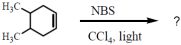
20. What is the major product of the following reaction?
(A)
(B)
(C)
(D)
(E) None of the above.
21. What is the major product of the following reaction?
(A) I (B) II (C) III (D) IV (E) V
22. Which of the following descriptions of the nucleoside uridine does NOT apply to the structure of the molecule? (A) The uracil base is directly bonded to the 1' position of ribofuranose in the α position. (B) The ribofuranose moiety is found in only the D configuration. (C) Nitrogen, at position 1 in the uracil base, is directly bonded to the ribofuranose moiety. (D) The 5' OH group is replaced with phosphate(s) in the nucleotide structure. (E) None of the above
23. Which sequence ranks the following aromatic rings of this compound in order of increasing reactivity in an electrophilic aromatic substitution reaction (slowest to fastest reacting)?
(A) 3 < 2 < 1 (B) 2 < 3 < 1 (C) 2 < 1 < 3 (D) 1 < 3 < 2 (E) 1 < 2 < 3
24. Which sequence ranks the indicated protons in order of increasing acidity?
(A) 3 < 2 < 1 (B) 2 < 3 < 1 (C) 2 < 1 < 3 (D) 1 < 3 < 2 (E) 1 < 2 < 3
25. Which pair of structures represents the same compound?
(A) I and II (B) II and IV (C) III and IV (D) III and V (E) IV and V
26. What is the major product of the following reaction?
(A) I (B) II (C) III (D) IV (E) V
27. What is the major product of the following reaction?
(A) I (B) II (C) III (D) IV (E) V
28. Which of the following is the strongest nucleophile? (A) NaOH (B) NaOMe (C) KOH (D) KOMe (E) KSMe
【已刪除】
複選題
29. Which would be the major product of the reaction shown?
(A) I (B) II (C) III (D) IV (E) V
(AB)送分
30. Provide the major product for the following reaction
?
(A) I (B) II (C) III (D) IV (E) V
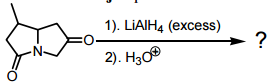
31. Predict the major product for the following reaction.
(A) I (B) II (C) III (D) IV (E) I and II.
32. Predict the major product for the following reaction.
(A) I (B) II (C) III (D) IV (E) V
33. Which of the alkynes below, after undergoing an acid-catalyzed hydration, would be expected to produce two different ketones in nearly equivalent yields?
(A) 1-hexyne (B) 2-hexyne (C) 3-hexyne (D) 3-methyl-1-pentyne (E) 4-methyl-1-pentyne
34. Predict the products of the following reaction:
(A) I, III, and IV (B) II, III, and IV (C) I, III, and V (D) II, IV, and VI (E) III and IV
35. Which of the following is a correct prediction of the chemical shifts (ppm) for the signals in the 1 H NMR spectrum for the following compound?
(A) a = 5.7, b = 5.2, c = 4.4, d = 1.9
(B) a = 5.2, b = 5.7, c = 1.9, d = 4.4
(C) a = 4.4, b = 5.2, c = 1.9, d = 1.9
(D) a = 5.2, b = 4.4, c = 5.7, d = 1.9 (E) a = 1.9, b = 5.7, c = 5.2, d = 4.4
36. Provide the name of the major alkene product that results when (2R,3R)-2,3-dibromopentane is treated with zinc in acetic acid. (A) (Z)-2-pentene (B) (E)-2-pentene (C) (R)-3-bromo-1-pentene (D) (S)-3-bromo-1-pentene (E) (R)-2-bromo-3-pentene
37. What is the major expected product(s) of the reaction shown below?
(A) 2,2-Dichloropentane (B) 3,3-Dichloropentane (C) 2,3-Dichloropentane (D) A and B (E) B and C
38. What is the expected major organic product from treatment of 4-methyl-2-pentyne with hydrogen in the presence of Lindlar's catalyst?
(A) (E)-4-methyl-2-pentene
(B) (Z)-4-methyl-2-pentene
(C) (E)-2-methyl-2-pentene
(D) (Z)-2-methyl-2-pentene
(E) 2-methylpentane
39. Refer to the equilibrium below, the correct name for the cyclic structure is_______.
(A) α-L-ribofuranose (B) β-D-ribofuranose (C) α-L-ribopyranose (D) β-D-ribopyranose (E) None of the above
40. Which of the following best describes the key mechanistic steps in the reaction of an acid chloride and an alcohol to form an ester? (A) elimination followed by addition (B) addition followed by decarboxylation (C) addition followed by elimination (D) substitution followed by addition (E) rearrangement
41. Many nucleophilic addition reactions of aldehydes and ketones are catalyzed by acid or base. Bases catalyze hydration by: (A) making the carbonyl group more electrophilic (B) shifting the equilibrium of the reaction (C) making the carbonyl group less electrophilic (D) converting the water to hydroxide ion, a much better nucleophile (E) None of the above
42. Which of the following would produce a mixture of products when treated under appropriate conditions with N-bromosuccinimide? (A) oct-4-ene (B) hept-1-ene (C) 4,4-dimethylcyclopentene (D) 4,5-dimethylcyclohexene (E) all produce a mixture of products .
43. Which of the following statements correctly characterizes the following compound?
(A) contains 6 π electrons and is aromatic
(B) contains 6 π electrons and is nonaromatic
(C) contains 8 π electrons and is antiaromatic
(D) contains 8 π electrons and is aromatic
(E) contains 8 π electrons and is nonaromatic
44. What is the major product of the following reaction? 1. OsO4, pyridine ?
45. The 1 H NMR spectrum of which of the compounds below, all of formula C7H12O2, would consist of three singlets only?
(A) I (B) II (C) III (D) IV (E) V
46. Arrange the following in order of increasing basicity: aniline, p-nitroaniline, p-toluidine, and p-methoxyaniline. (A) p-toluidine < p-methoxyaniline < aniline < p-nitroaniline (B) p-nitroaniline < p-toluidine < aniline < p-methoxyaniline (C) p-nitroaniline < aniline < p-toluidine < p-methoxyaniline (D) p-methoxyaniline < p-nitroaniline < p-toluidine < aniline (E) None of the above
47. What is the thermodynamic product of the sulfonation of naphthalene?
48. For the reaction shown, which of the compounds listed below would be the expected major, and final, organic product?
(A) I (B) II (C) III (D) IV (E) V
49. Predict the major product for the following Claisen rearrangement.
(A) I (B) II (C) III (D) IV (E) None of the above
50. Predict the major product for the following reaction.
(A) I (B) II (C) III (D) IV (E) V
51. Which of the following reagents can be used to cleave a tert-butoxycarbonyl (Boc) protecting group from a peptide? (A) H
2
/Pd (B) CF
3
CO
2
H (C) Na
2
CO
3
, H
2
O (D) LiAlH
4
(E) None of the above
52. The reaction shown below would be expected to produce as major products which of the following compounds?
(A)
+ enantiomer(B)
+ enantiomer
(C)
+ enantiomer (D)
+ enantiomer (E)
+ enantiomer
53. What is the best method for the preparation of m-dibromobenzene from benzene?
(A) 1). HNO
3
/H
2
SO
4
; 2). Sn/HCl; 3). NaNO
2
/HCl, 0°C; 4). Br
2
/FeBr
3
, twice.
(B) 1). HNO
3
/H
2
SO
4
; 2). Sn/HCl; 3). NaNO
2
/HCl, 0°C; 4). Br
2
/FeBr
3
; 5). H
3
PO
2
.
(C) 1). HNO
3
/H
2
SO
4
; 2). Sn/HCl; 3). NaNO
2
/HCl, 0°C; 4). H
3
PO
2
; 5). Br
2
/FeBr
3
, twice.
(D) 1). HNO
3
/H
2
SO
4
; 2). Br
2
/FeBr
3
; 3). Sn/HCl; 4). NaNO
2
/HCl, 0°C; 5). CuBr.
(E) Br
2
/FeBr
3
, twice.
54. Which is the best method for the synthesis of tert-butyl methyl ether?
(A) CH
3
ONa + (CH
3
)
3
CBr →
(B) (CH
3
)
3
CONa + CH
3
I →
(C) CH
3
OH + (CH
3
)
3
COH + H
2
SO
4
at 140°C →
(D) (CH
3
)
3
CONa + CH
3
OCH
3
→
(E) CH
3
ONa + (CH
3
)
3
COH →
55. Which of the following will result in removal of a benzyl ester protecting group? (A) acid hydrolysis only (B) decarbonylation only (C) catalytic hydrogenation only (D) both acid hydrolysis and decarbonylation (E) both catalytic hydrogenation and acid hydrolysis
56. Which of the following ketones will give a positive iodoform test? (A) 3-heptanone (B) 3-hexanone (C) cyclohexanone (D) 2-pentanone (E) 2-methyl-3-hexanone
57. Which of the following compounds will display a singlet, a triplet and a quartet in the 1 H NMR spectrum? (A) 1-chloro-2,2-dimethylbutane (B) 3-chloro-3-methylpentane (C) 3-chloropentane (D) 2-chloro-4-methylpentane (E) 3-chloro-2-methylpentane
58. Examining the infrared spectrum of a compound allows us to: (A) determine the types of functional groups present in the compound (B) determine the carbon-hydrogen framework of the compound (C) determine the molecular weight of the compound (D) determine the nature of the conjugated pi electron system in the compound (E) None of the above is correct
59. Which of these is the least reactive type of organometallic compound? (A) RK (B) R
2
Hg (C) RLi (D) R
2
Zn (E) R
3
Al
60. Which one of the following compounds will have the lowest wavenumber for carbonyl absorption?
(A) I (B) II (C) III (D) IV (E) V
【單選題】每題 2 分,共計 40 分,答錯 1 題倒扣 0.5 分,倒扣至本大題零分為止,未作答,不給分亦不扣分。
61. A student measured the optical activity of an unknown sugar at two different concentrations. The results of his measurements are shown below. Given that the sample cell had a path length of 10.0 cm, calculate the specific rotation for the unknown sugar.
concentration
observed rotation
2.00 g sugar in 10.0 mL water +159.1°
5.00 g sugar in 10.0 mL water +127.8°
(A) -10.5° (B) +25.6° (C) +79.5° (D) -104.5° (E) +256.2°
62. Which of the following series of synthetic steps could be used to carry out the transformation shown below?
(I) H
2
, Pt, (II) B
2
H
6
, (III) NaNO
2
, H
3
O , (IV) NaCN, HCl, (V) H
2
O
2
, NaOH (VI) PCC
(A) I → II → V (B) IV → I → III (C) III → VI → V (D) II → V → III (E) None of the above
63. What is the major product of the following reaction? H2SO4 ?
(A) I (B) II (C) III (D) IV (E) V
64. Which of the following sequences efficiently converts 2-methylpropene into 3-methylbutanal?
(A) 1) HBr; 2) NaCCH; 3) O
3
; 4) H
2
O
(B) 1) HBr; 2) NaCCH; 3) O
3
; 4) DMS
(C) 1) HBr, ROOR; 2) NaCCH; 3) O
3
; 4) H
2
O
(D) 1) HBr, ROOR; 2) NaCCH; 3) H
2
/Ni
2
B; 4) O
3
; 5) DMS (E) 1) NaCCH; 2) H
2
/Ni
2
B; 3) O
3
; 4) DMS
65. How many positive and negative peaks appear in the DEPT-135 and in the DEPT-90 spectrum of 2-methylpentane?
(A) DEPT-135: two positive and one negative, DEPT-90: one positive
(B) DEPT-135: three positive and two negative, DEPT-90: one positive
(C) DEPT-135: three positive and two negative, DEPT-90: no signals
(D) DEPT-135: two positive and three negative, DEPT-90: two positive
(E) None of the above is correct
66. The Fischer indole synthesis is the reaction of phenylhydrazine with a carbonyl compound to give the corresponding indole. For the preparation of the following indole, what carbonyl compound is needed?
(A) I (B) II (C) III (D) IV (E) V
67. What is the major product obtained from the following reaction sequence?
(A) I (B) II (C) III (D) IV (E) V
68. Which of the following compounds can adopt a chair conformation in which there are no axial methyl groups?
(A) 1,1-dimethylcyclohexane
(B) cis-1,2-dimethylcyclohexane
(C) trans-1,2-dimethylcyclohexane
(D) trans-1,3-dimethylcyclohexane
(E) everyone above have no axial methyl group
69. For the following reaction sequence, which molecule is an expected major product?
70. Which of these is NOT a useful method for the synthesis of 1,3-pentadiene?
(A) 1,4-pentanediol + H
2
SO
4
at 180
o
C
(B) 2,4-dibromopentane + (CH
3
)
3
COK , (CH
3
)
3
COH at 75
o
C
(C) 2,4-pentanediol + H
2
SO
4
at 180
o
C
(D) HC=CCH=CHCH
3
+ H
2
, Ni
2
B (P-2)
(E) 1,4-dibromopentane + CH
3
CH
2
ONa , CH
3
CH
2
OH at 75
o
C
71. Which of the following series of synthetic steps could be used to carry out the transformation shown below?
(I) NaOH, (II) heat, (III) CH
3
COCH
2
COOEt, EtONa, (IV) NaOH, heat, then HCl, H
2
O
(A) I → II → III → IV (B) IV → II → I → III (C) III →IV → II → I (D) II → IV → III → I (E) None of the above
72. What is the name of the following reaction?
(A) Mixed Aldol condensation (B) Mixed Claisen condensation (C) Mixed Dieckmann condensation (D) Mixed Michael reaction (E) Mixed Knoevenagel reaction .
73. Which of the following represents the HOMO of pentadienyl anion?
74. Predict the major product for the following reaction sequence.
(A) I (B) II (C) III (D) IV (E) V
75. The H-bonds formed in the tertiary structure of proteins can be differentiated from those formed in secondary structures. What is the major distinguishing factor?
(A) The H-bonds in 3° structures are significantly stronger than those found in 2° structures.
(B) The H-bonds in 3° structures are more random than those formed in 2° structures.
(C) The H-bonds in 3° structures are formed by predictable interactions among the peptide backbone α-amine and α-carboxylate groups.
(D) The H-bonds in 3° structures are formed by interactions involving the side chain R-groups.
(E) Both B and D are correct.
76. Predict the outcome of the following sequence of reactions.
(A) I (B) II (C) III (D) IV (E) V
77. Which of the following compounds exhibits the pattern of m/z values: 41, 43, 57, 87, 101, 116?
(A) n-butyl n-propyl ether (B) sec-butyl iso-propyl ether (C) 2-heptanol (D) hexanoic acid (E) None of the above
78. How many different β-hydroxyaldehydes and β-hydroxyketones, including constitutional isomers and stereoisomers, are formed upon treatment of a mixture of acetone and acetophenone with base? (A) 4 (B) 6 (C) 9 (D) 10 (E) 12 .
79. Deduce the identity of the compound from the data provided.
C
5
H
10
O
2
: IR (cm
-1
): 3380 (br, s).
1
H-NMR (ppm): 1.30 (s, 3H), 3.50 (t, 1H), 3.64 (d, 2H), 4.38 (d, 2H), 4.52 (d, 2H). 13C-NMR (ppm): 20.72 (q), 40.78 (t), 67.59 (t), 79.74 (t). (A) (2,3-dimethyloxiran-2-yl)methanol
(B) 1-(2-methyloxiran-2-yl)ethanol
(C) 1-(oxetan-3-yl)ethanol
(D) (3-methyloxetan-3-yl)methanol
(E) (tetrahydrofuran-2-yl)methanol
80. Predict the major product for the following reaction.
(A) I (B) II (C) III (D) IV (E) None of the above
申論題 (0)
相關試卷
105年 - 105 學士後西醫:有機化學#78642
105年 · #78642
104年 - 104 學士後西醫:有機化學#27032
104年 · #27032
103年 - 103 學士後西醫:有機化學#27037
103年 · #27037
101年 - 101 學士後西醫:有機化學#27197
101年 · #27197
100年 - 100 學士後西醫:有機化學#35480
100年 · #35480
98年 - 098 學士後西醫:有機化學#37156
98年 · #37156
96年 - 96學士後西醫-有機化學 #37201
96年 · #37201
 阿摩線上測驗
登入

 (A) I (B) II (C) III (D) IV (E) V

 (A) I (B) II (C) III (D) IV (E) V
 (A) I (B) II (C) III (D) IV (E) Both I and III

 (A) I (B) II (C) III (D) IV (E) V

 (A) I and III (B) II (C) II and V (D) IV (E) I, III and V.
 (A) 3 < 2 < 1 (B) 2 < 3 < 1 (C) 2 < 1 < 3
(D) 1 < 3 < 2 (E) 1 < 2 < 3
 ?

 (A) I (B) II (C) III (D) IV (E) V
 at m/z= 84, relative height=10.0%
 at m/z= 85, relative height=0.56%
 (A) 3 < 2 < 1 (B) 2 < 3 < 1 (C) 2 < 1 < 3 (D) 1 < 3 < 2 (E) 1 < 2 < 3 .
 (A) A < B < C (B) B < A < C (C) C < A < B
(D) B < C < A (E) None of above
 (A) I (B) II (C) III (D) I and II (E) all of the above
 (A)
 (B)
 (C)
 (D)
 (E) None of the above.

 (A) I (B) II (C) III (D) IV (E) V
 (A) 3 < 2 < 1 (B) 2 < 3 < 1 (C) 2 < 1 < 3
(D) 1 < 3 < 2 (E) 1 < 2 < 3
 (A) 3 < 2 < 1 (B) 2 < 3 < 1 (C) 2 < 1 < 3
(D) 1 < 3 < 2 (E) 1 < 2 < 3

 (A) I and II (B) II and IV (C) III and IV (D) III and V (E) IV and V


 (A) I (B) II (C) III (D) IV (E) V


 (A) I (B) II (C) III (D) IV (E) V


 (A) I (B) II (C) III (D) IV (E) V
 ?

 (A) I (B) II (C) III (D) IV (E) V
 (A) I (B) II (C) III (D) IV (E) I and II.


 (A) I (B) II (C) III (D) IV (E) V


 (A) I, III, and IV (B) II, III, and IV (C) I, III, and V
(D) II, IV, and VI (E) III and IV


 (A) α-L-ribofuranose (B) β-D-ribofuranose (C) α-L-ribopyranose
(D) β-D-ribopyranose (E) None of the above


 (A) I (B) II (C) III (D) IV (E) V




 (A) I (B) II (C) III (D) IV (E) V


 (A) I (B) II (C) III (D) IV (E) None of the above


 (A) I (B) II (C) III (D) IV (E) V

 + enantiomer(B)
 + enantiomer
 + enantiomer
(D)
 + enantiomer (E)
 + enantiomer

 (A) I (B) II (C) III (D) IV (E) V


 (A) I (B) II (C) III (D) IV (E) V


 (A) I (B) II (C) III (D) IV (E) V


 (A) I (B) II (C) III (D) IV (E) V


 (A) Mixed Aldol condensation (B) Mixed Claisen condensation (C) Mixed Dieckmann condensation (D) Mixed Michael reaction (E) Mixed Knoevenagel reaction .


 (A) I (B) II (C) III (D) IV (E) V


 (A) I (B) II (C) III (D) IV (E) V

 (A) I (B) II (C) III (D) IV (E) None of the above