阿摩線上測驗
登入
首頁
>
學士後西醫-有機化學
>
102年 - 102 學士後西醫:有機化學#27324
> 試題詳解
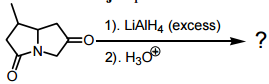
31. Predict the major product for the following reaction.
(A) I
(B) II
(C) III
(D) IV
(E) I and II.
答案:
登入後查看
統計:
A(2), B(5), C(21), D(6), E(0) #943159
私人筆記 (共 1 筆)
養樂多(MT112、後中上榜)
2024/06/27
私人筆記#6151273
未解鎖
【高點梁傑有機講義】
(共 10 字,隱藏中)
前往觀看
1
0
相關試題
6. 下列何試劑最適合用來將 amide 轉變成 amine? (A) LiAlH4 (B) SOCl2 (C) POCl3 (D) CuCN
#2022892
32. Predict the major product for the following reaction. (A) I (B) II (C) III (D) IV (E) V
#943160
33. Which of the alkynes below, after undergoing an acid-catalyzed hydration, would be expected to produce two different ketones in nearly equivalent yields? (A) 1-hexyne (B) 2-hexyne (C) 3-hexyne (D) 3-methyl-1-pentyne (E) 4-methyl-1-pentyne
#943161
34. Predict the products of the following reaction: (A) I, III, and IV (B) II, III, and IV (C) I, III, and V (D) II, IV, and VI (E) III and IV
#943162
35. Which of the following is a correct prediction of the chemical shifts (ppm) for the signals in the 1 H NMR spectrum for the following compound? (A) a = 5.7, b = 5.2, c = 4.4, d = 1.9 (B) a = 5.2, b = 5.7, c = 1.9, d = 4.4 (C) a = 4.4, b = 5.2, c = 1.9, d = 1.9 (D) a = 5.2, b = 4.4, c = 5.7, d = 1.9 (E) a = 1.9, b = 5.7, c = 5.2, d = 4.4
#943163
36. Provide the name of the major alkene product that results when (2R,3R)-2,3-dibromopentane is treated with zinc in acetic acid. (A) (Z)-2-pentene (B) (E)-2-pentene (C) (R)-3-bromo-1-pentene (D) (S)-3-bromo-1-pentene (E) (R)-2-bromo-3-pentene
#943164
37. What is the major expected product(s) of the reaction shown below? (A) 2,2-Dichloropentane (B) 3,3-Dichloropentane (C) 2,3-Dichloropentane (D) A and B (E) B and C
#943165
38. What is the expected major organic product from treatment of 4-methyl-2-pentyne with hydrogen in the presence of Lindlar's catalyst? (A) (E)-4-methyl-2-pentene (B) (Z)-4-methyl-2-pentene (C) (E)-2-methyl-2-pentene (D) (Z)-2-methyl-2-pentene (E) 2-methylpentane
#943166
39. Refer to the equilibrium below, the correct name for the cyclic structure is_______. (A) α-L-ribofuranose (B) β-D-ribofuranose (C) α-L-ribopyranose (D) β-D-ribopyranose (E) None of the above
#943167
40. Which of the following best describes the key mechanistic steps in the reaction of an acid chloride and an alcohol to form an ester? (A) elimination followed by addition (B) addition followed by decarboxylation (C) addition followed by elimination (D) substitution followed by addition (E) rearrangement
#943168
相關試卷
105年 - 105 學士後西醫:有機化學#78642
2016 年 · #78642
104年 - 104 學士後西醫:有機化學#27032
2015 年 · #27032
103年 - 103 學士後西醫:有機化學#27037
2014 年 · #27037
102年 - 102 學士後西醫:有機化學#27324
2013 年 · #27324
101年 - 101 學士後西醫:有機化學#27197
2012 年 · #27197
100年 - 100 學士後西醫:有機化學#35480
2011 年 · #35480
98年 - 098 學士後西醫:有機化學#37156
2009 年 · #37156
96年 - 96學士後西醫-有機化學 #37201
2007 年 · #37201


 阿摩線上測驗
登入
阿摩線上測驗
登入