所屬科目:研究所、轉學考(插大)◆普通化學
1. What is the element symbol for Antimony. (A) An (B) At (C) As (D) Sb (E) Sn
2. The oxidation state of S in sulfurous acid is A. What is A? (A) +2 (B) +3 (C) +4 (D) +5 (E) +6
3. Balance the following reaction (M and N are elements): . What is a+b+c+d? (A) 8 (B) 10 (C) 12 (D) 14 (E) 16
4. Balance the following oxidation-reduction reactions, which occur in basic solution. . What is a+b+c+d? (A) <10 (B) 10 (C) 11 (D) 12 (E) 13
5. After some NaF was added into a 1.0 M HF solution, how does the pH of this HF solution change? (A) larger (B) smaller (C) unchanged (D) not related
6. The product is colorless in the dimerization of yellow X gas at 25 °C. If it was found that as the reaction temperature increase, the color of the mixture is getting darker. Is this dimerization reaction an endothermic or exothermic (or not determined) reaction? (A) not related (B) endothermic (C) exothermic (D) not determined
7. At 25°C and 1 atm, 100 g NaN₃ was inflated, calculate the volume (liters) of the N₂ gas released from it. (A) 10-30 (B) 30-70 (C) 70-110 (D) 110-140 (E) >140
8. A solution contains 0.10 M HA (if ) and 0.10 M NaA. Calculate the pH of this solution. (A) 3 (B) 4 (C) 5 (D) 6 (E) 7
9. For the gas reaction of NX₃ with HBr, if X with average molecule weight of 29 and reaction figure shown below. If no air were present in the reaction tube, what will be the ratio (r) of NX₃: HBr gas traveling distances to form the white ring of (.
(A) 0.75-0.85 (B) 0.85-0.95 (C) 0.95-1.05 (D) 1.05-1.15 (E) >1.15
10. If H₃A is a triprotic acid with . What the pH of a 1.0 M solution of NaH₂A. (A) <5 (B) 5-6 (C) 6-7 (D) 7-8 (E) >8
11. Calculate the pH of a 0.10 solution. If the value for M is 1 x. (M is a compound). (A) <5 (B) 5-6 (C) 6-7 (D) 7-8 (E) >8
12. For the synthesis of ammonia at 500°C, the equilibrium constant is 6.0 x L²/mol². Predict the direction in which the system will shift to reach equilibrium in the following case.
(A) The ammonia synthesis reaction will go backward. (B) The ammonia synthesis reaction will go forward. (C) The ammonia synthesis reaction is under equilibrium. (D) The ammonia synthesis reaction is under equilibrium and will stop reaction. (E) The ammonia synthesis reaction will not work.
13. At 25°C, the following heats of reaction are known:
What is the ΔH (kJ/mol) for the following reaction at the same temperature?
CIF + F₂ → CIF₃ (A) -217.5 (B) -108.7 (C) +217.5 (D) -130.2 (E) none of these
14. For a second order reaction: aA → products. Which equation is true? (k is rate constant and is the initial concentration ofA) (A) (B)(C) (D) (E)
15. For a certain reaction with rate constant of k₁ at temperature T₁ and rate constant of k₂ at temperature T₂. Which equation is true for you to obtain the Ea (activation energy) of this reaction? (A) (B) (C) (D) (E) All the above four equations are wrong.
16. In which of the following changes is the work done by the system the largest at 25°C? (A) an isothermal reversible expansion of an ideal gas from 1 L to 10 L (B) an isothermal expansion of an ideal gas from 1 L to 10 L against an opposing pressure of 5 atm (C) an isothermal free expansion of an ideal gas from 1 L to 10 L (D) an isothermal expansion of an ideal gas from 1 L to 10 L against an opposing pressure of 1 atm (E) The work is the same for all these processes.
17. Which of the following is the strongest oxidizing agent?
(A) (B) I₂ (C) MnO₂ (D) Zn (E)
18. In which of the following cases must E be equal to zero?
(A). II only (B). I and II (C). III (D). I only (E). None of them
19. You make a cell with a copper electrode in a solution of copper nitrate and a silver electrode in a solution of silver nitrate.
If you could increase the concentration of , which of the following would be true about the cell potential? (A). It would remain constant. (B). This cannot be determined. (C). It would decrease. (D). It would increase. (E). All the statements are false.
20. Which of the following statements is correct? (A). The system does work on the surroundings when an ideal gas expands against a constant external pressure. (B). The internal energy of a system increases when more work is done by the system than heat is flowing into the system. (C). The internal energy of a system decreases when work is done on the system and heat is flowing into the system. (D). All the statements are true. (E). All the statements are false.
21. For the reaction: CO2(g) + 2H2O(g) → CH4(g) + 2O2(g), ΔH° = 803 kJ Which of the following will increase K? (A). decreasing the temperature of system (B). decreasing the number of moles of methane (C). increasing the volume of system (D). increasing the temperature of system (E). none of these
22. From the following list of observations, choose the one that most clearly supports the conclusion that electromagnetic radiation has wave characteristics. (A). diffraction (B). the emission spectrum of hydrogen (C). the scattering of alpha particles by metal foil (D). cathode "rays" (E). the photoelectric effect
23. Which of the following is a reasonable criticism of the Bohr model of the atom? (A) It shows the electrons to exist outside of the nucleus. (B) It does not adequately predict the ionization energy of the first-energy-level electrons for elements other than hydrogen. (C) It makes no attempt to explain why the negative electron does not eventually fall into the positive nucleus. (D) It does not adequately predict the ionization energy of the valence electron(s) for elements other than hydrogen. (E) It does not adequately predict the line spectrum of hydrogen.
24. Consider the following portion of the energy-level diagram for hydrogen:
For which of the following transitions does the light emitted have the longest wavelength? (A) n = 2 to n = 1 (B) n = 4 to n = 1 (C) n = 3 to n = 2 (D) n = 4 to n = 2 (E) n = 4 to n = 3
25. The molecule has a square pyramidal shape. Which of the following atoms could be X? (A) O (B) S (C) P (D) Xe (E) At least two of these atoms could be X.
26. Which ion is planar? (A) (B) (C) (D) (E)
27. Which of the following statements is false? (A) The carbon-carbon bond in is shorter than the one in CH3CH3. (B) The carbon-carbon bond in is stronger than the one in CH3CH3. (C) C2 is diamagnetic. (D) C2 is paramagnetic. (E) Two of these statements are false.
28. Which of the following statements is true? (A) All antibonding MOs are higher in energy than the atomic orbitals of which they are composed. (B) Electrons are never found in an antibonding MO. (C) Antibonding MOs have electron density mainly outside the space between the two nuclei. (D) None of these statements is true. (E) Two of these statements are true.
29. Of the following homonuclear diatomic molecules, which is paramagnetic? (A) C2 (B) B2 (C) F2 (D) N2 (E) None of the above
30. Shown below is a phase diagram for sulfur (not drawn to scale). Sulfur can exist in solid modifications, rhombic and monoclinic, denoted by , respectively. Which of the following statements is incorrect?
(A) At pressures close to 1 atm, rhombic sulfur can be in stable equilibrium with liquid sulfur. (B) Under ordinary atmospheric conditions (at sea level), sulfur does not sublime. (C) This system has two triple points. (D) At a given pressure, there is (at most) one temperature at which rhombic sulfur can exist in equilibrium with monoclinic sulfur. (E) None of these statements is incorrect.
31. A solution contains 1 mol of liquid A and 3 mol of liquid B. The vapor pressure of this solution is 314 torr at 25°C. At 25°C, the vapor pressure of liquid A is 265 torr and the vapor pressure of liquid B is 355 torr. Which of the following is true? (A) This solution exhibits a positive deviation from Raoult's law. (B) This solution is ideal. (C) This solution exhibits a negative deviation from Raoult's law. (D) None of these statements is incorrect.
32. Acetone (mw = 58.08, =232 mmHg) and butanone (mw = 72.11, =100 mmHg) have the indicated molar masses and vapor pressures. A container holds 1.00 kg of butanone. How much acetone must be added to the butanone to elevate the total vapor pressure over the mixture to 125 mmHg at 25°C? (A). 5.313 kg (B). 290 g (C). 188 g (D). More information needed (E). None of the above
33. Which of the following complexes shows geometric isomerism? (A). K[Co(H2O)2Cl4] (B). [Co(H2O)5Cl]Cl2 (C). [Co(H2O)5Cl]SO4 (D). Na3[CoCl6] (E). [Co(H2O)6]Cl3
34. In the Lewis acid-base model, acids are ______ and bases are ______ (A). donors, acceptors (B). donors, acceptors (C). electron pair donors, electron pair acceptors (D). donors, donors (E). electron pair acceptors, electron pair donors
35. Radiocarbon dating is based on which decay process? (A). (B). (C). (D). All of the above (E). None of the above
A. Ru
B. W
C. MgBr2
D. NO2
E. HCl (aq, acid)
2. The reaction between bromate ions and bromide ions in acidic aqueous solution is given by the following equation: → 3Br2(l) + 3H2O(l)
Using the following four experiment results to determine the orders (x, y, z) for all three reactants. Also calculate the rate constant.
3. Consider the following hypothetical reaction (at 308 K). Standard free energies, in kJ/mol, are given in parentheses.
What is the value of the equilibrium constant for the reaction at 308 K?
4. Gold (atomic mass = 197 g/mol) is plated from a solution of chlorauric acid, HAuCl4; it deposits on the cathode. Calculate the time it takes to deposit 0.65 g of gold, passing a current of 0.14 amperes. (1 faraday = 96,485 coulombs)
5. Given the following information:
Calculate the net change in energy for the reaction 2Li(s) + 2HCl(g) → 2LiCl(s) + H2(g)
 阿摩線上測驗
登入
 . What is a+b+c+d? (A) 8 (B) 10 (C) 12 (D) 14 (E) 16
 . What is a+b+c+d? (A) <10 (B) 10 (C) 11 (D) 12 (E) 13
 ) and 0.10 M NaA. Calculate the pH of this solution. (A) 3 (B) 4 (C) 5 (D) 6 (E) 7
 .
 (A) 0.75-0.85 (B) 0.85-0.95 (C) 0.95-1.05 (D) 1.05-1.15 (E) >1.15
 . What the pH of a 1.0 M solution of NaH₂A. (A) <5 (B) 5-6 (C) 6-7 (D) 7-8 (E) >8
 solution. If the
 value for M is 1 x
 . (M is a compound). (A) <5 (B) 5-6 (C) 6-7 (D) 7-8 (E) >8
 L²/mol². Predict the direction in which the system will shift to reach equilibrium in the following case.
 (A) The ammonia synthesis reaction will go backward. (B) The ammonia synthesis reaction will go forward. (C) The ammonia synthesis reaction is under equilibrium. (D) The ammonia synthesis reaction is under equilibrium and will stop reaction. (E) The ammonia synthesis reaction will not work.

 is the initial concentration ofA) (A)
 (B)
 (C)
 (D)
 (E)

 (B)
 (C)
 (D)
 (E) All the above four equations are wrong.
 (A)
 (B) I₂ (C) MnO₂ (D) Zn (E)

 (A). II only (B). I and II (C). III (D). I only (E). None of them

 , which of the following would be true about the cell potential? (A). It would remain constant. (B). This cannot be determined. (C). It would decrease. (D). It would increase. (E). All the statements are false.

 has a square pyramidal shape. Which of the following atoms could be X? (A) O (B) S (C) P (D) Xe (E) At least two of these atoms could be X.
 (B)
 (C)
 (D)
 (E)

 is shorter than the one in CH3CH3. (B) The carbon-carbon bond in
 is stronger than the one in CH3CH3. (C) C2 is diamagnetic. (D) C2 is paramagnetic. (E) Two of these statements are false.
 , respectively. Which of the following statements is incorrect?
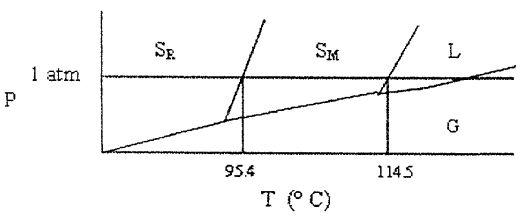 (A) At pressures close to 1 atm, rhombic sulfur can be in stable equilibrium with liquid sulfur. (B) Under ordinary atmospheric conditions (at sea level), sulfur does not sublime. (C) This system has two triple points. (D) At a given pressure, there is (at most) one temperature at which rhombic sulfur can exist in equilibrium with monoclinic sulfur. (E) None of these statements is incorrect.
 =232 mmHg) and butanone (mw = 72.11,
 =100 mmHg) have the indicated molar masses and vapor pressures. A container holds 1.00 kg of butanone. How much acetone must be added to the butanone to elevate the total vapor pressure over the mixture to 125 mmHg at 25°C? (A). 5.313 kg (B). 290 g (C). 188 g (D). More information needed (E). None of the above
 donors,
 acceptors (B).
 donors,
 acceptors (C). electron pair donors, electron pair acceptors (D).
 donors,
 donors (E). electron pair acceptors, electron pair donors
 (B).
 (C).
 (D). All of the above (E). None of the above
 → 3Br2(l) + 3H2O(l)


