所屬科目:研究所、轉學考(插大)◆普通化學
1. Consider the vapor vs. temperature plot for CH₄, SiH₄ and NH₃. Match each curve to the corresponding substance. (A) A: CH₄, B: SiH₄, C: NH₃ (B) A: SiH₄, B: CH₄, C: NH₃ (C) A: NH₃, B: SiH₄, C: CH₄ (D) A: SiH₄, B: NH₃, C: CH₄
2. Based on the given phase diagram, what is the transition from state a to state b? (A) Evaporation (B) Sublimation (C) Condensation (D) Fusion
3. Based on the above phase diagram, what is the transition from state b to state c? (A) Evaporation (B) Sublimation (C) Condensation (D) Fusion
4. Based on the above phase diagram, which of the following statements is correct? (A) The density in solid phase is smaller than that in liquid phase. (B) At the point (Tₜ, Pₜ), only two phases exist. (C) Temperature above T꜀ the gas cannot be liquefied, regardless of pressure. (D) P꜀ is the maximal pressure needed to liquefy a substance.
5. Regarding supercritical fluid, which of the following statements is incorrect? (A) The liquid and gas phases have exactly the same density. (B) Only a single phase exists. (C) It exhibits many of the properties of a liquid. (D) The density is more like the density in its liquid phase.
6. Which of the flowing statements regarding ionic salts is correct? (A) They consist of small, symmetrical anions such as $[PF6]^-$ and $[BF4]^-$. (B) They consist of larger, symmetrical organic cations. (C) They consist of large, asymmetrical anions (D) They consist of small, asymmetrical organic cations.
7. The molar solubility of $PbI2$ is $1.52 \times 10^{-3}$ M. Calculate the value of $K{sp}$ for $PbI_2$. (A) $3.51 \times 10^{-9}$ (B) $4.62 \times 10^{-6}$ (C) $1.40 \times 10^{-8}$ (D) $1.52 \times 10^{-3}$
8. Which of the following compounds has the lowest solubility in mol/L in water at $25^\circ\text{C}$? (A) $Al(OH)3 K{sp} = 2 \times 10^{-33}$ (B) $Sn(OH)2 K{sp} = 3 \times 10^{-27}$ (C) $CdS K_{sp} = 1.0 \times 10^{-28}$ (D) $CaSO4 K{sp} = 6.1 \times 10^{-5}$
9. Which of the flowing condition must be met for a chemical reaction to be non-spontaneous at any temperature? (A) $\Delta S^\circ > 0, \Delta H^\circ > 0$ (B) $\Delta S^\circ > 0, \Delta H^\circ < 0$ (C) $\Delta S^\circ < 0, \Delta H^\circ < 0$ (D) $\Delta S^\circ < 0, \Delta H^\circ > 0$
10. The standard reduction potentials are as follows: $$\begin{aligned} Cr^{3+}(aq) + 3e^- &\rightarrow Cr(s) \\ Br_2(aq) + 2e^- &\rightarrow 2Br^-(aq) \end{aligned}$$ $$E^0_{red} = -0.727 \text{ V}$$ $$E^0_{red} = 1.090 \text{ V}$$ In which direction do electrons flow in the external circuit? (A) The electrons flow from right to left. (B) The electrons flow from left to right (C) This device does not produce current. (D) The direction cannot be determined.
11. Which of the following cell diagrams represents the above device? (A) $Pt(s), Br_2(aq) | Br^-(aq) || Cr^{3+}(aq) | Cr(s)$ (B) $Cr(s), Br_2(aq) | Br^-(aq) || Cr^{3+}(aq) | Pt(s)$ (C) $Pt(s), Br_2(aq) | Br^-(aq) || Cr^{3+}(aq) | Pt(s)$ (D) $Cr(s) | Cr^{3+}(aq) || Br^-(aq), Br_2(aq) | Pt(s)$
12. What is this compound's name? (A) Phenol (B) Toluene (C) Benzoic acid (D) Aniline
13. Rank the London dispersion force among benzene, anthracene, and naphthalene. (A) benzene > naphthalene > anthracene (B) naphthalene > anthracene > benzene (C) anthracene > naphthalene > benzene (D) naphthalene > benzene > anthracene
14. A reaction is first-order with respect to the reactant R. Which of the following plots will produce a straight line? (A) [R] vs. 1/time (B) 1/[R] vs. time (C) [R]² vs. time (D) 1/[R]² vs. time (E) ln[R] vs. time
15. In an exothermic reaction, (A) the forward reaction is slower than the reverse reaction. (B) the reaction rate will speed up with time. (C) the activation energy will change as the reaction progresses. (D) the forward reaction will have a lower activation energy than the reverse reaction.
16. For the following reaction for ethane formation, $$\text{C}2\text{H}2(g) + 2\text{H}2(g) \rightleftharpoons \text{C}2\text{H}_6(g) \quad \Delta H^\circ = -311 \text{ kJ}$$ Which of the following reaction conditions would yield the greatest amount of ethane? (A) High temperature, high pressure (B) Low temperature, high pressure (C) High temperature, low pressure (D) Low temperature, low pressure
17. What is the pH of a 0.005 M KOH solution? (A) 2.5 (B) 5.7 (C) 8.5 (D) 11.7
18. Which of these molecules or ions is a Lewis base? (A) CO₂ (B) AlCl₃ (C) NH₃ (D) NH₄⁺
19. Why is the pH at the midpoint of the titration of a weak acid with strong base particularly important? (A) At the midpoint of the titration, the pH is equal to the pKb of the weak base. (B) At the midpoint of the titration, the pH is equal to the pKa of the weak acid. (C) At the midpoint of the titration, the pH is twice the pH at the equivalence point. (D) At the midpoint of the titration, the pH is one-half of the pH at the equivalence point.
20. Determine the electron geometry and molecular geometry of CO₃²⁻. (A) Tetrahedral and tetrahedral (B) Tetrahedral and trigonal pyramidal (C) Trigonal planar and bent (D) Trigonal planar and trigonal planar
21. Regarding molecular orbital theory, which of the following statements is incorrect? (A) The bond order for O₂⁺ is larger than the bond order for O₂. (B) The bond order for O₂⁻ is larger than the bond order for O₂. (C) B₂ is paramagnetic. (D) F₂ is diamagnetic.
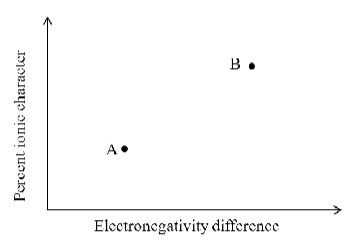
22. Regarding the percent ionic character vs. electronegativity difference plot for substances A and B, which of the flowing statement is incorrect? (A) If the two substances are HCl and KI, A is HCl and B is KI. (B) If the two substances are HI and KI, A is HI and B is KI. (C) If the two substances are CsCl and LiF, A is CsCl and B is LiF. (D) If the two substances are HCl and CsF, A is CsF and B is HCl.
23. Based on the following experiment data, the condition at 40°C is (A) Thermodynamic control (B) Kinetic control
 阿摩線上測驗
登入
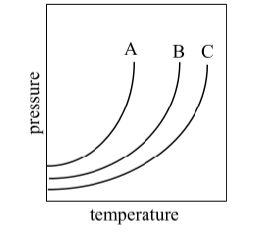 (A) A: CH₄, B: SiH₄, C: NH₃ (B) A: SiH₄, B: CH₄, C: NH₃ (C) A: NH₃, B: SiH₄, C: CH₄ (D) A: SiH₄, B: NH₃, C: CH₄
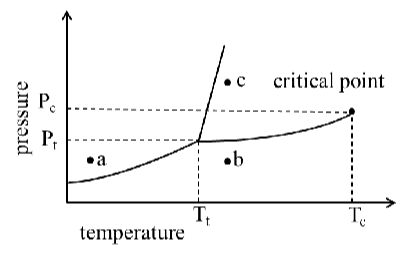 (A) Evaporation (B) Sublimation (C) Condensation (D) Fusion
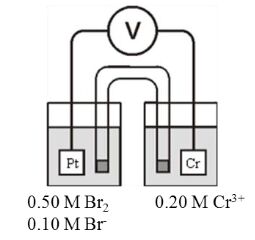 (A) $Pt(s), Br_2(aq) | Br^-(aq) || Cr^{3+}(aq) | Cr(s)$ (B) $Cr(s), Br_2(aq) | Br^-(aq) || Cr^{3+}(aq) | Pt(s)$ (C) $Pt(s), Br_2(aq) | Br^-(aq) || Cr^{3+}(aq) | Pt(s)$ (D) $Cr(s) | Cr^{3+}(aq) || Br^-(aq), Br_2(aq) | Pt(s)$
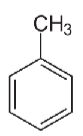 (A) Phenol (B) Toluene (C) Benzoic acid (D) Aniline
 (A) The bond order for O₂⁺ is larger than the bond order for O₂. (B) The bond order for O₂⁻ is larger than the bond order for O₂. (C) B₂ is paramagnetic. (D) F₂ is diamagnetic.
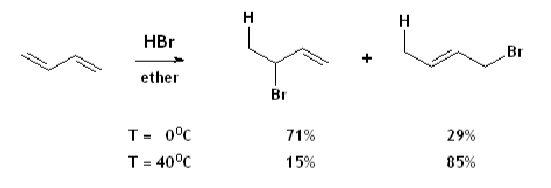 (A) Thermodynamic control (B) Kinetic control