所屬科目:研究所、轉學考(插大)◆分子生物學
1. Which of the following explains the events in late stage of phage T7 infection in E. coli? (A) There is a high level of transcription of host genes. (B) Host polymerase holoenzyme directs transcription. (C) The host core enzyme participates in transcription in conjunction with the phage-encoded specific sigma factor. (D) Phage T7-specific core polymerase participates in transcription in conjunction with the host sigma factor. (E) The T7 phage -specific RNA polymerase specifies transcription of genes.
2. Which of the following descriptions about infection of E. coli by phage λ is correct? (A) CII protects CIII against cellular proteases and thus is important for lytic cycle induction during a infection. (B) Q is an antiterminator that permits RNA polymerase to ignore the terminators at the ends of the immediate early genes and continue transcribing into the delayed early genes. (C) The cro gene is stimulated during the lytic cycle of infection. (D) N is an antiterminator which permits transcription of the late genes during the lytic cycle of infection (E) Without Q, transcription from the late promoter PR stops after 194 bp.
3. A DNA element that binds protein factors and stimulates transcription is called _____(A) Enhancer (B) Promoter (C) Suppressor (D) Operator (E) Terminator
4. Which of the following statement is correct regarding the sigma-factor? (A) Subregions 2.4 and 4.2 are involved in operator recognition. (B) Region 1 appears to be in preventing σ from binding to DNA by itself. (C) It determines rifampicin sensitivity or resistance. (D) Subregion 2.4 has a β-sheet domain. (E) Region 3 is the most highly conserved σ region.
5. During an experiment to study the rate of infection of bacteria with a phage, the bacterial cultures were accidentally exposed to a UV light source. Which of the following would be expected for this exposure? (A) recA gene is turned off. (B) Coprotease activity in repressor is activated. (C) Lysogenic cycle is induced. (D) Coprotease activity in RecA protein is activated. (E) SOS response is turned off.
6. Which of the following statements is not true concerning DNA replication in prokaryotes? (A) Semidiscontinuous (B) Semiconservative (C) RNA dependent. (D) There is one terminus of replication. (E) There is one origin of replication.
7. Which of the following is not a characteristic of the prokaryotic single stranded DNA binding (SSB) protein? (A) It binds more tightly to ssDNA than to dsDNA. (B) It aids helicase action. (C) It stimulates homologous DNA polymerase. (D) It keeps DNA strands from annealing. (E) It is not essential for cell replication.
8. Put the following steps of E. coli primosome assembly in the correct order. (1) DnaG binds. (2) DnaA binds to oriC at dnaA boxes. (3) DnaB binds to the open complex. (4) DnaA, ATP, and HU protein melt the DNA. (A) 2, 4, 1, 3 (B) 2, 4, 3, 1 (C) 4, 1, 2, 3 (D) 4, 2, 1, 3 (E) 3, 4, 1, 2
9. The Ds transposable element of maize cannot transpose on its own because it lacks (A) Tn3. (B) inverted repeats. (C) origin of replication. (D) direct repeats. (E) transposase.
10. Which of the following is not true concerning immunoglobulin gene recombination signal sequences? (A) There are conserved heptamers. (B) There are conserved nonamers. (C) Recombination only occurs between two heptamers. (D) The conserved sequences are separated by a nonconserved sequence of either a 12 bp or a 23 bp sequence. (E) Recombination occurs between a 12 bp signal and a 23 bp signal.
11. Which DNA segment contains the Ori sequence? (A) Segment A (B) Segment B (C) Segment C (D) Segment D
12. Assume that a lagging strand is made from the Region X, what will be the sequence of this lagging strand? (A) 5'-CCAGTTAAC-3' (B) 5'-GTTAACTGG-3' (C) 5'-GGTCAATTG-3' (D) 5'-CAATTGACC-3'
13. Which of the following best explains why the two DNA polymerase proteins that are held by the sliding clamp are oriented in the opposite directions? (A) The efficiency of replication is increased if the two DNA polymerases synthesize the template in the opposite directions (B) DNA polymerase is such a large protein complex that steric hindrance prevents both polymerases from following the replication fork (C) DNA polymerase can read only the template from 5' to 3' direction and the template strands are aligned in an anti-parallel direction (D) DNA polymerase can read only the template from 3' to 5' direction and the template strands are aligned in an anti-parallel direction (E) None of the above
14. Which of the following statements is not correct? (A) Maturation of mRNA, rRNA, and tRNA involves processing by different RNases (B) RNA alternative splicing only occurs in eukaryotes (C) In some organisms, proteins can be cut and rejoined to form a new protein. (D) In bacteria, the transcription can be coupled together with translation at the same time
15. DNA sequences that are rich in guanine and cytosine are called ___ and are usually targets of ___ on heterochromatin. (A) interins; acetylation (B) promoters; transcriptional regulation (C) enhancers; mediator binding (D) GC islands; methylation (E) GC islands; acetylation
16. Which of the following is the most common type of histone modification? (A) lysine ε-amino methylation (B) serine O-phosphorylation (C) lysine N-phosphorylation (D) histidine N-phosphorylation (E) acetylation
17. Histone acetylation can occur in the (A) nucleus. (B) cytoplasm. (C) ER lumen. (D) nucleus and cytoplasm. (E) nucleus, cytoplasm, and ER lumen.
18. The first two bases and the last two bases in the splicing signal consensus sequence are (A) GT-AG (B) GT-TG (C) CU-AG (D) GU-AG (E) GU-AC
19. Which of the following is NOT a function of the mRNA cap? (A) protects the mRNA from degradation (B) enhances translatability of the mRNA (C) enhances transport of the mRNA to the cytoplasm (D) enhances splicing of the mRNA (E) helps regulate expression of the mRNA
20. Which of the following processes occurs post-transcriptionally? (A) Cap addition (B) adenosine deamination (C) Poly(A) addition (D) promoter clearance (E) unwinding
II. 問答題 1. (a) Draw a diagram and explain the method of Nitrocellulose Filter-binding Assay. (b) Describe how this method can be used to study the binding of RNA polymerase to promoters.
(a) negative control and
(b) positive control of this operon.
3. Please describe how to control the location of the septum by min-C, -D, and -E
4. Please describe the functions of RecA, RecBCD, RuvA, RuvB and RuvC during Homologous Recombination in E. coli
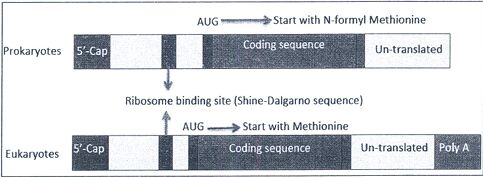
5. Please identify two mistakes in the following figure and provide correct answers.
6. A single mRNA can be translated into multiple different proteins in bacteria, but not in human. Please explain why.
7. Please describe the outcomes of miRNA mediated gene silencing (in animal cells) when miRNA base-paring is imperfect match to the 3'UTR of the target mRNA.
(a) please draw the spliced RNAs if intron splicing follows intron definition,
(b) please draw the spliced RNAs if intron splicing follows exon definition.
 阿摩線上測驗
登入