所屬科目:【阿摩】未分類題庫
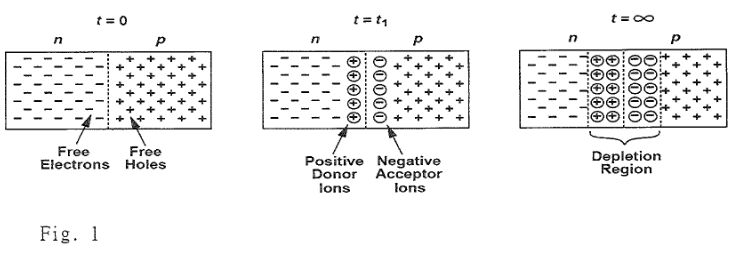
1. For a pn-junction in Fig. 1, explain (a) why are there free electrons (holes) on the n-side (p-side), (b) why are there positive (negative) ions on the n-side( p-side) of the depletion region. (10%)
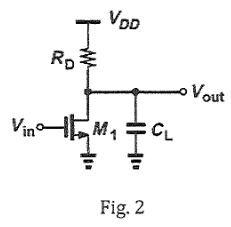
2. Draw the small-signal model and prove the dc gain and -3dB frequency of the circuit in Fig. 2. (10%)
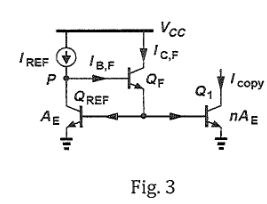
3. Q₁, QREF and QF in Fig. 3 have the same current gain β. Q₁ and QREF have emitter area n•AE and AE, respectively. Assume that the collector current of QF is equal to its emitter current. IREF is the input current, compute the output current Icopy? (10%)
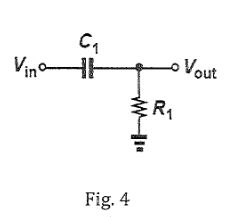
4. Determine the transfer function \( V_{out}(s)/V_{in}(s) \) of the circuit shown in Fig. 4, find the zero and pole frequency? (10%)
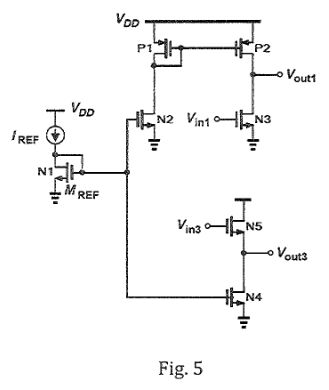
5. For the circuit shown in Fig. 5, the input current is IREF that goes into N1. Applying the devices dimensions N1=(W/L), N2=2(W/L), N3=4(W/L), N4=8(W/L), N5=16(W/L), P1=(W/L), P2=2(W/L), where W and L are channel width and length, respectively. What are the currents for N3 and N5, respectively? (10%)
6. Explain (a) drift current, (b) velocity saturation of electrons. (10%)
7. Define common-mode rejection ratio? What is the purpose to define it? (10%)
8. Why is the device dimension of BJT not shown in current \( I_C \) but the device dimension W/L is included in current \( I_D \) of MOSFET? (10%) (\( I_C=I_S \exp (V_{BE}/V_T) \), \( I_D=(1/2)(\mu_n C_{ox})(W/L)(V_{GS}-V_{TH})^2 \).)
9. Explain (a) active saturation region of BJT, (b) saturation region of MOSFET. (Draw I-V curve and define the voltages that operates in the region.) (10%)
10. Explain Kirchhoff's Current Law(KCL) and Kirchhoff's Voltage Law(KVL). (10%)
 阿摩線上測驗
登入