所屬科目:研究所、轉學考(插大)◆電磁學
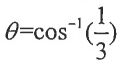
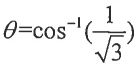
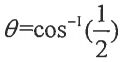
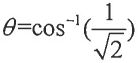
1. Find the angle between the body diagonals of a cube. (A) (B)(C) (D)
2. Find the divergence of the function v = s(2+sin²φ)ŝ + s sinφ cosφ φ̂ + 3zẑ (A)5 (B)10 (C)8 (D)3
3. One of these is a possible electrostatic field. Which one? (A)E = k[xyx̂ + 2yzŷ + 3xzẑ] (B)E = k[y²x̂ + (2xy + z²)ŷ + 2yzẑ] (C)E = k[yx̂ + x²ẑ] (D)E = k[yzx̂ + y²ŷ + z²ẑ]
4. The potential at the surface of a sphere (radius R) is given by V₀=k cos3θ where k is a constant. Find the potential inside and outside the sphere, as well as the surface charge density σ(θ) on the sphere. (Assume there's no charge inside or outside the sphere.) (A)cosθ[140cos²θ - 93] (B)cosθ[140cos²θ] (C)cosθ[140cosθ - 93] (D)cosθ[140cos²θ - 93]
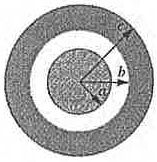
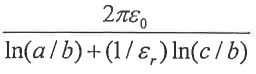
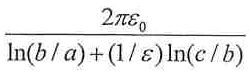
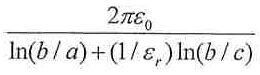
5. A certain coaxial cable consists of a copper wire, radius a, surrounded by a concentric copper tube of inner radius c. The space between is partially filled (from b out to c) with material of dielectric constant εᵣ, as shown. Find the capacitance per unit length of this cable.
(A)(B) (C)(D)
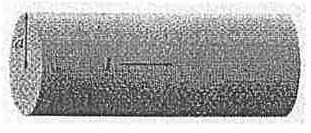
6. A steady current I flows down a long cylindrical wire of radius a. Find the magnetic field outside the wire if the current is uniformly distributed over the outside surface of the wire.
(A)0 (B)(C)(D)
7. An infinitely long circular cylinder carries a uniform magnetization M parallel to its axis. Find the magnetic field (due to M) inside the cylinder. (A)2μ₀M (B)μ₀M (C)0 (D)μ₀M/4π
8. A square loop of wire, of side a, lies midway between two long wires, 3a apart, and in the same plane. (Actually, the long wires are sides of a large rectangular loop, but the short ends are so far away that they can be neglected.) A clockwise current I in the square loop is gradually increasing: dI/dt = k (a constant). Find the emf induced in the big loop. Which way will the induced current flow? (A), counterclockwise (B), clockwise (C), counterclockwise (D), clockwise
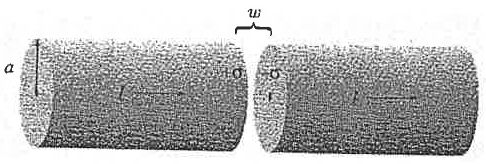
9. A fat wire, radius a, carries a constant current I, uniformly distributed over its cross section. A narrow gap in the wire, of width ω≪a, forms a parallel-plate capacitor, as shown in figure. Find the magnetic field in the gap, at a distance s < a from the axis.
10. Express the wave equation of the standing wave f(z,t) = A sin(kz)cos(kvt) as the sum of a wave traveling to the left and a wave traveling to the right. (A){sin[k(z+vt)] + sin[k(z-vt)]} (B){cos[k(z+vt)] + sin[k(z-vt)]} (C){sinh[k(z+vt)] + sinh[k(z-vt)]} (D){cosh[k(z+vt)] + cosh[k(z-vt)]}
 阿摩線上測驗
登入
 (B)
 (C)
 (D)
 cosθ[140cos²θ - 93] (B)
 cosθ[140cos²θ] (C)
 cosθ[140cosθ - 93] (D)
 cosθ[140cos²θ - 93]
 (A)
 (B)
 (C)
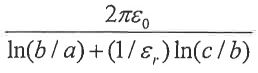 (D)
 (A)0 (B)
 (C)
 (D)

 , counterclockwise (B)
 , clockwise (C)
 , counterclockwise (D)
 , clockwise
 (A)
 (B)
 (C)
 (D)

 {sin[k(z+vt)] + sin[k(z-vt)]} (B)
 {cos[k(z+vt)] + sin[k(z-vt)]} (C)
 {sinh[k(z+vt)] + sinh[k(z-vt)]} (D)
 {cosh[k(z+vt)] + cosh[k(z-vt)]}