所屬科目:研究所、轉學考(插大)◆普通化學
3. What is the concentration of ions in a solution prepared by dissolving 15.0 g of Ba(NO3)2 in enough water to produce 300. mL of solution? (A)0.057 M (B)0.191 M (C)0.573M (D)0.382 M
5. Consider the following ground state electron configuration: 1s22s22p4. Which of the ions has this ground state electron configuration? (A)(B) (C) (D)
6. Which of the following are allowed resonance forms of NCS-? (A)only I (B)only l (C)only III (D)I and Ill
7. What is the F-B-F bond angle in BF3? (A)less than 109.5° (B)109.5° (C)120* (D)greater than 120
8. For a process at constant pressure, (A)△E = w and q = 0. (B)△E = q and w = 0. (C)△E = AH. (D)△H = q.
9. A 1.75 L container filled with CO2 gas at 25℃and 225 kPa pressure springs a leak. When the container is re-sealed, the pressure is 200 kPA and the temperature is 10℃. How many moles of gas were lost? (A)0.0101 mol (B)0.149 mol (C)6.71 mol (D)99.0 mol
13. A mixture of carbon monoxide, hydrogen, and methanol is at equilibrium. The balanced chemical equation is: At 250℃, the mixture contains 0.0960 M CO, 0.191 M H2, and 0.150 M CH30H. What is the value for Kc? (A)2.33 x 10⁻² (B)0.244 (C)4.09 (D)42.8
14. Write a balanced equation for the dissociation of the Br0nsted-Lowry acid HSO4- in water. (A)HSO4-(aq) + H2O(1) H2SO4(aq)+ OH-(aq) (B)HSO4-(aq) + H20(/) SO42-(aq)+H3+(aq) (C)HSO4-(aq) + H20(/) SO32-(aq)+ OH-(aq) (D)HSO4-(aq) + H2O(1) SO3(g) + OH-(aq) + H20()
16. Which forward reaction is a nonspontaneous process? (A)The expansion of a gas into a vacuum (B)(C)(D)None of these
17. What is the oxidation half reaction in the following chemical reaction? (A) (B) (C) (D)
18. Using the following standard reduction potentials calculate the standard cell potential for the galvanic cell reaction given below, and determine whether or not this reaction is spontaneous under standard conditions. Pb2+(aq) + 2 Fe2+(aq) → 2 Fe3+(aq)+ Pb(s) (A)E°= -0.90 V, nonspontaneous (B)E°= -0.90 V, spontaneous (C)E° = +0.90 V, nonspontaneous (D)E° = +0.90 V, spontaneous
20. A common rule in organic chemistry is that increasing the temperature of a reaction at room temperature by 10℃doubles the rate. Calculate Ea for a reaction that follows this rule. Assume room temperature is 25℃. (A)0.576 kJ (B)12.2 kJ (C)38.4 kJ (D)52.9 kJ
計算(20%,每五分 [1]. The Balmer-Rydberg equation can be extended to ions with only one electron, such as He+. In that case it has the form: , where Z is the atomic number.Derive the energy (expressed in terms of h c and R) of the photon required to promote an electron in He+ from a 1s orbital to a 2p orbital?
[2]. When 50.0 mL of 0.400 M Ca(NO3)2 is added to 50.0 mL of 0.800 M NaF, CaF2 precipitates, as shown in the net ionic equation below. The initial temperature of both solutions is 30.00℃. Assuming that the reaction goes to completion, and that the resulting solution has a mass of 100.00 g and a specific heat of 4.18 J/(g ㆍ ℃), calculate the final temperature of the solution.
[3]. A concentration-time study of the gas phase reaction 2 A3 ÷7 3 A2 produced the data in the table below. What is the average rate of decomposition of A3 in the time interval 20-30 seconds?
[4]. The second-order reaction, has a rate constant equal . If the initial concentration M, how long will it take for 90.% of the reactant to disappear?
 阿摩線上測驗
登入
 ions in a solution prepared by dissolving 15.0 g of Ba(NO3)2 in enough water to produce 300. mL of solution? (A)0.057 M (B)0.191 M (C)0.573M (D)0.382 M
 (B)
 (C)
 (D)

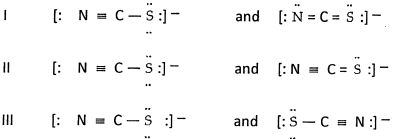 (A)only I (B)only l (C)only III (D)I and Ill
 At 250℃, the mixture contains 0.0960 M CO, 0.191 M H2, and 0.150 M CH30H. What is the value for Kc? (A)2.33 x 10⁻² (B)0.244 (C)4.09 (D)42.8
 H2SO4(aq)+ OH-(aq) (B)HSO4-(aq) + H20(/)
 (C)
 (D)None of these
 (A)
 (B)
 (C)
 (D)

 calculate the standard cell potential for the galvanic cell reaction given below, and determine whether or not this reaction is spontaneous under standard conditions.
 , where Z is the atomic number.Derive the energy (expressed in terms of h c and R) of the photon required to promote an electron in He+ from a 1s orbital to a 2p orbital?

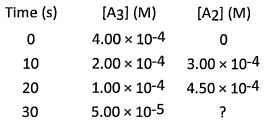 What is the average rate of decomposition of A3 in the time interval 20-30 seconds?
 has a rate constant equal
 . If the initial concentration
 M, how long will it take for 90.% of the reactant to disappear?