所屬科目:研究所、轉學考(插大)◆普通化學
2.What group of elements does the shaded area in the following periodic table indicate? (A)gases (B) metals (C) nonmetals (D) semimetals
4. What is the first ionization energy for a hydrogen atom in the ground state? The Rydberg constant is . (A)(B) (C)(D) 0.00823
5. The symbol [Kr] represents(A) (B)(C) (D)
7. Assign formal charges to each atom in the resonance form for SOCl2 given below. (A)0 for Cl, O for S, and O for O (B) 0 for CI, +1 for S, and -1 for O (C) -1 for CI, +4 for S, and -2 for O (D) -1 for CI, -2 for S, and -2 for O
8. Which of the following would be expected to have sp2 hybridization on atom A? (A)II (B) I and III (C) I, Il, and Ill (D) I and IV
9. The MO diagram below is appropriate for B2 (Boron atom), Based on this diagram, B2 (A)has a bond order of one and is diamagnetic. (B) has a bond order of one and is paramagnetic. (C) has a bond order of two and is diamagnetic. (D) has a bond order of two and is paramagnetic.
11. When 50.0 mL of 0.400 M Ca(NO3)2 is added to 50.0 mL of 0.800 M NaF, CaF2 precipitates, as shown in the net ionic equation below. The initial temperature of both solutions is 30.00℃. Assuming that the reaction goes to completion, and that the resulting solution has a mass of 100.00 g and a specific heat of 4.18 J/(g ㆍ ℃), calculate the final temperature of the solution. (A)29.45℃ (B) 30.55℃ (C) 31.10℃ (D) 31.65℃
12. Use the given standard enthalpies of formation to calculate AH" for the following reaction (A)-5213.4 kJ (B)-577.2 kJ (C)-47.2 k (D) +47.2 kJ
13. For the conversion of water to ice at 25℃ and 1 atm, (A)△G is negative and △H is negative. (B) △G is negative and △H is positive. (C) △G is positive and △H is negative. (D) △G is positive and △H is positive.
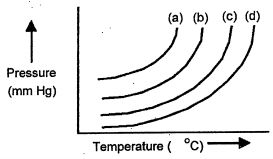
15. While mercury is very useful in barometers, mercury vapor is toxic. Given that mercury has a of 59.11 kJ/mol and its normal boiling point is 356.7℃, calculate the vapor pressure in mm Hg at room temperature, 25℃. (A)2.68 x 10⁻³ mm Hg (B) 2.99 mm Hg (C) 372 mm Hg (D) 753 mm Hg The plots below represent vapor pres assure vs, temperature curves for diethyl ether, ethanol, mercury, and water, not necessarily in that order.
17. How much heat is released when 95.0 g of steam at 100.0℃ is cooled to ice at -15.0℃ ? The enthalpy of vaporization of water is 40.67 kJ/mol, the enthalpy of fusion for water is 6.01 kJ/mol, the molar heat capacity of liquid water is 75.4 J/(mol .℃ ), and the molar heat capacity of ice is 36.4 J/(mol .℃ ). (A)54.8 kJ (B) 247 kJ (C) 289 kJ (D) 314 kJ
19. When a particular solid begins to dissolve in water, the temperature rises dramatically. For the dissolving of this solid in pure water (A)(B) (C) (D)
20. The second-order reaction, has a rate constant equal to 3.0 x If the initial concen entration , how long will it take for 90.% of the reactant to disappear? (A)(B) (C) (D)
21. The first-order isomerization reaction: n: cycloprop opane → propene, has a rate constant of . What is the activation energy, Ea, for the reaction? (A)46 klJ/mol (B) 110kJ/mol (C) 260 kJ/mol (D) 380 kj/mol
22. The following figure depicted the variation of A,B,and C concentration variation with reaction time Which equation best represents the reaction? (A)4A(g) → B(g) + 2C(g) (B) 4A(g) + B(g) → 2C(g) (C) 2C(g) → 4A(g) + B(g) (D) 2C(g) + B(g) →4A(g)
23. An equilibrium mixture of CO, O2 and CO2at a certain temperature contains 0.0010 M CO2and 0.0015 M O2. At this temperature, Kc, equals 1.4 x 10² for the reaction: What is the equilibrium concentration of CO? (A)(B) (C) (D)
24. Shown below is a concentration vs. time plot for the reaction2B. For this reaction the value of the equilibrium constant is (A)Kc<1. (B) Kc-0, (C)kc=1. (D) Kc>1.
25. An acidic solution at 25℃has (A)[H3O+] > [OH-]>1xM. (B) [H3O+] > 1 x M >[OH-]. (C)[H3O+]=[OH-)>1x M. (D)[H3O+]<1xM>[OH-].
26. For the hypothetical reaction For this - reaction, if the value of x is 4, then the value of y= _____________.(A)1 (B)2 (C) 3 (D)4
27. Which of the following reactions should be spontaneous under standard conditions?(A)I and Il are both nonspontaneous. (B) I is nonspontaneous and II is spontaneous. (C) I is spontaneous and Il is nonspontaneous. (D) I and II are both spontaneous.
28. Consider the following table of standard reduction potentials: Which substance is the strongest reducing agent?(A)A (B)B (C)C3 (D)C-
29. Which reaction below represents decay by positron (正子) emission? (A)(B) (C) (D)
30. If a sample of takes 62.7 days to decrease to 20.0% of its original mass, what is its half-life? (A)0.0370 days (B) 27.0 days (C) 157 days (D) 195 days
二·計算題(25%,每五分) [1]. How many grams of calcium chloride are needed to produce 10.0 g of potassium chloride?( atomic weight Ca:40, C:12, 0:16,K:39,CI:35.5)
[2]. Balance the chemical equation given below, and calculate the volume of nitrogen monoxide gas produced when 8.00 g of ammonia is reacted with 9.00 g of oxygen at 25℃? The density of nitrogen monoxide at 25℃ is 1.23 g/L.
[3]. The following data shows hydrogen peroxide decomposes to water and oxygen according to the reaction below:What is the average rate of disappearance of H2O2(aq) in M/s in the first 45.0 seconds of the reaction if 1.00 L of H2O2 reacts at 25℃ and 1.00 atm pressure?
[4]. The second-order reaction, has a rate constant equal to 3.0 x at 25℃. If the initial concentrationM, how long will it take for 90.% of the reactant to disappear?
[5]. Phosphorus pentachloride decomposes to phosphorus trichloride at high temperatures according to the reaction: At 250℃, 0.250 M PCl5 is added to a flask. If Kc = 1.80, what are the equilibrium concentrations of each gas?
 阿摩線上測驗
登入
 (A)gases (B) metals (C) nonmetals (D) semimetals
 . (A)
 (B)
 (C)
 (D) 0.00823
 (B)
 (C)
 (D)

 (A)0 for Cl, O for S, and O for O (B) 0 for CI, +1 for S, and -1 for O (C) -1 for CI, +4 for S, and -2 for O (D) -1 for CI, -2 for S, and -2 for O


 (A)II (B) I and III (C) I, Il, and Ill (D) I and IV
 (A)has a bond order of one and is diamagnetic. (B) has a bond order of one and is paramagnetic. (C) has a bond order of two and is diamagnetic. (D) has a bond order of two and is paramagnetic.
 (A)29.45℃ (B) 30.55℃ (C) 31.10℃ (D) 31.65℃

 (A)-5213.4 kJ (B)-577.2 kJ (C)-47.2 k (D) +47.2 kJ
 of 59.11 kJ/mol and its normal boiling point is 356.7℃, calculate the vapor pressure in mm Hg at room temperature, 25℃. (A)2.68 x 10⁻³ mm Hg (B) 2.99 mm Hg (C) 372 mm Hg (D) 753 mm Hg
 (B)
 (C)
 (D)

 has a rate constant equal to 3.0 x
 If the initial concen entration
 , how long will it take for 90.% of the reactant to disappear? (A)
 (B)
 (C)
 (D)

 . What is the activation energy, Ea, for the reaction? (A)46 klJ/mol (B) 110kJ/mol (C) 260 kJ/mol (D) 380 kj/mol
 Which equation best represents the reaction? (A)4A(g) → B(g) + 2C(g) (B) 4A(g) + B(g) → 2C(g) (C) 2C(g) → 4A(g) + B(g) (D) 2C(g) + B(g) →4A(g)

 (B)
 (C)
 (D)

 2B. For this reaction the value of the equilibrium constant is
 (A)Kc<1. (B) Kc-0, (C)kc=1. (D) Kc>1.
 M. (B) [H3O+] > 1 x
 For this - reaction, if the value of x is 4, then the value of y= _____________.(A)1 (B)2 (C) 3 (D)4
 Which of the following reactions should be spontaneous under standard conditions?
 (A)I and Il are both nonspontaneous. (B) I is nonspontaneous and II is spontaneous. (C) I is spontaneous and Il is nonspontaneous. (D) I and II are both spontaneous.
 Which substance is the strongest reducing agent?(A)A (B)B (C)C3 (D)C-
 decay by positron (正子) emission? (A)
 (B)
 (C)
 (D)

 takes 62.7 days to decrease to 20.0% of its original mass, what is its half-life? (A)0.0370 days (B) 27.0 days (C) 157 days (D) 195 days


 , has a rate constant equal to 3.0 x
 at 25℃. If the initial concentration
 M, how long will it take for 90.% of the reactant to disappear?
 At 250℃, 0.250 M PCl5 is added to a flask. If Kc = 1.80, what are the equilibrium concentrations of each gas?