所屬科目:研究所、轉學考(插大)-普通生物學
1. Which of the following events does NOT occur during light absorption in the vertebrate eye? (A) The retinal component of rhodopsin change from cis to trans form. (B) Rhodopsin, a G protein-coupled receptor, triggers a signal transduction pathway to close Na⁺ channels in the plasma membrane. (C) The light stimulus passes from rods and cones to bipolar cells and horizontal cells and then to ganglion cells, whose axons compose the optic nerve. (D) As light absorption increases, the rhodopsin response causes an increase in the release of neurotransmitter. (E) When integrating information across the retina, horizontal cells connect the rods and cones, and amacrine cells join with bipolar cells and ganglion cells
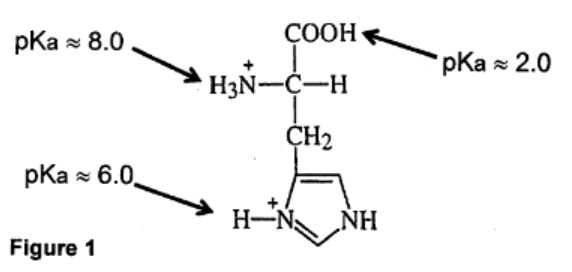
2. What is the pH at which the average net charge of the polar amino acid histidine, shown in figure 1, equal zero (the isoelectric point, pI)? (A) 9 (B) 7 (C) 5 (D) 3 (E) 1
3. Which of the following structures is NOT found in a prokaryotic cell? (A) Krebs cycle intermediates (B) Golgi Apparatus (C) extrachromosomal double-stranded DNA molecules (D) components of electron transport chain (E) ribosome
4. A neurotransmitter can trigger different responses in postsynaptic cells due to the (A) point of release. (B) receptors present. (C) concentration of neurotransmitter. (D) receptor mode of action. (E) Both B and D are correct.
5. A red blood cell is in a vehicle in the wall of small intestine of a human. How many (at least) capillary beds must this cell pass through before it is returned to the left ventricle of the heart? (A) one (B) two (C) three (D) four (E) five
6. Which of the following is NOT true about helper T cells? (A) They function in both cell-mediated and humoral immune responses. (B) They bear surface CD4 molecules. (C) They recognize polysaccharide fragments presented by MHC-II molecules. (D) They are subject to infection by HIV. (E) When activated, they secrete cytokines that stimulate other lymphocytes.
7. A dog learns to come running into kitchen when it hears the electric cane opener. This response is an example of (A) operant conditioning (B) habituation (C) classical conditioning (D) sensitization (E) insight learning
8. Before myosin heads bind to a thin filament, myosin-binding sites are opened up when __ bind(s) to the thin filament. (A) Ca²⁺ (B) Na⁺ (C) K⁺ (D) neurotransmitter molecules (E) ATP
9. Which of the following could cause a realized niche to differ from a fundamental niche?(A) temperature limitations(B) food size and availability(C) water availability(D) competition from other species(E) population size
10. When conditions cause the hemoglobin-oxygen dissociation curve to shift to the right, there is_________.(A) greater unloading of carbon dioxide to the tissues(B) greater unloading of oxygen in the lungs(C) greater unloading of oxygen to the tissues(D) higher pH produced by the respiring tissues(E) less carbon dioxide produced by the respiring tissues
11. Humoral signals that regulate hormone secretion include_________.(A) ions, prostaglandins, and metabolites(B) prostaglandins, metabolites, and minerals(C) vitamins, metabolites, and minerals(D) ions, hormones, and metabolites(E) ions, neurotransmitter, and vitamins
12. Which of the following processes contributes to the uptake of mineral ions by plant roots?(A) chlorosis(B) osmosis(C) cation exchange(D) anion leaching(E) growth of root hairs
13. Which of the following is NOT an example of pattern formation in developing plants?(A) an epidermal cell receiving developmental signals from a cortical cell(B) the loosening of the cell wall to allow the elongation of selected cells to reach mature size(C) regulation by homeotic genes of the position of different flower parts(D) oriented cell division that establishes the shape of an organ(E) cell expansion that directs specific cells to undergo mitosis at a given time and place
14. In the Meselson and Stahl experiment, the DNA in the parental generation was all N¹⁵N¹⁵, and after one round of replication, the DNA was all N¹⁵N¹⁴. What DNAs were seen after three rounds of replication, and in what ratio were they found?(A) one N¹⁵N¹⁴, one N¹⁴N¹⁴(B) one N¹⁵N¹⁴, two N¹⁴N¹⁴(C) one N¹⁵N¹⁴, three N¹⁴N¹⁴(D) one N¹⁵N¹⁴, four N¹⁴N¹⁴(E) one N¹⁵N¹⁴, seven N¹⁴N¹⁴
15. Which of the following statements about DNA replication is FALSE?(A) Synthesis of the new DNA strand is from 3' to 5'.(B) DNA is bidirectional in its synthesis.(C) DNA unwinds, primase adds RNA primer, and DNA polymerases synthesize the new strand and remove the RNA primer.(D) Many initiation points exist in each eukaryotic chromosome.(E) Okazaki fragments are synthesized in the opposite direction from the direction in which the replication fork moves.
16. You are breathing in oxygen and breathing out carbon dioxide. Most of the carbon dioxide arises from(A) glucose in glycolysis.(B) NAD⁺ redox reactions in the mitochondrial matrix(C) NADH redox reactions on the inner mitochondrial membrane.(D) FADH₂ in the electron transfer system.(E) the oxidation of pyruvate, isocitrate, and α-ketoglutarate in the citric acid cycle.
17. Which of the following statements about proteins is correct?(A) Proteins are transported to the rough ER for use within the cell.(B) Lipids and carbohydrates are added to proteins by the Golgi apparatus.(C) Proteins are transported directly into cytosol for secretion from the cell.(D) Proteins that are to be stored by the cell are moved to rough ER.(E) Proteins are synthesized in vesicles.
18. In living systems,(A) proteins rarely combine with other macromolecules.(B) proteins are composed of 20 amino acids.(C) enzymes are not always proteins.(D) chaperonins inhibit protein movement.(E) a protein domain refers to the place in the cell where proteins are synthesized and function.
19. Which of the following does NOT help systematists determine whether a morphological character state is ancestral or derived?(A) outgroup comparison(B) patterns of embryonic development(C) studies of the fossil record(D) studies of the character in more related species(E) dating of the character by molecular clocks
20. If the genotype frequencies in a population are 0.60 AA, 0.20 Aa, and 0.20 aa, and if the requirements of the Hardy-Weinberg principle apply, the genotype frequencies in the offspring generation will be(A) 0.60 AA, 0.20 Aa, 0.20 aa(B) 0.36 AA, 0.60 Aa, 0.04 aa(C) 0.49 AA, 0.42 Aa, 0.09 aa(D) 0.70 AA, 0.00 Aa, 0.30 aa(E) 0.64 AA, 0.32 Aa, 0.04 aa
a. Which of the following statements is the most likely explanation for the effect of BTX on the squid giant axon? (2%) (A) Inactivation of Na+/K+ pump (B) Closing of sodium channels (C) Opening of sodium channels (D) Opening of potassium channels
II. 解釋名詞 (每題 4 分,共 20 分)1. genomic imprinting
2. a monophyletic taxon
3. carrying capacity (for each population)
4. fast block in polyspermy
5. hippocampus
III. 簡答題 (每題 8 分,共 40 分)1. What is the proteome, and what are the major goals of proteomics?
2. How would you determine how a steroid hormone affects gene expression in human tissue culture cells?
3. How are carbon fixation and the Calvin cycle different in C4 plants and CAM plants?
4. What is the mechanism that the peptide hormone ADH (antidiuretic hormone) stimulates water reabsorption in the kidney collecting ducts? In diabetes insipidus, the kidneys are unable to conserve water. One heritable form of the disease, central diabetes insipidus, can be treated by desmopressin, a synthetic replacement for ADH. Another heritable form of the disease, nephrogenic diabetes insipidus, does not respond to treatment with desmopressin. Hypothesize in which components might have been affected by the mutations in the two forms of the disease.
b. Identify a research technique (for electrophysiology) that could be used to discover how BTX affects specific membrane proteins. (3%)
c. Based on figure 2, what would you expect this technique to show? (3%)
 阿摩線上測驗
登入
 (A) 9 (B) 7 (C) 5 (D) 3 (E) 1