所屬科目:研究所、轉學考(插大)◆生物化學
1. Which of the following formulas would be a carbohydrate?(A) (B) C4H8O6 (C) (D) C3H8O3 (E)
2. Fatty acids are ______ meaning that they have both a hydrophobic and hydrophilic region of the molecule.(A) aliphatic (B) amphipathic (C) saturated (D) unsaturated (E) phosphorylated
3. Which ofthe following polysaccharides contains exclusively glucose in β(1→4) glycosidic bonds?(A) Amylose (B) Amylopectin (C) Glycogen (D) Cellulose (E) Chitin
4. An N-linked glycan would be attached to ______ while an O-linked glycan would be attached to ______.(A) Asn; Ser (B) Lys; Tyr (C) Gln; Thr (D) Arg; Ser (E) Lys; Ser
5. Which of the following would most likely move across a membrane by simple diffusion?(A) Potassium ions (B) Glucose (C) Carbon dioxide(D) Sodium ions (E) Water
6. A ceramide is derived from which combination of the following?(A) A molecule of sphingosine and a monosaccharide(B) A molecule of sphingosine and a molecule of phosphocholine(C) A molecule of sphingosine and a fatty acid(D) A molecule of sphingosine and two fatty acids(E) A molecule of sphingosine, a fatty acid and a monosaccharide
7. DNA double helix structure is stabilized by all of the following EХСЕРТ:(A) the sugar-phosphate backbones are oriented in opposite directions.(B) the glycosidic bonds holding paired bases are directly across the helix from one another.(C) cations such as Mg2+ bind to the anionic phosphates.(D) bases stack together through hydrophobic interactions and van der Waals forces.(E) appropriate base pairing builds a polymer whose external dimensions are uniform.
8. All are characteristics of pyrimidines EXCEPT:(A) six membered ring.(B) heterocyclic.(C) conjugated.(D) fused five membered rings.(E) two nitrogens separated by a carbonyl.
9. Which enzyme catalyzes the primary regulation site of glycolysis?(A) Неxokinase(B) Phosphofructokinase-1(C) Glyceraldehyde-3-phosphate dehydrogenase(D) Phosphoglycerate kinase(E) Pyruvate kinase
10. In aerobic metabolism, ______ is the terminal electron acceptor during cellular oxidation of carbon containing fuels.(A) (B) FAD (C) ATP (D) H2O (E) O2
11. Which of the following carbohydrates is the most common molecule exported by photosynthetic cells for use in other parts ofthe plant?(A) Sucrose (B) Glucose (C) Fructose (D) Amylopectin (E) Amylose
12. Gluconeogenesis is the synthesis of:(A) glucose from non-carbohydrate precursors.(B) glycogen from glucose.(C) pyruvate from glucose.(D) fatty acids from glucose.(E) glucose from fatty acids.
13. In its non-phosphorylated state, glycogen phosphorylase can be activated by which ofthe following molecules?(A) ATP(B) Glucose-6-phosphate(C) Glucose(D) AMP(E) None of the above
14. The pentose phosphate pathway is an important source of ______ and ______,which is an essential precursor for DNA and RNA.(A) ATP; NADH(B) NADH; ATP(C) NADPH; ATP(D) NADH; ribose-5-phosphate(E) NADPH; ribose-5-phosphate
15. The only reaction ofthe citric acid cycle (or TCA cycle) that provides substrate-level phosphorylation is catalyzed by:(A) aconitase.(B) isocitrate dehydrogenase.(C) succinyl-CoA synthetase.(D) fumarase.(E) nucleotide triphosphate kinase.
16. Which of the following amino acid residues would most likely be buried in the interior of a water-soluble, globular protein?(A) Asp (B) Lys (C) Ser (D) Arg (E) Phe
17. What term describes an inactive precursor of an enzyme such as the precursors to protease enzymes produced by thepancreas?(A) Allosteric enzyme (B) Zymogen (C) Isozyme (D) Ribozyme (E) Hydrolase
18. Which of the following amino acid residue is the precursor of glutathione?(A) Cys (B) Gly (C) Met (D) A&B (E) A&C
19. Tyrosine is the precursor of many biological molecules. Which of the following molecules is derived from tyrosine?(A) Serotonin (B) Heme (C) Dopa (D) Spermidine (E) None of the above
20. Which of the following amino acid residue is required for heme biosynthesis?(A) Ser (B) Cys (C) Gly (D) Trp (E) Glu
21. Which of the following fatty acid is the essential fatty acid?(A) Palmitic acid(B) Stearic acid(C) Linolenic acid(D) Arachidonic acid(E) None of the above
22. The primary activation of triacylglycerol mobilization in adipocytes is through phosphorylation of the enzyme ______.(A) perilipin(B) hormone sensitive lipase(C) adipose triglyceride lipase(D) monoacylglycerol lipase(E) none of the above
23. Which of the following represents the correct sequence of events in a cycle of ẞ-oxidation beginning with a saturated fattyacyl-CoA?(A) Hydration, FAD-coupled oxidation, -coupled oxidation, thiolytic cleavage(B) FAD-coupled oxidation, hydration, -coupled oxidation, thiolytic cleavage(C) FAD-coupled oxidation, -coupled oxidation, hydration, thiolytic cleavage(D) NAD+-coupled oxidation, FAD-coupled oxidation, hydration, thiolytic cleavage(E) NAD+-coupled oxidation, hydration, FAD-coupled oxidation, thiolytic cleavage
24. Which of the following types of tissues can use glucose and ketone bodies as sources of fuel?(A) Skeletal muscle (B) Cardiac muscle (C) Liver (D) Brain (E) Adipose
25. Which of the following is used to activate phosphatidic acid for conversion to various phospholipids?(A) ATP (B) UTP (C) GTP (D) CTP (E) TTP
26. The hormone ______ induces lipolysis, whereas the hormone ______ inhibits the process.(A) epinephrine; adrenocorticotropic hormone(B) glucagon; insulin(C) insulin; norepinephrine(D) glucagon; epinephrine(E) epinephrine; glucagon
27. How many rounds of ẞ-oxidation would be required for a 18-C fatty acyl chain to be degraded to acetyl-CoA?(A) 16 (B) 8 (C)7 (D) 15 (E) None of the above
28. What is the committed step in fatty acid synthesis?(A) Binding of the fatty acyl group to the acyl carrier protein(B) Synthesis of malonyl CoA(C) Transacylase reaction(D) The formation of acetoacetyl-AСР(E) None of the above
29. Which of the following is an irreversible form of inhibition?(A) Competitive inhibitor(B) Suicide inhibitor(C) Noncompetitive inhibitor(D) Uncompetitive inhibitor(E) None of the above
30. What are the expected changes in kinetics in the presence of a competitive inhibitor?(A) decreases, appears to decrease(B) does not change, арpears to increase(C) decreases, appears to increase(D) does not change, appears to decrease(E) decreases, does not change
(1) Which amino acid residue forms the disulfide bond?
(2) What kind of the reagent can break the disulfide bond?
(3) In addition, antibodies have various applications. Please list and describe two techniques using antibodies.
2. What is the "specific activity" of the enzyme? Please describe it.
3. (1) Which amino acid residue is often found in the active sites of enzymes?
(2) In addition, please draw the amino acid and describe the characteristics of the amino acid residue.
4. The Nobel Prize in Physiology or Medicine 2019 was awarded jointly to William G. Kaelin Jr, Sir Peter J. Ratcliffe and Gregg L. Semenza "for their discoveries of how cells sense and adapt to oxygen availability."When oxygen is limited, hypoxic stress triggers the expression of hypoxia inducible factor (HIF) protein in mammalian tissues. Briefly describe the function of HIF-1 and how it affects the rate of glycolysis under hypoxia.
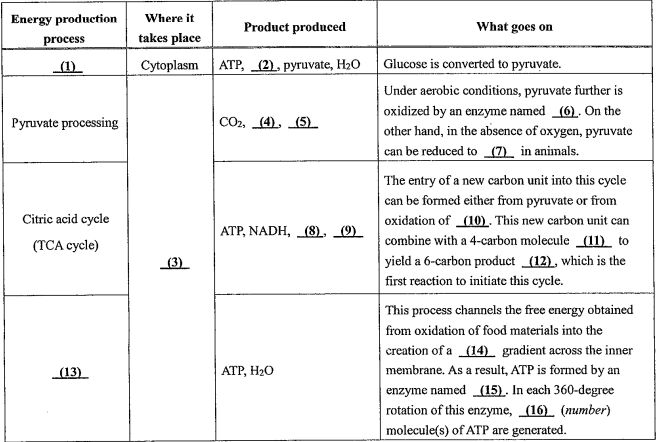
5. The transformation of glucose to CO2 and H2O is a major energy production process. Pleases fill the blanks in the summary table of cell respiration below.
 阿摩線上測驗
登入
 (B) C4H8O6 (C)
 (D) C3H8O3 (E)

 (B) FAD (C) ATP (D) H2O (E) O2
 -coupled oxidation, thiolytic cleavage
 -coupled oxidation, thiolytic cleavage
 -coupled oxidation, hydration, thiolytic cleavage
 decreases,
 appears to decrease
 does not change,
 арpears to increase
 decreases,
 appears to increase
 does not change,
 appears to decrease
 decreases,
 does not change