所屬科目:研究所、轉學考(插大)◆統計學
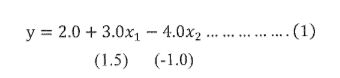
1. Peter has T = 43 observations on variables y, x₁ and x₂. He estimates the following equation by OLS method:where the numbers in parentheses are standard errors for coefficients (except for intercept.). Total sum of squares (SST)=100; R² = 0.8. What is the true value of the sum of squares errors (SSE) in equation (1)?(4%) __(1)__(A) 40(B) 80(C) 60(D) 20
2. Continue Question 1, If Peter tests the following hypothesis: H₀: β₁ = β₂ = 0, what is the value of F-statistic? (4%)__ (2)__(A) 80(B) 16(C) 100(D) 160
3. Suppose that the true model of y is y = β₁x₁ + β₂x₂ + u, but you estimated an incorrect model by OLS:$$y = \beta1 x1 + v \dots \dots \dots \dots \dots \dots \dots \dots \dots \dots \dots \dots \dots \dots \dots \dots \dots \dots \dots \dots \dots \dots \dots \dots \dots \dots \dots \dots \dots \dots \dots \dots \dots \dots \dots \dots \dots \dots \dots \dots \dots \dots \dots \dots \dots \dots \dots \dots \dots \dots \dots (2)$$The true parameter β₂ < 0 , and E(x₂|x₁) has a linear relationship:$$E(x2|x1) = \delta0 + \delta1 x_1.$$If we have the prior information that OLS estimator β̂₁ of Equation (2) has positive bias, what is the sign of δ₁? (4%) __(3)__(A) \( \delta_{1} < 0 \)(B) \( \delta_{1} = 0 \)(C) \( \delta_{1} > 0 \)(D) cannot decide
4. Suppose you have data $(yt, xt)$, $t = 1, 2, \dots, 50$, with $\sum{t=1}^{50} xt = 0$, $\sum{t=1}^{50} yt = 100$, $\sum{t=1}^{50} xt^2 = 100$, $\sum{t=1}^{50} yt^2 = 300$ and $\sum{t=1}^{50} xt y_t = 50$. What is the $R^2$ of this regression? (4%) (4)(A) 0.125(B) 0.25(C) 0.75(D) 0.032
5. Suppose that there is an exact relationship between random variable $y{it}$ and its lag value $y{it-1}$:$$y{it} = \beta1 y{it-1} + v{it}$$A researcher want to estimate the coefficient $\beta$ by ordinary least squares (OLS) method. Unfortunately, due to data collection mistakes, she only has time average data. $\overline{y}{it} = \frac{1}{T} \sum{t=1}^{T} y_{it}$. If she wants to estimate the following regression by OLS method:$$\overline{y}{it} = \beta \overline{y}{it-1} + \overline{v}_{it},$$where $\overline{v}{it} = \frac{1}{T} \sum{t=1}^{T} v_{it}$. Which of the following characteristics will the OLS estimator $\hat{\beta}$ have? (4%)__ (5)__(A) unbiased and consistent(B) unbiased and inconsistent(C) biased and consistent(D) biased and inconsistent
1-1 (10%) Now consider the estimator $\hat{\beta} = (x1 y1 + \frac{1}{2} x2 y2) / (x1^2 + \frac{1}{2} x2^2)$.Whether this estimator is unbiased. __(6)__ Calculate its variance. __(7)__
1-2 (10%) Please compare $\text{var}(\hat{\beta})$ with $\text{var}(\hat{\beta})$, the variance of least squares estimator $\hat{\beta}$. Does this result contradict the general result that ordinary least squares is efficient? __(8)__
2. (10%) A linear stationary time series model relating a variable, $yt$, to the rational expectation of the, $xt$, is given by$$yt = \beta E(xt | I{t-1}) + ut,$$where $E(xt | I{t-1})$ is the expected value of $xt$ given all information known up to time t-1. Note that, at a minimum, $(y{t-1}, x{t-1}, y{t-2}, x{t-2}, \ldots)$ is contained in $I{t-1}$. Throughout this problem assume that $E(ut | I{t-1}) = 0$. For simplicity, there is no intercept in the model. Let $\hat{\beta}$ be the OLS estimator from the regression $yt$ on $xt$, $t = 1, 2, \ldots, T$. Whether $\hat{\beta}$ is a consistent estimator of $\beta$?__(9)__
1. Consider$$f(y1, y2) = \begin{cases} 6(1 - y2) & , 0 \le y1 \le y_2 \le 1, \\ 0 & , otherwise \end{cases}$$1-1 (7%) Find $P(Y1 \le 3/4, Y2 \ge 1/2)$ __(10)__1-2 (7%) Find $E(Y1 | Y2 = y_2)$ __(11)__
2-1 (7%) Find the unconditional probability function for Y. __(12)__
2-2 (7%) Find the expected number of defects per yard. __(13)__
3-1 (7%) At the first round the opponent played rock. Based on that sample, what is the likelihood function regarding the opponent type? __(14)__
3-2 (8%) Before the first round you formulate a null hypothesis that the opponent is rock focusing type and will reject that null hypothesis if the first round he does not play rock. What is the probability of type I error? __(15)__ What is the probability of type II error against the hypothesis the opponent is a paper focusing type? __(16)__
3-3 (7%) Before the first round, with no information your belief of the opponent's being paper focusing type, rock focusing type and scissor focusing type are all 1/3. After the first round of his playing rock, what should be your Bayesian updated belief regarding his type probabilities?__ (17)__
 阿摩線上測驗
登入