所屬科目:研究所、轉學考(插大)◆普通植物學
1. A sclerenchyma cell must be very strong to function, so it has a (A) Primary wall only (B) Secondary wall only (C) Primary wall, plus a secondary wall that contains only cellulose (D) Primary wall, plus a secondary wall that contains cellulose and hemicelluloses (E) Primary wall, plus a secondary wall that contains cellulose, hemicelluloses, and lignin
2. Which of the following groups of plants are haploid? (A) Bryophytes, gymnosperms, and angiosperms (B) Ferns, lycophytes, and cycads (C) Hornworts, grasses, liverworts A. (D) Mosses, liverworts, and hornworts (E) Mosses, lycophytes, and ferns
3. Which of the following is paired incorrectly? (A) Chloroplast -- thylakoid (B) Microfilament - tubulin (C) Mitochondrion - cristae (D) Peroxisome - catalase (E) Rough ER - ribosome
4. A sclerenchyma cell must be very strong to function, so it has a (A) Primary wall only (B) Primary wall, plus a secondary wall that contains only cellulose (C) Primary wall, plus a secondary wall that contains cellulose and hemicelluloses (D) Primary wall, plus a secondary wall that contains cellulose, hemicelluloses, and lignin (E) Secondary wall only
5. The pathway that an amino acid takes after entering a cell until found on the surface of a carnivorous plant leaf is (A) Rough endoplasmic reticulum → ER vesicle → dictyosome → secretion vesicle → leaf surface (B) Smooth endoplasmic reticulum → ER vesicle → dictyosome → secretion vesicle → leaf surface (C) ER vesicle → rough endoplasmic reticulum → smooth endoplasmic reticululm → dictyosome leaf surface (D) Dictyosome →→ rough endoplasmic reticulum → ER vesicle → smooth endoplasmic reticulum → secretion vesicle → leaf surface (E) Rough endoplasmic reticulum dictyosome → leaf surface
6. Which of the following statements about algal blooms is FALSE? (A) Some are known as brown tides. (B) They are associated with water disturbed by humans. (C) The frequency of marine algal blooms has decreased globally. (D) They occur when algal growth is unchecked. (E) They are often correlated with the release of toxic compounds.
7. Which of the following statements about gymnosperms is FALSE? (A) Gymnosperm means "naked seed." (B) Ovules and seeds are exposed on the surface of sporophylls. (C) The female gametophyte produces several archegonia. (D) The male gametophyte produces several antheridia. (E) The male gametophyte is endosporic.
8. In flowers with sepals, petals, and stamens attached below the ovary, the ovary is said to be: (A) hypogynous. (B) epigynous. (C) inferior. (D) perigynous. (E) superior.
9. What is the apparent function of most secondary plant products? (A) attracting pollinators (B) facilitating fruit or seed dispersal (C) restricting the palatability of the plant to herbivores (D) serving as plant hormones (E) serving as sources of energy for the plant
10. The root and shoot apical meristems first become discernible during the transition between the _ and _. (A) globular stage; torpedo stage (B) proembryo; globular stage (C) heart stage; globular stage (D) torpedo stage; embryo proper (E) torpedo stage; proembryo
11. An example of programmed cell death is the differentiation of: (A) parenchyma cells. (B) collenchyma cells. (C) cells of the cortex. (D) the secondary cell wall. (E) tracheary elements.
12. Which of following lists the correct root developmental sequence during primary plant body, the formation of (I) lateral root; (II) the cortex; (III) the epidermis; (IV) the stele? (A) I, IV, II, III (B) III, II, IV, I (C) III, I, II, IV (D) I, III, II, IV (E) II, III, I, IV
13. biotroph and saprotroph
14. root nodules and mycorrhiza
15. plasmogamy and karyogamy
16. perforation plate and sieve plate
17. Explain the differences between primary and secondary growth.
18. Draw a longitudinal section of caryopsis of corn including scutellum, endosperm and shoot apical meristem
19. Explain why terrestrial plants need: transporting tissues; supporting tissues; parenchyma.
20. Make comparison the life cycle of seed plants and bryophytes.
21.(1)我們吃的”白米”,主要是哪一個構造?
(2)承上題,這一個構造是如何發育來的?
(1)哪兩種植物賀爾蒙對於種子休眠有拮抗作用?
(2)哪一種光會促進種子萌芽?感知此光線的光受器(photoreceptor)為何?
(1) Endodermis 細胞壁加厚的構造是甚麼?
(2)此構造對於水分以及養分的吸收與運輸,有甚麼影響?
(3)A的 構造主要運送的物質為何? Cortex Endodermis A B Xylem
24. 植物如何利用xylem在不耗能的情形下,將水分與養分從根部運送到地上部?請簡述3種機制。
(1)光合作用主要在植物的哪一個器官進行?
(2)光反應與碳反應的最終產物各是甚麼?
(1) TCA cycle 在哪裡進行?
(2)哪一個區域的氫離子(H+)濃度特別高? Mitochondrion Outer membrane Inner membrane Matrix Crista Intermembrane space
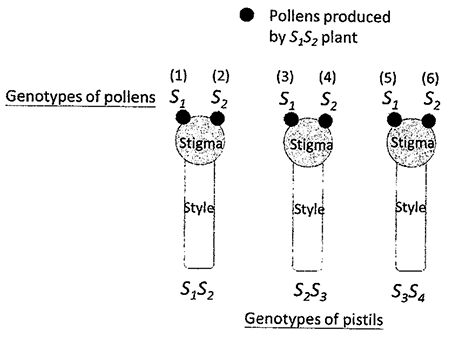
27.(1) 甚麼是"自交不親合(self-incompatibility)?”
(2)自交不親合有何優點?
(3)下圖為配子體型自交不親合(gametophytic self-incompatibility),請問哪幾號花粉可以順利生長?
 阿摩線上測驗
登入