所屬科目:研究所、轉學考(插大)◆生物化學
1. The disulfide bond is a covalent linkage formed between two cysteine residues in proximity under an oxidative environment. In eukaryotic cells, disulfide bonds can be formed only in:(A)The cytosol;(B)Endoplasmic reticulum;(C)Endosomes;(D)Mitochondria.
2. Ferroptosis is a type of programmed cell death. Which of the following is NOT the feature of ferroptosis:(A)Caspase activation;(B)Increased oxidative stress;(C)Iron-dependent;(D)Inhibition of cystine/glutamate transporter.
3. All of the following molecular features are present in both prokaryotic and eukaryotic cells EXCEPT:(A)DNA double helix;(B)Microtubules;(C)Lipid bilayer-based biomembranes;(D)Potassium channels.
4. Which of the following nucleotide sequence is likely a recognition site of a restriction enzyme?(A)GCTACG;(B)ATGCTA;(C)CTCGTG;(D)AGATCT.
5. Collagen is an essential component of the extracellular matrix. A deficiency in which of the following nutrient will disable collagen biogenesis:(A)Vitamin A;(B)Vitamin B;(C)Vitamin C;(D)Vitamin D.
6. Which of the following amino acid is vital for suppling α-ketoglutarate to keep the flow of the TCA cycle?(A)E(B)A(C)S(D)Y
7. Eucaryotic cells uptake cholesterol buried in low-density lipoprotein (LDL) by a cellular process known as receptor-mediated endocytosis. A defect in which of the following molecule might inhibit a eukaryotic cell with normal LDL receptor to uptake LDL:(A)Caveolae;(B)Dynamin;(C)SAR1;(D)Transferrin.
8. Which of the following conditions can fully turn on the Lac operon in Escherichia coli?(A)Low glucose and lactose levels;(B)Low glucose but high lactose levels;(C)High glucose and lactose levels;(D)Low cAMP and high glucose levels.
9. Your Biology teacher gives you two human cell lines, A and B, which are in G₀ and G₁ phases of the cell cycle, respectively. Which of the following cellular event is true if these two cell lines are stimulated with growth factors to pass the restriction point?(A)Only the G₀ cell will replicate its DNA;(B)Only the G₁ cell will replicate its DNA;(C)Both cells will replicate their DNA;(D)Neither of the cells will replicate their DNA.
10. How many ATP (and GTP) molecules can be generated from the complete oxidation of one molecule of acetyl CoA through the TCA cycle and oxidative phosphorylation in the mitochondrion?(A)10;(B)12;(C)13.5;(D)14.5;(E)15.
11. Which one is incorrect?(A)The diffraction of X-rays by protein crystals can reveal a protein's exact structure.(B)Molecular structure can also be determined using nuclear magnetic resonance (NMR) spectroscopy.(C)Sequence similarity can provide clues about DNA function.(D)Fusion proteins can be used to analyze protein function and to track proteins in living cells.
12. Which one is incorrect?(A)Affinity chromatography and immunoprecipitation allow identification of associated proteins.(B)Protein-DNA interactions can be identified by use of the two-hybrid system.(C)Phage display methods also detect protein interactions.(D)Protein interactions can be monitored in real time using surface plasmon resonance.
13. Which one is incorrect?(A)DNA footprinting reveals the sites where RNA binds on a DNA molecule.(B)To determine the three-dimensional structure of a protein at atomic resolution, large proteins have to be crystallized and studied by x-ray diffraction.(C)The structure of small proteins in solution can be determined by nuclear magnetic resonance analysis.(D)Because proteins with similar structures often have similar functions, the biochemical activity of a protein can sometimes be predicted by searching for known proteins that are similar in their amino acid sequences.
14. Which one is incorrect?(A)Transcription initiation by Pol I is directed by a core promoter element, which overlaps the start site, and an upstream control element (UCE). It requires two general transcription factors, SL1 and UBF.(B)Transcription initiation by RNA polymerase I is most often directed by internal promoter elements. Two general transcription factors are required to initiate transcription of tRNA genes (TFIIIC and TFIIIB); an additional factor (TFIIIA) also is required to initiate transcription of 5S-rRNA genes.(C)Transcription initiation by all three eukaryotic nuclear RNA polymerases requires a polymerase-specific general transcription factor that contains TBP as a subunit.(D)Initiation by Pol I and Pol III does not require ATP hydrolysis, whereas initiation by Pol II depends on ATP hydrolysis.
15. Which one is incorrect?(A)Bacteriophage T7 and related bacteriophage express a simple monomeric RNA polymerase. These polymerases recognize a 23-bp promoter region that includes the start site.(B)Mitochondria contain circular DNAs transcribed by a nuclear-encoded RNA polymerase composed of two subunits. One subunit is homologous to the simple bacteriophage T7 RNA Polymerase; the other resembles bacterial σ factors.(C)Chloroplasts contain DNA that is transcribed by a chloroplast-encoded RNA polymerase homologous to bacterial RNA polymerases, except that it lacks a σ factor.(D)Archaeans utilize a multisubunit RNA polymerase that resembles the eukaryotic nuclear RNA polymerases. Transcription initiation in archaeal cells requires a protein, homologous to eukaryotic TBP, that binds to an G/C-rich promoter element just upstream from the start site and a protein homologous to TFIIB.
16. Which one is incorrect?(A)In eukaryotic genomes, cis-acting control elements that regulate transcription from a promoter often are located many kilobases away from the start site. In contrast, bacterial control elements generally lie within 60 base pairs of the promoters they regulate.(B)RNA polymerase I synthesizes only pre-rRNA. RNA polymerase II synthesizes mRNAs and some of the small nuclear RNAs that participate in mRNA splicing. RNA polymerase III synthesizes tRNAs, 5S rRNA, and several relatively short, stable RNAs.(C)RNA polymerase II usually initiates transcription of genes at a specific base pair or alternative neighboring base pairs in a DNA template. The 3' nucleotide that is capped in an mRNA corresponds to the nucleotide in the template strand at which transcription is initiated.(D)Transcriptional control is the primary means of regulating gene expression in eukaryotes, as it is in bacteria.
17. Which one is incorrect?(A)Generally, proteolytic maturation occurs in secretory or transport vesicles carrying proteins from the trans-Golgi network to the cell surface.(B)Generally, ER signal sequences are located at the C-terminus and are cleaved from the protein in the rough ER lumen.(C)Secretory proteins, enzymes destined for the ER, Golgi complex, and lysosomes, and integral plasma-membrane proteins are synthesized on ribosomes bound to the rough ER. Synthesis of this class of proteins is initiated on membrane-unattached ribosomes.(D)In both nuclear export and import, the protein to be transported contains a specific amino acid sequence that functions as a nuclear-export signal (NES) or a nuclear-localization signal (NLS). Nucleus-restricted proteins contain a NLS but not a NES, whereas proteins that shuttle between the nucleus and cytosol contain both signals.
18. The division of the nucleus is called(A)cytokinesis(B)S phase(C)G1 phase(D)Mitosis
19. The phase during which DNA is replicated is called(A)G1(B)S phase(C)prophase(D)telophase
20. Sister chromatids are ________.(A)two copies of the same exact chromosome held together by a centromere(B)pairs of chromosomes, one from mom and one from dad(C)small pieces of DNA that code for specific proteins(D)like a single codon that codes for an amino acid
21. Which of the following is NOT a reason for cell division in multicellular organisms?(A)growth(B)repair(C)nutrition(D)reproduction
22. Paracrine signaling(A)involves secreting cells acting on nearby target cells by discharging a local regulator into the extracellular fluid.(B)requires nerve cells to release a neurotransmitter into the synapse.(C)occurs only in paracrine yeast cells.(D)has been found in plants but not animals.(E)involves mating factors attaching to target cells and causing production of new paracrine cells.
23. Up to 60% of all medicines used today exert their effects by influencing what structures in the cell membrane?(A)tyrosine-kinases receptors(B)ligand-gated ion channel receptors(C)growth factors(D)G proteins
24. Which of the following is recognized by the innate immune system and triggers an immune response that will produce antiviral cytokines and trigger effector molecules(A)Complement(B)IgA(C)IL-2(D)PAMPs
25. The major difference between benign and malignant tumors is that:(A)benign tumors are capable of metastasis.(B)malignant tumors do not invade surrounding tissue.(C)benign tumors are not neoplasms.(D)malignant tumors are capable of uncontrolled growth
26. The phase in which chromosomes separate and move to opposite poles is(A)Prophase(B)Anaphase(C)Metaphase(D)Telophase
27. Which one is the component of linker histone?(A)H1(B)H2A(C)H2B(D)H3(E)H4
28. Haemophilia (type A) is an X-linked recessive disease. Mary and her husband are both unaffected; however, their first son has haemophilia. What is the possibility of being affected by haemophilia for their next children?(A)50%(B)25%(C)6.25%(D)12.5%
29. There are four alleles of a polymorphic locus have been found in a particular gene of a diploid organism. If all homozygous are lethal, how many different genotypes will be observed?(A)20(B)10(C)12(D)6
30. A point mutation in a sequence of DNA that results in a premature stop codon and translates a nonfunctional protein product is called?(A)Non-sense mutation(B)Frameshift mutation(C)Amber mutation(D)Silent mutation(E)Missense mutation
31. Which of following principal bases of nucleic acid are pyrimidines?A. AdenineB. UracilC. ThymineD. GuanineE. Cytosine(A)AD(B)BCE(C)ABC(D)DE(E)CE
32. Synaptic signaling between adjacent neurons is like hormone signaling in which of the following ways?(A)It sends its signal molecules through the blood.(B)It sends its signal molecules quite a distance.(C)It requires calcium ions.(D)It requires binding of a signaling molecule to a receptor.(E)It persists over a long period.
33. Which of the following is the gene that controls the development of a particular adult structure?(A)homeotic gene(B)structural gene(C)regulator gene(D)proto-oncogene
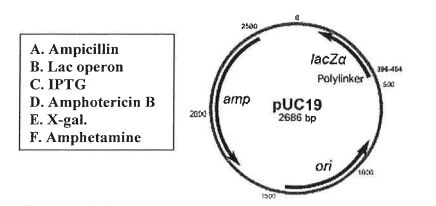
34. If you want to clone a DNA fragment into vector shown below, what are required to select clones with insert DNA?A. AmpicillinB. Lac operonC. IPTGD. Amphotericin BE. X-gal.F. Amphetamine(A)AB(B)CEF(C)ACE(D)BE(E)CDE
35. Synaptic signaling between adjacent neurons is like hormone signaling in which of the following ways?(A)It sends its signal molecules through the blood.(B)It sends its signal molecules quite a distance.(C)It requires potassium ions.(D)It persists over a long period.(E)It requires binding of a signaling molecule to a receptor.
1. Please describe how to define a eukaryotic cell that is undergoing APOPTOSIS. (5 points)
2. Please describe post-translational modification. (3 points)
3. Please describe siRNA vs. shRNA: Similarities and differences? (4 points)
4. Please describe ER Stress and Oxidative Stress. (4 points)
5. Aren't mRNA vaccines just too new for scientists to know they're safe? (9 points)
6. Jennifer Doudna and Emmanuelle Charpentier won The Nobel Prize in Chemistry 2020 for their breakthrough research on CRISPR technology. Please describe their contribution on gene editing. (5 points)
 阿摩線上測驗
登入